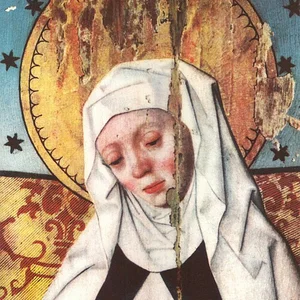

Thirteenth-century Brabantine poet and mystic, a towering figure of medieval female spirituality. She was most likely a beguine and left an exceptional literary and mystical body of work written in Middle Dutch.
Hadewijch of Antwerp(1300 — 1260)
Hadewijch of Antwerp
duché de Brabant
7 min read
Frequently asked questions
Famous Quotes
« Love is all that is: there is nothing that is not love.»
« Whoever wishes to be all that God is must lose himself entirely.»
Key Facts
- Active around 1220–1260 in Brabant (present-day Belgium/Netherlands)
- Author of Visions, Letters, and Poems in Middle Dutch — among the earliest major literary works in a vernacular language
- Central figure of the beguine movement, independent women's devotional communities
- Developed the concept of Minne (divine love), drawing on the tradition of courtly poetry
- Her work influenced Meister Eckhart and Jan van Ruusbroec
Works & Achievements
A collection of 45 lyric poems in Middle Dutch, inspired by troubadour poetry. It is Hadewijch's most accessible work, in which she expresses her central concept of 'Minne' (divine Love) in language of great poetic beauty.
31 letters addressed to disciples and spiritual friends, blending spiritual guidance, mystical theology, and personal testimony. This epistolary collection is a valuable source on the life and thought of Beguine communities.
14 accounts of mystical visions of exceptional symbolic richness, weaving together courtly allegories and experiences of union with Christ. This text stands as one of the most singular documents in medieval women's mysticism.
A set of poems in various forms, some of which are attributed to Hadewijch with less certainty. They round out the portrait of a poet who commanded a wide range of stylistic registers.
Anecdotes
Hadewijch is one of the earliest authors to have written in Middle Dutch (Diets), at a time when Latin dominated religious literature. By choosing her own vernacular language to express her mystical visions, she paved the way for an entire literary tradition in the medieval Low Countries.
In her Visions, Hadewijch describes a eucharistic experience at Pentecost in which Christ appears to her first as a beautiful child, then as a grown man, embracing her and merging with her. This account, of startling precision, blends courtly sensibility with mystical theology in a display of remarkable literary boldness.
Hadewijch developed the concept of 'Minne' — divine Love — by borrowing the vocabulary and conventions of troubadour courtly poetry. She portrays God as a demanding lord whose favor the lover must earn through trial and suffering, thereby inverting the traditional dynamics of devotion.
Some historians believe Hadewijch was driven out of her beguine community, likely accused of a spirituality deemed too independent. In her letters, she alludes to persecution and misunderstanding from those who could not grasp the depth of her mystical experience.
Hadewijch compiled a list of 'perfect lovers of God,' a kind of catalogue of saints and mystics she regarded as spiritual models, among them several unorthodox figures. This rare text bears witness to the breadth of her reading and the freedom of her theological thought.
Primary Sources
Love has conquered me so completely that neither joy nor suffering seems great or small to me anymore. Whoever wishes to possess all must give all: that is what Love has taught me.
Be wise, be strong, be just and merciful toward all; but above all, keep yourself whole for Love alone, for Love demands everything that you are.
He came to me in the form of a man such as I had imagined in my longing... He gave me of himself, body and blood, and I received all of him. Then I was wholly melted into him, and nothing of me remained.
Love demands that whoever wishes to live within it renounce their own will; the soul that surrenders in this way becomes the bride of eternity.
Key Places
The city whose name Hadewijch bears as a surname, Antwerp was in the 13th century a booming trading city in the Duchy of Brabant. It was in this dynamic urban context that the beguine movement flourished.
A territory covering what is now central Belgium and the southern Netherlands, Brabant was the heartland of the beguine movement. Hadewijch most likely lived and taught there within a beguinage.
A major episcopal city where the beguine movement was born in the early 13th century, around figures such as Mary of Oignies. The women's spiritual network of this region deeply shaped Hadewijch's thought.
One of the most important beguinages in Brabant, founded around 1245. This type of community — devout women living together without permanent vows — closely matches the likely environment in which Hadewijch lived.
Typical Objects

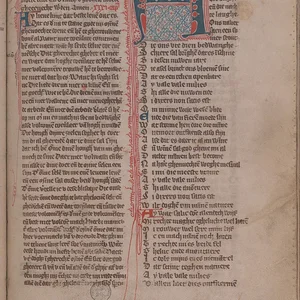
Hadewijch wrote her visions, letters, and poems on parchment, a costly material reserved for important texts. Literacy was rare among women of her time, and her command of writing points to an exceptional education.

The psalter was central to medieval devotion, guiding the liturgical hours of prayer. Hadewijch used it to structure her daily spiritual life within the beguine community.

Candlelight symbolized the divine presence during religious offices and nightly hours of meditation. In Hadewijch's writings, light is a recurring metaphor for mystical union with God.

The Eucharist lies at the heart of Hadewijch's visions, most notably in Vision VII, where she describes a merging communion with Christ. The chalice embodies for her the total union of the soul with God.

Used for drafts and notes before the final copy was made on parchment, the wax tablet was the everyday writing tool of medieval scholars. Hadewijch would likely have sketched out her poems on one before setting them down in their final form.

Beguines wore simple garments, typically of grey or brown wool, distinct from monastic habits but marking their commitment to a life of devotion. This sober dress reflected the ideal of voluntary poverty.
School Curriculum
Vocabulary & Tags
Key Vocabulary
Daily Life
Morning
Hadewijch rose before dawn to recite Matins, the first canonical hour of the day. The beguine community gathered in the chapel for communal prayer, then each woman went about her tasks in a spirit of quiet recollection.
Afternoon
The afternoon was devoted to manual work — sewing, weaving, or caring for the sick — a source of income for beguines who did not rely on dowries. Hadewijch added to this the spiritual instruction of her younger disciples and the writing of her letters and poems.
Evening
After Vespers and the communal meal, the evening allowed time for reading, meditation, and sometimes writing by candlelight. It was most likely during these quiet hours that Hadewijch set down her mystical visions in writing.
Food
Beguines followed a simple but not austere diet: bread, vegetables, legumes, and occasionally fish. Liturgical fast days — Advent, Lent, and vigils — were frequent and formed an integral part of their spiritual discipline.
Clothing
Hadewijch wore the distinctive beguine habit: a coarse grey or brown wool dress, a white veil over the head, and a plain mantle. This dress, neither an official monastic habit nor ordinary lay clothing, symbolized the in-between nature of beguine life.
Housing
Beguines lived in small houses clustered around a chapel and garden, forming a semi-enclosed beguinage. Hadewijch's room — a modest cell with a straw mattress, a chest, and a writing table — served as both a living space and a place of spiritual work.
Historical Timeline
Period Vocabulary
Visual Style
Style enluminure flamande du XIIIe siècle, inspiré de l'école mosane : fonds d'or, bleus profonds, silhouettes féminines gracieuses dans des intérieurs gothiques baignés de lumière de chandelle.
Sound Ambience
Ambiance sonore d'une communauté béguinale du XIIIe siècle en Brabant : chants liturgiques, cloches, prières collectives et travail du scriptorium.
Liens externes & ressources
Références
Œuvres
Strofische Gedichten (Poèmes strophiques)
vers 1240-1260
Brieven (Lettres)
vers 1240-1260
Visioenen (Visions)
vers 1240-1260
Mengeldichten (Poèmes mêlés)
vers 1240-1260