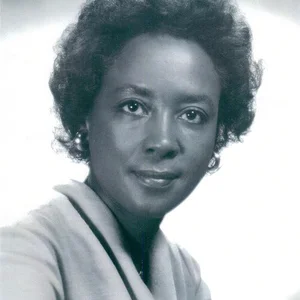

An African American mathematician and computer scientist at NASA, Annie Easley contributed to the development of Centaur rockets and early solar energy technologies. A pioneer in a field dominated by white men, she also advocated for equal access to education.
Annie Easley(1932 — 2011)
Annie Easley
États-Unis
8 min read
Frequently asked questions
Key Facts
- 1955: joins NACA (future NASA) as a “human computer”
- Contributes to developing the Centaur rocket code, used for lunar missions
- Works on alternative and solar energy technologies in the 1970s
- Earns her mathematics degree in 1977 while working at NASA
- 1989: retires after a 34-year career at NASA
Works & Achievements
Annie Easley developed FORTRAN programs to simulate and analyze the performance of the Centaur liquid-hydrogen upper stage. These calculations were essential to NASA's lunar and planetary exploration missions, including Surveyor and Pioneer.
In response to the 1973 oil crisis, Easley contributed to NASA research on alternative energy sources. Her mathematical analyses focused on renewable energy conversion and storage systems.
Easley worked on discharge curves for batteries destined for electric and hybrid vehicles, contributing to research that was far ahead of its time and foreshadowed today's energy challenges.
The Centaur upper stages improved through Easley's work propelled several probes to the Moon (Surveyor) and to Jupiter and Saturn (Pioneer 10 and 11). Her calculations were integrated into the validation pipeline for these historic missions.
Anecdotes
In 1955, Annie Easley read a newspaper article in Cleveland mentioning two women working as "human computers" at the NACA laboratory. She called the next morning and was hired two weeks later. That stroke of luck would lead her to dedicate 34 years of her life to the American space program.
When she arrived at NACA, Easley was one of the few Black women in an environment that was almost exclusively white and male. Some colleagues refused to appear in the same official photographs as her. She chose to respond with excellence and perseverance, gradually becoming an indispensable authority on propulsion calculations.
During the 1960s, as the civil rights movement shook the United States, Annie Easley volunteered in Cleveland to help Black citizens prepare for the literacy tests required to register to vote — tests deliberately designed to exclude them. She was putting her command of words in service of democracy just as much as in service of science.
When electronic computers began replacing human computers in the 1970s, Annie Easley refused to be left behind: she went back to school and earned a bachelor's degree in mathematics from Cleveland State University in 1977, at the age of 45. She proved that it is never too late to reinvent yourself.
The computer code Annie Easley developed for the Centaur rockets helped propel probes toward the Moon and the outer planets. That same family of boosters contributed to major space missions for decades. Yet her name long remained in the shadows, even though her calculations had literally guided rockets across the solar system.
Primary Sources
I always liked math. That was always my strong subject. I never had a problem with it. [...] I had heard about these women who were working out here as computers, and I thought, well, I can do that.
The sustained analytical efforts of computing and engineering staff at Lewis Research Center were instrumental in validating the cryogenic propulsion parameters of the Centaur vehicle throughout the 1960s and 1970s.
The Center has continued to expand technical opportunities for minority employees, though persistent disparities in promotion rates remain a challenge requiring active institutional attention.
Federal agencies including NASA increased minority hiring in technical positions during the early 1960s, yet advancement rates for Black employees remained significantly lower than for white counterparts in comparable roles.
Key Places
Annie Easley's birthplace, born on April 23, 1932, in this Deep South state deeply shaped by racial segregation. Growing up in this challenging environment forged her determination to overcome discrimination.
A historically Black university where Annie Easley studied pre-pharmacy after high school. This institution gave her a solid scientific foundation before she discovered her calling in applied mathematics.
The research center where Annie Easley worked for 34 years (1955–1989), first as a human computer, then as a computer scientist and mathematician specializing in propulsion and energy. It was here that she developed the code for the Centaur rocket.
The university where Annie Easley earned her mathematics degree in 1977 at the age of 45, all while continuing her career at NASA. This achievement illustrates her determination to keep learning in the face of rapid technological change.
Liens externes & ressources
Références
Œuvres
Code de simulation pour le propulseur Centaur
Années 1960-1970
Recherches sur les systèmes d'énergie solaire et éolienne
Années 1970
Analyses des batteries nickel-cadmium pour véhicules électriques hybrides
Fin des années 1970
Contributions aux missions Surveyor (Lune) et Pioneer (planètes extérieures)
1966-1978