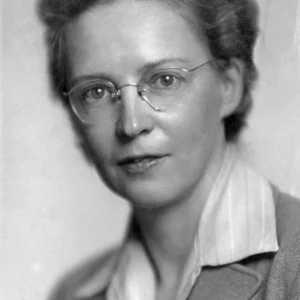

Beatrice Shilling (1909-1990) was a British aeronautical engineer. She is famous for solving a serious flaw in the Rolls-Royce Merlin engines that powered RAF fighters during the Second World War.
Beatrice Shilling(1909 — 1990)
Beatrice Shilling
Royaume-Uni, Royaume-Uni de Grande-Bretagne et d'Irlande
5 min read
Frequently asked questions
Key Facts
- Born in 1909 in England, she earned an engineering degree from the University of Manchester in the 1930s, at a time when women engineers were extremely rare.
- She joined the Royal Aircraft Establishment (RAE) at Farnborough in 1936.
- In 1941, she designed a small device (a diaphragm that restricted the fuel flow) which solved the problem of the Merlin engine cutting out during dives, nicknamed “Miss Shilling's orifice”.
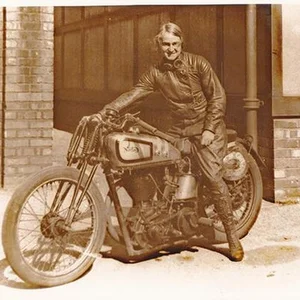
- A speed enthusiast, she raced motorcycles and won a gold medal at the Brooklands circuit.
- She died in 1990 and remains a pioneering figure in women's aeronautical engineering.
Works & Achievements
Her most famous achievement: a simple pierced disc that eliminated the engine cut-out during dives in RAF fighters, without grounding the aircraft.
A rare degree for a woman at the time, which paved the way for her career as a research engineer.
An award given for completing a lap at over 160 km/h on a motorcycle, proving her talent as both a rider and a mechanic.
Post-war work on tyre friction and aquaplaning, which improved the safety of airfield runways.
Participation in cutting-edge British research on propulsion and ballistic missiles.
Appointment as Officer of the Order of the British Empire, in recognition of her contribution to aeronautical research.
Anecdotes
Passionate about mechanics from childhood, Beatrice Shilling bought a motorcycle as a teenager and took it completely apart to understand how it worked. This curiosity drove her to study electrical engineering at the University of Manchester, at a time when women there were an exceedingly rare exception.
On the Brooklands circuit, she rode a Norton she had modified with her own hands. By completing a lap at over 160 km/h, she won the prestigious “Gold Star,” a feat very few riders, men or women, had ever achieved.
According to a famous anecdote, Beatrice is said to have refused to marry her fiancé George Naylor until he too had earned the Brooklands Gold Star by riding at over 160 km/h. He managed it, and they were married.
During the war, RAF pilots affectionately nicknamed her invention “Miss Shilling's orifice.” This tiny brass disc with a hole drilled through it saved countless lives by keeping engines from cutting out in the middle of combat.
Rather than simply sending out instructions, Beatrice took to the road with a small team to fit her device onto the fighters herself, air base after air base, giving priority to the front-line squadrons.
Primary Sources
Beatrice Shilling, Esq. [sic], Bachelor of Science, Royal Aircraft Establishment — appointed Officer of the Order of the British Empire for services to aeronautical research.
The R.A.E. restrictor, a calibrated orifice inserted into the carburettor's fuel inlet, limits the maximum fuel flow and prevents the engine from flooding during negative load-factor manoeuvres.
When you pushed the stick forward to dive, the Merlin spluttered and choked, whereas the fuel-injected Messerschmitt plunged without missing a beat; Miss Shilling's orifice put an end to this deadly disadvantage.
Key Places
Town in southern England where Beatrice Shilling was born in 1909.
Where she earned her degrees in electrical and then mechanical engineering, as one of very few female students.
The world's first purpose-built motor racing circuit, where she won her Gold Star on a motorcycle.
Major British aeronautical research centre where she worked from 1936 until her retirement, and where she designed her famous restrictor.
Town where she lived much of her life and where she died in 1990.
Typical Objects

A small brass disc pierced with a calibrated hole, inserted into the carburettor of the Merlin engine. It limited the fuel flow to stop the engine from cutting out during a dive.

A British V12 aero engine fitted to the Spitfire and Hurricane fighters. Its float carburettor suffered from a flaw that Shilling corrected.

A motorcycle that she tuned and rode herself on the Brooklands circuit. On it she exceeded 100 mph to earn her Gold Star.

A device that mixes air and petrol to feed the engine. Under negative g-force it would flood and then run short of fuel, making the Merlin cut out.

A mechanical calculating instrument essential to engineers before electronic calculators. Shilling used it for her flow and strength calculations.

The iconic RAF fighter aircraft of the Battle of Britain. It was on this type of machine that the flaw in the Merlin carburettor proved deadly.
School Curriculum
Vocabulary & Tags
Key Vocabulary
Tags
Daily Life
Morning
Beatrice would arrive early at the Farnborough research centre, where test benches and engines awaiting examination were waiting for her. She loved getting her hands dirty just as much as holding a pencil and a slide rule.
Afternoon
Her afternoons were split between engine testing, fuel-flow measurements and meticulous calculations. She led her team with rigour, demanding verified results rather than assumptions.
Evening
In the evening, she would retreat to her personal workshop to tune her motorcycles and racing cars. On weekends, she sped off to the racetracks to ride and drive them herself.
Food
Like all Britons during the war, she lived with rationing: bread, vegetables, a little meat and tea. Meals were simple and free of waste.
Clothing
At work, she happily wore a workshop coat or overalls, and trousers — an outfit considered daring for a woman of her time. Practicality came before elegance.
Housing
She lived in a modest house in the Farnborough area, extended by a very well-equipped garage-workshop. This do-it-yourself space mattered as much to her as the living room.
Historical Timeline
Period Vocabulary
Liens externes & ressources
Références
Œuvres
Restricteur R.A.E. — "l'orifice de Miss Shilling"
1941
Master d'ingénierie mécanique (université de Manchester)
1933
Gold Star de Brooklands
1934
Recherches sur l'adhérence et le freinage sur piste
années 1950
Travaux sur les statoréacteurs et le programme de fusée Blue Streak
années 1950-1960
Distinction OBE
1948