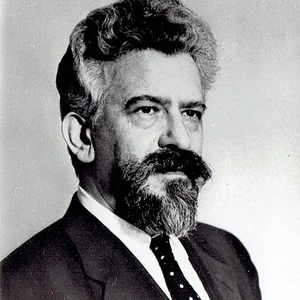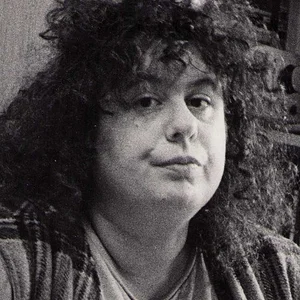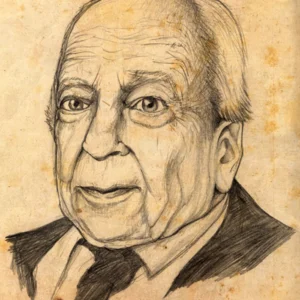

German philosopher, student of Heidegger, founder of modern philosophical hermeneutics. His major work, Truth and Method (1960), reshaped the theory of interpretation and understanding.
Hans-Georg Gadamer(1900 — 2002)
Hans-Georg Gadamer
Allemagne
5 min read
Frequently asked questions
Famous Quotes
« Being that can be understood is language.»
Key Facts
- Born in 1900 in Marburg, died in 2002 in Heidelberg, spanning the entire 20th century
- Studied under Martin Heidegger and defended his thesis in 1922
- Published his major work Truth and Method (Wahrheit und Methode) in 1960
- Professor at the University of Heidelberg from 1949 onward
- Developed the concept of the “fusion of horizons” (Horizontverschmelzung)
Works & Achievements
A major study of the Platonic dialogue (the *Philebus*); it already reveals Gadamer's interest in conversation as a path to truth.
His masterwork, which founds modern philosophical hermeneutics and analyzes how human beings understand and interpret.
An essential text in which Gadamer reflects on the weight of history and tradition in all understanding.
A collection of essays that extends and refines his theory of interpretation as applied to art, language, and texts.
A set of texts clarifying his thought in response to critics, notably in his debate with Jürgen Habermas.
An intellectual autobiography in which Gadamer retraces his journey and his encounters, from Marburg to Heidelberg.
An essay on art as play, festival, and symbol, which shows the importance of aesthetic experience in his philosophy.
Anecdotes
Hans-Georg Gadamer lived to be 102: born in 1900 along with the century, he lived through almost all of it, from the German Empire of Wilhelm II to the year 2002. This exceptional longevity made him a direct witness to all the major crises of 20th-century Germany.
As a young man, Gadamer contracted polio and had to spend several months isolated in a sanatorium. Confined, he immersed himself in reading the classics, and he later recounted that this forced ordeal had turned him into a truly attentive reader of texts.
Gadamer was a student of the famous philosopher Martin Heidegger, whose intelligence intimidated him so much that it took him years to dare publish his major book. *Truth and Method* did not appear until 1960, by which time its author was already 60 years old.
Having become rector of the University of Leipzig in 1946, in an East Germany occupied by the Soviets and in the midst of postwar reconstruction, Gadamer had to maneuver carefully among the communist authorities before leaving for the West, to Heidelberg, in 1949.
Even in his old age, Gadamer continued to give lectures and to debate. At nearly 100 years old, he was still taking part in public philosophical dialogues, faithful to his conviction that to understand is first of all to know how to converse with others.
Primary Sources
To understand is always already to interpret. Interpretation is the explicit form of understanding.
The prejudices of an individual, far more than his judgments, constitute the historical reality of his being.
Being that can be understood is language.
Whoever wants to understand a text must be ready to let it say something to him.
Key Places
University town where Gadamer was born in 1900 and studied philosophy, under the influence of Neo-Kantianism and then Heidegger.
Gadamer was a professor here and then rector in 1946, in Soviet-occupied Germany in the aftermath of the war.
From 1949, Gadamer held the chair of philosophy here and wrote Truth and Method; he would remain attached to the city all his life.
The town where Heidegger taught; Gadamer stayed here to follow his mentor and deepen his study of phenomenology.
The setting, in 1981, of the famous debate between Gadamer and Jacques Derrida on the limits of textual interpretation.
Typical Objects

His great 1960 book, the summation of philosophical hermeneutics. A thick bound volume that became a classic studied the world over.

Gadamer read Plato and Aristotle in the original. These annotated volumes accompanied his daily work as an interpreter of ancient texts.

The place and instrument of scholarly writing. Here Gadamer composed the essays, lectures and letters of a long academic career.

A symbol of German higher education. From the lecture-hall podiums of Leipzig and later Heidelberg, Gadamer delivered his courses.

An everyday object of a man whose entire life was devoted to reading and rereading texts. Indispensable to a reader who lived to a hundred.

Gadamer often prepared his lectures from notes rather than fully written-out texts, true to his taste for living dialogue.
School Curriculum
Vocabulary & Tags
Key Vocabulary
Daily Life
Morning
An early riser and methodical worker, Gadamer devoted his mornings to reading and writing in his study in Heidelberg. He tirelessly reread the Greek texts and prepared his lectures, pen in hand.
Afternoon
Afternoons were often reserved for teaching: lectures and seminars at the university, where he favored lively discussion with students over the mere reading of a written text.
Evening
Evenings lent themselves to conversation, which he regarded as the very heart of philosophy. Gadamer received colleagues and friends, exchanged ideas, and kept up an intense correspondence.
Food
Like every German academic of his time, he shared the simple meals of bourgeois life: bread, cold cuts, cheeses, soups, and coffee. During the shortages of the two wars and the postwar years, food was sometimes scarce.
Clothing
He wore the sober attire of the university professor: jacket, shirt, tie, and, in winter, a wool coat. The formal dress reflected the seriousness of his academic role.
Housing
Gadamer lived in university lodgings and apartments in the towns where he taught, above all in Heidelberg, a city of peaceful surroundings where he spent the greater part of his long life.
Historical Timeline
Period Vocabulary
Liens externes & ressources
Références
Œuvres
L'Éthique dialectique de Platon
1931
Vérité et méthode
1960
Le Problème de la conscience historique
1963
L'Art de comprendre (Kleine Schriften)
1967
La Philosophie herméneutique
1971
Années d'apprentissage philosophique (Philosophische Lehrjahre)
1977
L'Actualité du beau
1977