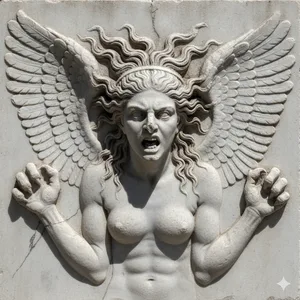

The Harpies are creatures from Greek mythology, half-woman and half-bird, personifying violent and destructive winds. Sent by the gods to torment the blind prophet Phineus, they would defile or steal his food. They were driven away by the Argonauts Zetes and Calais, sons of the wind god Boreas.
Harpies
Harpies
7 min read
Frequently asked questions
Key Facts
- The Harpies (Ἅρπυιαι) means 'those who snatch away' in ancient Greek
- Named primarily Aello, Ocypete, and Celaeno according to Hesiod (8th–7th century BCE)
- Daughters of the Titan Thaumas and the Oceanid Electra
- They torment King Phineus of Thrace on the gods' orders, defiling his every meal
- Driven off by Zetes and Calais during the expedition of the Argonauts (the myth of the Golden Fleece)
Works & Achievements
The first literary mention of the Harpies, presented as daughters of Thaumas and Electra, and sisters of Iris. Hesiod emphasizes their extraordinary speed without yet attributing a monstrous character to them.
The most complete and vivid account of the Phineus-Harpies episode. Apollonius describes in detail the seer's deliverance by Zetes and Calais, establishing the canonical version of the myth.
Virgil transposes the myth into a Trojan context: the Harpies attack Aeneas at the Strophades, where Celaeno delivers a threatening prophecy, reinforcing their ominous and oracular dimension.
A Lycian sculptured frieze depicting winged creatures carrying off small figures representing souls. This monument attests to the spread of Harpy imagery well beyond mainland Greece.
A mythographic synthesis bringing together the main versions of the Harpy myth, serving as the reference source for modern historians on the full range of ancient variants of the story.
Anecdotes
The Harpies take their name from the Greek word "harpazein," meaning "to seize" or "to snatch away by force." Hesiod counts two of them — Aello ("Whirlwind") and Ocypete ("Swift Wing") — and claims they surpass in speed both birds and the winds themselves. Their mere presence was an omen of devastating storms and sudden misfortune.
The seer Phineus, king of Thrace, was punished by Zeus for revealing too many divine secrets: the gods sent the Harpies to defile or steal every meal he was given. No food could reach him without being tainted by an unbearable, pestilential stench, condemning him to perpetual hunger and misery despite his royal status.
During the voyage of the Argonauts, the heroes Zetes and Calais — sons of Boreas, the god of the north wind, and thus winged half-brothers of the Harpies — intervened to free Phineus. They chased the creatures across the sky all the way to the Strophades Islands, where the goddess Iris stopped them by promising that the Harpies would never torment Phineus again.
In Virgil's Aeneid, the Harpies reappear at the Strophades Islands and attack Aeneas and his companions by defiling their feasts. Their leader, Celaeno, then delivers a menacing prophecy foretelling famine for the Trojans, adding an oracular dimension to their role as malevolent creatures rooted in Greek mythology.
In Homer, the Harpies are simply snatching winds that carry off the daughters of Pandareus — with no monstrous appearance. It is in later tradition that they become hybrid beings with the faces of women and the bodies of birds, reflecting Greek anxieties about uncontrollable natural forces and the sudden violence of storms.
Primary Sources
Aello and Ocypete, the lovely-haired Harpies, who keep pace with the blasts of the winds and the birds on their swift wings; for in swift flight they soar on high.
The Harpies swooped suddenly from the clouds like swift winds or like flashes of lightning, and in one fell swoop snatched away the food; the old man could barely seize any nourishment; and what remained gave off a foul and unbearable stench.
Suddenly, with a horrible beating of wings, the Harpies swoop down from the mountains and beat the air; they defile everything with their unclean hands, spreading a foul stench and letting out dreadful cries.
Phineus was tormented by the Harpies: whenever food was brought to him, they would swoop down from the air and carry off the greater part of it; what remained they made so foul by their touch that it was impossible to go near it.
Key Places
Kingdom of the seer Phineus, and the main setting of his torment at the hands of the Harpies. It was here that the Argonauts freed Phineus by driving the creatures away for good.
The ultimate refuge of the Harpies according to Apollonius of Rhodes and Virgil. It was on these barren, rocky islands that they landed after fleeing from Zetes and Calais, and where they later attacked Aeneas.
Home of the Olympian gods, who commanded the Harpies to punish Phineus. Zeus decreed their mission from Olympus, and the goddess Iris intervened from there to bring it to an end.
Lycian city where the famous Harpy Monument (4th century BC) was erected, its sculpted friezes depicting winged figures carrying away souls. The monument is now on display at the British Museum in London.
Typical Objects

The Harpies seize and defile food with their bird-like talons. Their ability to 'snatch' (harpazein) is their defining attribute, embedded in the very etymology of their name.

A symbol of their wind-like nature and superhuman speed, their wings allow them to rival the very gusts of the wind itself, as Hesiod attests as early as the Theogony.

The table of the seer-king Phineus is the recurring stage of their misdeed: every meal served upon it is stolen or defiled, condemning their victim to perpetual hunger and symbolic misery.

The remains left behind by the Harpies spread an unbearable stench and a ritual miasma that renders all food unusable. This defilement symbolizes total corruption and absolute deprivation.

The Harpies always emerge from a darkened sky, accompanied by sudden gusts and whirlwinds. Black clouds and violent wind are their invariable harbingers in ancient texts.
School Curriculum
Vocabulary & Tags
Key Vocabulary
Daily Life
Morning
The Harpies know no ordinary day: creatures of the wind, they appear without warning at dawn when Phineus's servants bring his first meal. They emerge from dark clouds driven by cold currents from the north, announcing their arrival with a sudden sound of storm.
Afternoon
After defiling the seer's meals, the Harpies vanish as quickly as they came, carried by air currents toward distant and unknown lands. Their existence is entirely devoted to aerial wandering and carrying out Zeus's punitive commands.
Evening
At nightfall, the Harpies take refuge in wind-battered caves or on isolated rocky islets such as the Strophades. Their rest is like that of the winds themselves: never truly still, always ready to swoop down on their prey at the first order from the gods.
Food
As divine creatures personifying the winds, the Harpies have no need for food in the human sense. Yet they spend their existence stealing or defiling the food of others, condemning their victims to starvation while never eating themselves — a cruel irony at the very heart of their nature.
Clothing
The Harpies are typically depicted naked or draped in light veils tossed by the wind. Their great dark wings, sharp talons, and disheveled hair — perpetually whipped by the gusts they embody — make up their characteristic appearance in ancient iconography.
Housing
With no fixed home or hearth, the Harpies inhabit the wild and unreachable in-between spaces: wind-swept cliffs, deserted islands in the middle of the Ionian Sea, dark caves. The Strophades Islands, mentioned by Apollonius and Virgil, represent their most famous refuge in ancient tradition.
Historical Timeline
Period Vocabulary
Visual Style
Style céramique grec archaïque et classique, figures ailées dynamiques sur fond de ciel d'orage, palette contrastant la terre cuite et l'ocre chaud avec des tonalités nocturnes profondes, dans l'esprit des vases attiques à figures rouges.
Sound Ambience
Ambiance de tempête côtière grecque mêlant vents violents, battements d'ailes immenses et cris stridents mi-humains mi-aviaires, évoquant la nature sauvage et surnaturelle des Harpies personnifiant les vents dévastateurs.
Liens externes & ressources
Références
Œuvres
Théogonie — Hésiode
vers 700 av. J.-C.
Argonautiques — Apollonios de Rhodes
IIIe siècle av. J.-C.
Énéide, Livre III — Virgile
19 av. J.-C.
Monument des Harpies de Xanthos
vers IVe siècle av. J.-C.
Bibliothèque — Pseudo-Apollodore
IIe siècle apr. J.-C.