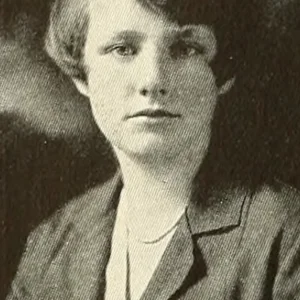

American geneticist and botanist, Harriet Creighton is celebrated for her landmark experiment conducted with Barbara McClintock in 1931, proving that genetic crossing-over corresponds to a physical exchange between chromosomes. She taught botany at Wellesley College for decades.
Harriet Creighton(1909 — 2004)
Harriet Creighton
États-Unis
7 min read
Frequently asked questions
Key Facts
- 1909: Born in Delphos, Ohio
- 1931: Publication with Barbara McClintock of experimental proof of chromosomal crossing-over in maize
- This paper is considered one of the founding experiments of modern genetics
- Research and teaching career at Wellesley College (Massachusetts)
- 2004: Died at the age of 94
Works & Achievements
A landmark article published in the Proceedings of the National Academy of Sciences, providing the first experimental proof that genetic crossing-over corresponds to a physical exchange between chromosomes. Considered one of the most elegant experimental demonstrations in the history of biology.
A general botany textbook widely used in American universities, reflecting Creighton's commitment to education and her ability to make complex concepts in plant biology accessible to students.
A body of research conducted at Cornell on the structure and behavior of maize chromosomes during meiotic division, which provided the cytological foundation necessary to demonstrate physical crossing-over.
Anecdotes
In 1931, Harriet Creighton was only 22 years old and working on her doctoral dissertation at Cornell when she published, alongside Barbara McClintock, one of the most decisive experiments in the history of genetics. It was Thomas Hunt Morgan, Nobel laureate and towering figure in biology, who urged them to publish without delay, fearing that European researchers might reach the same conclusions first.
The ingenious trick of the experiment rested on maize plants carrying a chromosome 9 that was visually identifiable under the microscope, thanks to a distinctive knob and chromatin “node.” By observing the offspring, Creighton and McClintock could verify that each genetic exchange corresponded exactly to a visible physical exchange between chromosomes.
Despite the revolutionary significance of her discovery, Harriet Creighton chose to dedicate most of her career to teaching botany at Wellesley College in Massachusetts. There she trained generations of students over more than three decades, preferring the transmission of knowledge to the pursuit of scientific fame.
When Barbara McClintock received the Nobel Prize in 1983 for the discovery of transposons, the scientific community recalled the foundational role that Harriet Creighton had played fifty years earlier in establishing the cytological basis of genetics. The two women had proven together that heredity is rooted in real physical exchanges between chromosomes.
Primary Sources
“The results presented in this paper show that cytological crossing-over and genetical crossing-over involve the same chromosome segment. They constitute, therefore, a cytological demonstration of the occurrence of genetic crossing-over.”
Morgan urged both researchers to publish their results immediately in the Proceedings of the National Academy of Sciences, stressing the urgency given competition from European laboratories.
A general botany textbook widely used in American universities, reflecting Creighton's commitment to science education and the rigorous transmission of knowledge in plant biology.
Key Places
It was at Cornell that Harriet Creighton completed her doctoral research and conducted with Barbara McClintock the landmark experiment on crossing-over. The university's botany and genetics laboratory was at the time one of the most advanced in the United States.
Harriet Creighton taught botany here for more than three decades, making this prestigious women's college a center for the transmission of scientific culture in genetics and plant biology.
A landmark institution of American genetics where Barbara McClintock, Creighton's collaborator, continued her pioneering research on maize and would later discover transposons.
Harriet Creighton's hometown, where she grew up in the American Midwest before pursuing scientific studies that would take her to the highest levels of genetics research.
Typical Objects

The central tool in the cytology laboratory of the 1930s, it allowed Creighton to observe corn chromosomes magnified several hundred times and to pinpoint physical exchanges during crossing-over with great precision.

The preferred biological material: corn has large chromosomes that are easy to observe. Creighton and McClintock selected strains carrying visible chromosomal markers to track genetic exchanges from generation to generation.

On these thin glass plates, Creighton carefully prepared sections of plant tissue stained with acetocarmine, revealing the structure and anomalies of chromosomes undergoing meiotic division.

This red stain, which binds specifically to chromosomes, was indispensable for making the chromosomal structures of corn visible and identifying the exchange points during crossing-over.

Harriet Creighton meticulously recorded her observations, crosses, and results in handwritten notebooks — irreplaceable evidence of the scientific rigor that defined her experiments.

Handwritten tables listing the results of corn plant crosses, essential for correlating microscopic observations with genetic data collected across multiple generations of offspring.
School Curriculum
Vocabulary & Tags
Key Vocabulary
Tags
Daily Life
Morning
Harriet Creighton arrives early at Cornell's botany laboratory, puts on her white lab coat, and begins by inspecting the corn plants grown in the greenhouse. She carefully prepares her microscope slides by staining plant tissue sections with acetocarmine, taking advantage of the morning's natural light for her most delicate observations.
Afternoon
Afternoons are devoted to careful microscopic observation and correlating cytological data with the results of genetic crosses. She regularly exchanges ideas with Barbara McClintock, recording results in her notebooks with absolute rigor before preparing the following week's crosses.
Evening
In the evenings, Creighton immerses herself in reading international scientific journals — particularly the German publications that then dominated cytology — to keep up with advances in European research. She also prepares her lecture notes for her students at Wellesley, always seeking to connect cutting-edge research with teaching.
Food
Like many American academics of the interwar period, Harriet Creighton followed a practical and frugal diet: meals at the campus cafeteria, sandwiches on busy days, and seasonal fruit. Coffee was essential for keeping up with the long hours of work at the microscope.
Clothing
In the laboratory, she wore a white protective coat over modest and functional outfits typical of women scientists of the era: a mid-length skirt, blouse, and hair tied back. Outside the laboratory, she adopted the neat but understated appearance of professors at the great American women's colleges.
Housing
Harriet Creighton lived in housing close to the university campus — first in Ithaca, then at Wellesley. She lived simply, following the rhythm of the academic calendar, sometimes sharing her lodgings with other faculty members in keeping with the tradition of women's colleges of the era.
Historical Timeline
Period Vocabulary
Visual Style
Un style visuel ancré dans l'esthétique des laboratoires universitaires américains des années 1930 : tons naturels, lumière dorée, matériaux nobles (bois, laiton, verre) et précision rigoureuse des illustrations scientifiques botaniques.
Sound Ambience
L'ambiance sonore discrète et studieuse d'un laboratoire de botanique universitaire des années 1930, mêlant bruits de microscopes, de carnets de notes et discussions scientifiques feutrées aux sons du campus et de la nature.
Liens externes & ressources
Références
Œuvres
A Correlation of Cytological and Genetical Crossing-Over in Zea Mays (avec Barbara McClintock)
1931
Textbook of General Botany (coauteure avec R.M. Holman)
1955
Travaux de cytologie chromosomique sur Zea mays
1930–1935