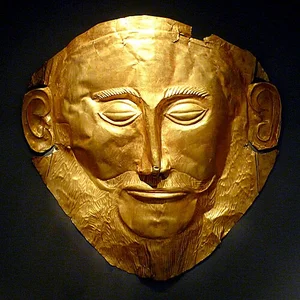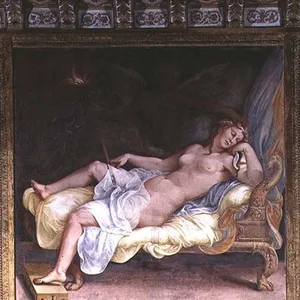

Queen of Troy in Greek mythology, wife of King Priam and mother of Hector, Paris, and Cassandra. A central figure in the Iliad and Greek tragedies, she embodies maternal grief and the fall of an entire civilization.
Hecuba
Hecuba
9 min read
Frequently asked questions
Famous Quotes
« O my children, I am lost! (words attributed by the Greek tragic tradition, notably in Euripides)»
Key Facts
- Wife of King Priam of Troy, she is said to have had nineteen children according to some traditions, including Hector, Paris, and Cassandra
- Before the birth of Paris, she dreamed that her son would bring ruin upon Troy — a dream recorded by various ancient sources
- After the fall of Troy (a legendary event placed around the 12th century BCE in the tradition), she witnessed the murder of her sons and the enslavement of her daughters
- Euripides devoted two tragedies to her: Hecuba and The Trojan Women (5th century BCE)
- According to some versions of the myth, she is transformed into a dog after the death of her last son Polydorus
Works & Achievements
The founding epic of Western literature gives Hecuba several scenes of exceptional emotional power, including her supplication of Hector before his fatal battle and her lamentations on the city walls.
A tragedy centered entirely on Hecuba after the fall of Troy: her enslavement, the sacrifice of Polyxena, the discovery of Polydorus's murder, and her relentless revenge against Polymestor. A masterpiece of psychological portraiture exploring grief and vengeance.
Hecuba is the central figure in this anti-war tragedy, performed just before the Sicilian Expedition: she embodies the suffering of the defeated and the senseless destruction wrought by war.
Virgil offers a poignant portrait of Hecuba seeking refuge with her daughters at the altars of the gods during the sack of Troy, as she witnesses the murder of Priam by Neoptolemus.
Ovid recounts Hecuba's revenge against Polymestor and her transformation into a dog, reworking and expanding the mythological tradition with the emotional attention to detail characteristic of his poetry.
In Hamlet, an actor recites a monologue about Hecuba's grief, moving the Danish prince to tears. This reference speaks to the universal and enduring resonance of her character throughout European culture.
Anecdotes
Before the birth of Paris, Hecuba had a terrifying prophetic dream: she gave birth to a flaming torch that set the entire city of Troy ablaze. The seers interpreted this vision as an omen of destruction. Priam and Hecuba decided to abandon the child on the slopes of Mount Ida, but fate mocked them: Paris survived, grew up among shepherds, and years later sparked the war that annihilated their kingdom.
Hecuba was the mother of nineteen children according to some traditions, the most famous being Hector, the mightiest of Troy's warriors, Paris, the cause of the war, and Cassandra, the priestess condemned to prophesy and be ignored by all. Losing her children one by one over ten years of siege was an ordeal without precedent in Greek literature, making her the supreme maternal figure of grief.
After the fall of Troy, Hecuba was enslaved and assigned by lot to Odysseus, her worst enemy. Before setting sail, she discovered on the coast of Thrace the body of her youngest son Polydorus, whom she had entrusted to King Polymestor to keep him safe — only for Polymestor to murder him and seize the gold he carried. The old queen, consumed by grief and rage, then devised a cold and terrible revenge.
To avenge the murder of Polydorus, Hecuba lured King Polymestor into a trap with his Thracian wives, gouged out his eyes, and killed his sons before him. According to some versions of the myth, the gods then transformed her into a fire-eyed dog, and she ended her days on a rock in the Aegean Sea that the ancients called the 'Tomb of the Bitch' (Cynossema). This ending symbolizes the extreme limit of human suffering transformed into animal fury.
Primary Sources
Hecuba cried out and tore away her veils; with both hands she beat her breast and wept, gazing upon her son. Priam called for her to come inside, but she remained on the ramparts, her arms stretched out toward Hector.
Oh, my children, I am lost! All is over. Troy is no more, and I who was a queen am now a slave. The gods have taken everything from me: my homeland, my sons, my honor.
Hecuba: Carry me, lift my trembling limbs — raise me up toward the city. O Troy, once so great among the cities of the barbarians, your glorious name is leaving you forever.
After Hecuba tore out Polymestor's eyes, she was transformed into a dog that barked toward the Thracian shore. Greeks and Trojans alike were seized with wonder at this strange portent.
There lay Priam, his great body bathed in blood upon the altar steps. Hecuba and her daughters had gathered together like doves driven down by a storm, clinging to the statues of the gods.
Key Places
Capital of the kingdom of Priam and Hecuba, a powerful city commanding the Hellespont strait. It was here that Hecuba lived as queen, watched her sons fall, and witnessed the total destruction of her world.
Ramparts from which Hecuba, Priam, and the elders watched the fighting on the plain below. It was from this vantage point that Hecuba saw Hector challenge Achilles, then watched her son fall at the Greek hero's hands.
A mountain near Troy where the infant Paris was exposed on his parents' orders. Mount Ida is also the setting of the Judgment of Paris, the founding episode that set the Trojan War in motion.
The shoreline of what is now the Gallipoli Peninsula, where Hecuba discovered the body of her son Polydorus and where her transformation into a dog is said to have taken place. A site known as Cynossema (Tomb of the Dog) was located here in antiquity.
The women's apartments within Priam's palace, where Hecuba lived surrounded by her daughters and daughters-in-law. This is where Homer places her during the intimate scenes of the Iliad, weaving and praying for her sons in battle.
Typical Objects

A large dark veil worn by Greek and Trojan women as a sign of lamentation. Hecuba is consistently depicted veiled in the Iliad, beating her breast and tearing at her veils with each death of her children.

A diadem or crown of precious metal signifying the rank of queen. Hecuba falls from absolute sovereignty to total enslavement: the crown symbolizes everything she loses in the fall of Troy.

Cups and amphorae used to pour offerings to the gods during prayers and funeral ceremonies. Hecuba repeatedly implores the Olympian gods for the protection of Troy and her children.

The central symbol of Hecuba's prophetic dream before the birth of Paris. The torch foretelling the burning of Troy is the most iconic image associated with her tragic motherhood.

In ancient Greece, weaving was the central occupation of high-born women. Hecuba and her attendants wove in the women's quarters of Priam's palace, a feminine space described by Homer.

The gold entrusted along with her son Polydorus to the Thracian king Polymestor symbolizes Hecuba's desperate attempt to save at least one of her children. Polymestor's betrayal for this gold sets her final act of vengeance in motion.
School Curriculum
Vocabulary & Tags
Key Vocabulary
Tags
Daily Life
Morning
Hecuba began her day with libations and prayers to the gods who protected Troy — chiefly Apollo and Athena — at the palace sanctuary. She then oversaw the activities of the gyneceum, receiving reports from the servants and organizing the day's tasks.
Afternoon
Afternoons were devoted to noble feminine pursuits: weaving large pieces of fabric to be offered to the gods or given as precious garments, overseeing the palace storerooms, and granting audiences to the wives and mothers of Trojan nobles who came seeking her judgment or support.
Evening
Evenings brought the royal family together for a shared meal in the megaron — the great hall of the palace. There Hecuba joined Priam, her sons, and their wives. Bards sang of heroes' deeds, libations were poured to the gods, and news from the front was discussed with the growing anxiety that came with years of siege.
Food
The Trojan court's diet included barley and wheat bread, olives and olive oil, goat and sheep's cheese, dried or fresh fish from the Hellespont, and beef and mutton during ritual banquets, all accompanied by wine mixed with water in large bronze kraters.
Clothing
Hecuba wore the peplos, a long finely woven and dyed woolen robe fastened at the shoulders and draped with elegance. Over it she wore a himation, a large rectangular cloak. In times of mourning — increasingly frequent during the war — she dressed in dark or black garments and wore a veil drawn down over her face. Her royal adornments included gold fibulae, bracelets, and a diadem.
Housing
Hecuba lived in the royal palace of Troy, a vast stone complex on the citadel (acropolis) overlooking the Scamandrian plain. The palace included the central megaron (great throne room), the gyneceum (the women's quarters, an enclosed and private space), inner courtyards, storage rooms, and domestic altars. The walls were adorned with painted friezes and carved wooden columns.
Historical Timeline
Period Vocabulary
Visual Style
Style inspiré de la céramique grecque antique (figures noires et rouges) et de la sculpture en relief : Hécube en reine âgée drapée de noir sur fond de citadelle en flammes, palette de pourpre sombre, ocre brûlé, gris cendre et or ancien.
Sound Ambience
Ambiance sonore du palais assiégé de Troie : lamentations féminines, crépitement des incendies, fracas des armes sur la plaine, vent marin soufflant entre les tours de pierre et chants funèbres rythmés.
Liens externes & ressources
Références
Œuvres
Iliade — Homère
VIIIe siècle av. J.-C.
Hécube — Euripide
424 av. J.-C.
Les Troyennes — Euripide
415 av. J.-C.
Énéide (Livre II) — Virgile
19 av. J.-C.
Métamorphoses (Livre XIII) — Ovide
8 apr. J.-C.
Hécube — Shakespeare (inspiration directe d'Hamlet)
1600 apr. J.-C.