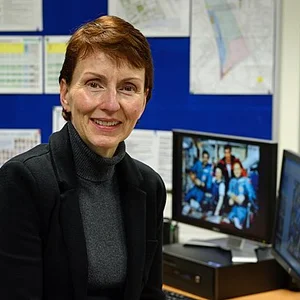

British chemist born in 1963, Helen Sharman became in 1991 the first British person and the first Western woman to travel to space, aboard the Soviet station Mir as part of the Juno project.
Helen Sharman(1963 — ?)
Helen Sharman
Royaume-Uni
7 min read
Frequently asked questions
Key Facts
- 1963: born in Sheffield, England
- 1989: selected from 13,000 applicants for the Juno project after a radio announcement
- 18 May 1991: launch aboard Soyuz TM-12 to the Mir station
- 1991: first British person and first woman from Western Europe in space
- 8-day stay aboard the Mir space station
Works & Achievements
The first spaceflight by a British woman: eight days aboard the Soviet Mir space station conducting experiments on plant growth and human physiology in weightlessness. Helen Sharman became the first Western woman to stay in space.
An autobiographical account in which Helen Sharman tells the story of her journey from ordinary chemist to cosmonaut, from hearing the radio announcement to experiencing weightlessness. Widely used in British schools to inspire young people to pursue scientific careers.
An honorary distinction awarded by the British Crown in recognition of her role as a space pioneer and her efforts to promote science among young people.
Helen Sharman made hundreds of visits to British schools and universities to encourage young people — especially girls — to pursue careers in science and technology.
Following her space career, Helen Sharman conducted scientific research and public engagement activities at two of the United Kingdom's most important research institutions.
Anecdotes
In 1989, Helen Sharman was driving her car when she heard a stunning announcement on the radio: “Astronaut wanted, no experience necessary.” A chemist at Mars (the chocolate manufacturer), she decided to apply almost out of curiosity. Among some 13,000 British candidates, she was ultimately selected.
To prepare for her journey, Helen Sharman spent eighteen months at Star City (Zvyozdny Gorodok), the Soviet cosmonaut training centre near Moscow. She learned Russian from scratch, mastered the systems of the Mir space station, and trained in weightlessness aboard freefall aircraft — becoming the only British person on an entirely Soviet team.
On 18 May 1991, the Soyuz TM-12 rocket lifted off from Baikonur with Helen Sharman on board, alongside cosmonauts Anatoli Artsebarsky and Sergei Krikalev. Over eight days, she conducted experiments on plant growth and human physiology in weightlessness, becoming the first British person and the first Western woman in space.
The funding for Project Juno relied on private commercial partnerships — a novelty in spaceflight at the time. When the sponsoring companies withdrew, the Soviet government stepped in to cover the mission at no cost, unwilling to break the diplomatic agreement with the United Kingdom just months before the dissolution of the USSR.
After returning to Earth, Helen Sharman became a science ambassador for an entire generation of young British people. She gave hundreds of talks in schools, stressing that she was not an extraordinary hero but an ordinary scientist who had seized an opportunity — her message being: “Curiosity and perseverance are within everyone’s reach.”
Primary Sources
I heard the advertisement on the radio: 'Astronaut wanted. No experience necessary.' I thought, why not apply? I was a chemist, I was fit, I was curious about the world.
Helen Sharman stated that the experiments conducted aboard the Mir station on plant growth in weightlessness had provided valuable scientific data, and that cooperation with the Soviet cosmonauts had been exemplary.
Helen Sharman explained that her daily routine aboard Mir included scientific experiments, maintenance checks and communications with Mission Control in Moscow, all conducted in Russian, a language she had not known two years before.
Space travel is not about heroism. It is about science, teamwork and preparation. I trained as hard as any Soviet cosmonaut and I was treated as an equal member of the crew.
Key Places
Helen Sharman's birthplace, where she was born on 30 May 1963. This industrial city in South Yorkshire embodies her journey from ordinary scientist to space pioneer.
The Soviet cosmonaut training centre near Moscow, where Helen Sharman spent eighteen months preparing: learning Russian, practising weightlessness simulations, and undergoing survival training.
The launch site from which the Soyuz TM-12 rocket lifted off on 18 May 1991 with Helen Sharman on board. Baikonur is the world's oldest cosmodrome and remains operational today.
The station where Helen Sharman stayed from 18 to 26 May 1991. There she conducted scientific experiments and became the first British person to live and work in weightlessness.
A leading London science university where Helen Sharman worked after her space career, conducting research and engaging in science outreach activities.