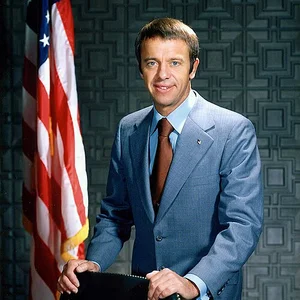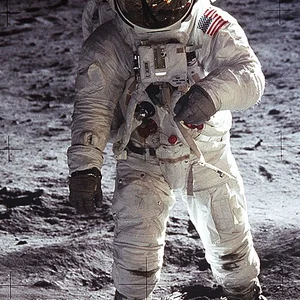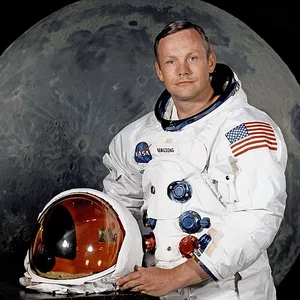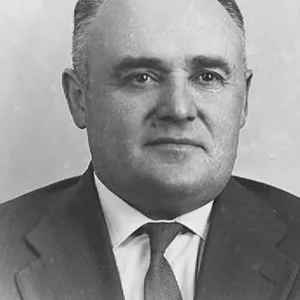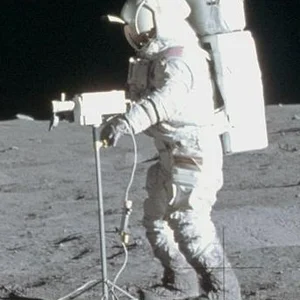

An American NASA astronaut, Edgar Mitchell was the sixth man to walk on the Moon during the Apollo 14 mission in February 1971. Holding a doctorate in aeronautics from MIT, he devoted his life after the space conquest to the study of human consciousness.
Edgar Mitchell(1930 — 2016)
Edgar Mitchell
États-Unis
8 min read
Frequently asked questions
Famous Quotes
« You develop an instant global consciousness, a people orientation, an intense dissatisfaction with the state of the world, and a compulsion to do something about it.»
Key Facts
- Born September 17, 1930, in Hereford, Texas
- 6th man to walk on the Moon during Apollo 14 in February 1971
- Performed a 9-hour EVA on the lunar surface in the Fra Mauro region
- Founder of the Institute of Noetic Sciences (IONS) in 1973
- Died February 4, 2016, in West Palm Beach, Florida
Works & Achievements
The sixth Apollo mission to land on the Moon. Mitchell and Shepard explored the Fra Mauro region and collected 42.9 kg of lunar rocks, making Mitchell the sixth person to walk on the Moon.
After returning from the Moon, Mitchell established this research organization dedicated to the scientific study of consciousness, intuition, and the relationship between mind and matter — a pioneer in a field that was largely marginalized at the time.
An autobiography in which Mitchell recounts his journey to the Moon, the mystical epiphany he experienced on the return trip, and his subsequent commitment to the study of consciousness. A key reference for understanding his thought.
Mitchell conducted an unauthorized telepathy experiment from the spacecraft, attempting to transmit symbols by thought to partners on Earth. The results, published in 1971, fueled scientific debate on parapsychology.
A collective volume edited by Mitchell bringing together contributions from scientists on parapsychological phenomena. He sought to approach these subjects with academic rigor, despite widespread skepticism from the scientific community.
Anecdotes
On the return journey to Earth after Apollo 14, Edgar Mitchell had an unexpected mystical experience: gazing at the Earth, the Moon, and the stars through the porthole, he suddenly felt a profound sense of unity with the universe. He described the moment as an 'instant epiphany,' becoming convinced that human consciousness was connected to everything that exists. This experience radically transformed his worldview and shaped the entire course of his life after NASA.
During the Apollo 14 mission, Mitchell secretly conducted a telepathy experiment that had not been authorized by NASA. From his capsule en route to the Moon, he attempted to transmit symbols telepathically to four friends back on Earth. Upon his return, he published the results, claiming success rates above chance. NASA distanced itself from the experiment, but the episode illustrates Mitchell's unconventional intellectual curiosity.
On February 5, 1971, Mitchell and Alan Shepard landed in the Fra Mauro highlands, a mountainous region of the Moon selected for its geological interest. During their two moonwalks totaling nearly nine hours, they collected 42 kilograms of rock samples. Mitchell carried his own equipment by hand in intense heat, and exhausted, he wished he could simply lie down and watch the stars.
After his astronaut career, Mitchell founded the Institute of Noetic Sciences (IONS) in 1973 in Petaluma, California. This research organization aimed to study human consciousness, intuition, and the connection between mind and matter through a scientific lens. Mitchell believed that traditional science ignored essential dimensions of human experience, and he devoted the last forty years of his life to this ambitious and controversial endeavor.
Primary Sources
I had an experience that I can only describe as an instant global consciousness. I suddenly felt that everything that exists is part of a coherent whole, that the universe is in some way conscious.
Mitchell: Fra Mauro, here we are. The surface is much firmer than expected. We're picking up the samples now.
The crew of Apollo 14 successfully completed all primary mission objectives, including collection of 42.9 kg of lunar material from the Fra Mauro formation.
I conducted an ESP experiment during the flight. The results were statistically significant and deserve serious scientific attention, regardless of one's prior beliefs on the subject.
The exploration of the cosmos and the exploration of consciousness are two sides of the same coin. We cannot truly understand one without the other.
Key Places
Birthplace of Edgar Mitchell, born on September 17, 1930. This small agricultural town in Texas is where the future astronaut grew up in a rural environment before pursuing a military and scientific career.
A highland region of the Moon where Mitchell and Alan Shepard landed on February 5, 1971. Mitchell conducted two extravehicular activities there and collected primordial rock samples of great scientific value.
Mitchell earned his doctorate in aeronautics and astronautics here in 1964, a qualification that enabled him to be selected by NASA. MIT is one of the world's foremost scientific institutions.
The launch facility from which Apollo 14 lifted off on January 31, 1971, carrying Mitchell, Shepard, and Roosa toward the Moon. Mitchell underwent intensive training there ahead of the mission.
An organization founded by Mitchell in 1973 to scientifically explore human consciousness. He worked there until the end of his life, seeking to reconcile science and spirituality.
Typical Objects
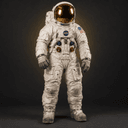
Pressurized suit worn by Mitchell on the Moon, made up of 21 protective layers designed to shield against the vacuum, radiation, and extreme temperatures of space. It allowed astronauts to survive for several hours outside the lunar module.
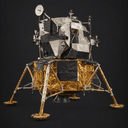
The vehicle in which Mitchell and Shepard landed at Fra Mauro on February 5, 1971. It was from this module that they conducted their two moonwalks on the lunar surface.
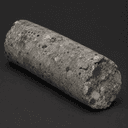
Mitchell collected 42.9 kg of geological samples on the Moon, including primitive rocks from the lunar subsurface never seen before. These samples significantly advanced our understanding of how the solar system formed.
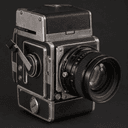
Medium-format camera used during the Apollo 14 mission to document the lunar surface and scientific experiments. The photographs taken by Mitchell and his crew constitute an essential piece of historical record.
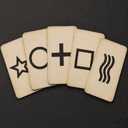
Sets of simple geometric symbols (star, circle, cross, square, wavy lines) traditionally used to test telepathy. Mitchell drew on them to design his extrasensory perception experiment, which he conducted during the voyage to the Moon.
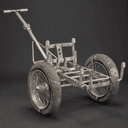
A small two-wheeled cart used by Mitchell and Shepard to carry their equipment and samples across the lunar surface — the first time such a vehicle had been used in the history of space exploration.
School Curriculum
Vocabulary & Tags
Key Vocabulary
Tags
Daily Life
Morning
During his NASA training, Mitchell rose early for intense physical exercise sessions followed by technical briefings. Astronauts devoted their mornings to simulation in altitude chambers or to studying the lunar module systems, following a highly structured military routine.
Afternoon
Afternoons were dedicated to suited exercises, emergency procedure drills, and centrifuge sessions reproducing the g-forces of launch. Mitchell also took part in scientific preparation work for the geological sampling planned on the Moon.
Evening
In the evenings, astronauts studied technical manuals, gathered for debriefings, or spent time with their families when possible. Mitchell, intellectually curious, also read widely in philosophy and science — interests he cultivated alongside his career.
Food
Aboard Apollo 14, food consisted of freeze-dried and rehydratable items: meats, vegetables, fruits, and compressed cereals, all carefully packaged. On Earth, astronauts followed a balanced, medically supervised diet to keep their physical performance at its peak.
Clothing
On mission, Mitchell wore the Apollo A7L suit weighing 81 kg with its life-support system, and a simple lightweight garment inside the spacecraft. On Earth, like other Navy officers, he wore either his military uniform or the understated civilian dress typical of engineers of that era.
Housing
During his NASA career, Mitchell lived in the suburbs of Houston, Texas, near the Johnson Space Center, in a single-family home typical of American professionals in the 1960s–70s. After his career, he settled in California, near the IONS he had founded.
Historical Timeline
Period Vocabulary
Liens externes & ressources
Références
Œuvres
Mission Apollo 14
31 janvier – 9 février 1971
Fondation de l'Institut des Sciences Noétiques (IONS)
1973
The Way of the Explorer: An Apollo Astronaut's Journey Through the Material and Mystical Worlds
1996
Expérience de perception extrasensorielle (ESP) durant Apollo 14
Février 1971
Psychic Exploration: A Challenge for Science
1974