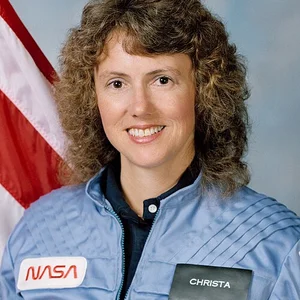

An American teacher selected for NASA's Teacher in Space program, she was set to become the first civilian in space. She perished in the Space Shuttle Challenger disaster on January 28, 1986.
Christa McAuliffe(1948 — 1986)
Christa McAuliffe
États-Unis
7 min read
Frequently asked questions
Key Facts
- 1948: born in Boston, Massachusetts
- 1985: selected from among 11,000 applicants for NASA's Teacher in Space program
- January 28, 1986: killed in the explosion of the Space Shuttle Challenger 73 seconds after launch
- She was scheduled to teach lessons from space to be broadcast live to American schools
- Her death prompted a presidential commission of inquiry into the safety of the space program
Works & Achievements
McAuliffe's application stood out for its clear educational vision and her plan to teach lessons from space. This document, preserved in NASA's archives, reflects her vision of teaching as a 'bridge between yesterday and tomorrow'.
The first of the two lessons she was scheduled to teach from orbit, consisting of a guided tour of the Space Shuttle for students. This groundbreaking educational project aimed to bring the experience of space to children back on Earth.
The second planned orbital lesson, tracing the history of human exploration from the great navigators to the conquest of space. McAuliffe wanted to show her students that space is the natural continuation of the human spirit of adventure.
Following her selection, Christa McAuliffe became the public face of the American space program. Her television appearances and school visits inspired an entire generation of students and teachers.
In her honor, annual conferences bringing together innovative educators were established in New Hampshire to carry forward her ideal of teaching that embraces technology and the wider world.
Anecdotes
Christa McAuliffe was selected from more than 11,400 applications for NASA's Teacher in Space program, launched in 1984 by President Reagan. She was a history and social studies teacher at Concord High School (New Hampshire) and stood out for her contagious enthusiasm and her ability to explain complex concepts with remarkable clarity.
She had prepared two lessons she was to teach live from space: “The Ultimate Field Trip,” a guided tour of the shuttle for students, and “Where We've Been, Where We're Going, Why,” on the history of space exploration. These lessons were to be broadcast into thousands of American classrooms.
The night before the launch — postponed multiple times due to weather — Morton Thiokol engineers warned NASA about the risks posed by the extreme cold (below -1°C the previous night) to the O-rings of the solid rocket boosters. Their warnings were overridden by management. Christa McAuliffe and her six crewmates had no idea their flight was compromised before they even lifted off.
The disaster of January 28, 1986 unfolded 73 seconds after launch: the Space Shuttle Challenger broke apart before the eyes of millions of television viewers, including many children gathered in their classrooms to watch their teacher fly. That same evening, President Reagan delivered a historic address, quoting the poem “High Flight”: “they touched the face of God.”
In tribute to Christa McAuliffe, a planetarium was inaugurated in Concord in 1990, and hundreds of schools across the United States bear her name today. Her personal motto, widely displayed in schools, was: “I touch the future — I teach.”
Primary Sources
We will never forget them, nor the last time we saw them, this morning, as they prepared for their journey and waved goodbye and 'slipped the surly bonds of earth' to 'touch the face of God'.
The Space Shuttle's Solid Rocket Booster problem begun with the faulty design of its joint and increased as both NASA and contractor management first failed to recognize it as a problem, then failed to fix it and finally treated it as an acceptable flight risk.
Sharon Christa McAuliffe, a social studies teacher at Concord High School in Concord, New Hampshire, has been selected as the first private citizen to fly in space under NASA's Teacher in Space Project.
I expressed my fear that the O-ring seal integrity would be compromised at low temperature, and that the result would be a catastrophic failure of the vehicle.
Key Places
Christa McAuliffe's hometown (born September 2, 1948). She grew up here and completed her secondary education before going on to university.
The high school where McAuliffe had been teaching history and civics since 1982. It was as a teacher at this school that she was selected by NASA for the Teacher in Space program.
Christa McAuliffe's training site from September 1985 onward. She spent months in intensive training there — weightlessness simulations, survival exercises, and space procedures — alongside the six other members of the Challenger crew.
Launch site of the space shuttle Challenger on January 28, 1986. In temperatures unusually cold for Florida, Challenger lifted off at 11:38 a.m. and broke apart 73 seconds later before a gathered crowd.
Opened in 1990, this planetarium was built in memory of the teacher and her educational mission. Every year it welcomes tens of thousands of schoolchildren for sessions on astronomy and the history of space exploration.
Typical Objects

Christa McAuliffe wore the sky-blue pressurized crew suit during the shuttle launch. This outfit, distinct from the orange suits introduced after Challenger, symbolized NASA's excessive confidence in the reliability of its flights.

She had written detailed lesson plans for her two lessons from orbit, with teaching materials adapted to microgravity. These documents, preserved by NASA, reflect her commitment to making space accessible to children.

As a social studies teacher, McAuliffe used American history and civics textbooks in her classes. Her engaging teaching style earned her an outstanding reputation among her students.

During her months of training at the Johnson Space Center, she recorded her experiences with simulations, survival training, and weightlessness. These notebooks capture the demanding journey of a civilian joining the astronaut corps.

Like all astronauts, Christa McAuliffe was to carry small American flags intended as gifts to schools after the mission. These symbolic objects of space exploration never reached their destination.

In thousands of American classrooms, television sets had been brought in on the morning of January 28, 1986, to watch the Challenger launch live. Many children witnessed the disaster unfold in real time before their eyes.
School Curriculum
Vocabulary & Tags
Key Vocabulary
Tags
Daily Life
Morning
During her training period in Houston (fall 1985 – January 1986), Christa McAuliffe rose early to head to the Johnson Space Center. Her day began with technical briefings, spacesuit simulations, or sessions in the neutral buoyancy pool that replicated the feeling of weightlessness.
Afternoon
Afternoons were devoted to specialized training: emergency procedures, handling onboard instruments, and preparing her orbital lessons. She stayed in regular contact with her students in Concord through letters and phone calls to share her experiences.
Evening
In the evenings, she returned to her family — her husband Steve and their two children — at the apartment provided by NASA in Houston. She worked through the large volume of mail she received from enthusiastic students across the country, determined not to lose her identity as a teacher despite the media pressure.
Food
The crew's diet was designed by NASA nutritionists with the mission in mind: freeze-dried and dehydrated meals intended for space, tested during training. On the ground, McAuliffe kept the simple eating habits of an American family in the 1980s, sharing meals together whenever possible.
Clothing
During training, she wore standard NASA attire — a blue jumpsuit and technical jacket. For public appearances, she favored a casual look that reflected her image as an approachable teacher rather than a media personality.
Housing
McAuliffe and her family lived in a modest house in Concord, New Hampshire, typical of the American middle class in the 1980s. During her training in Houston, she stayed in apartments provided by NASA within the Johnson Space Center complex.
Historical Timeline
Period Vocabulary
Liens externes & ressources
Références
Œuvres
Dossier de candidature Teacher in Space (NASA)
1985
Programme pédagogique 'The Ultimate Field Trip'
1985-1986
Programme pédagogique 'Where We've Been, Where We're Going, Why'
1985-1986
Interventions médiatiques et conférences de presse NASA (1985-1986)
Juillet 1985 – Janvier 1986
Héritage : création des Christa McAuliffe Technology Conferences
À partir de 1987