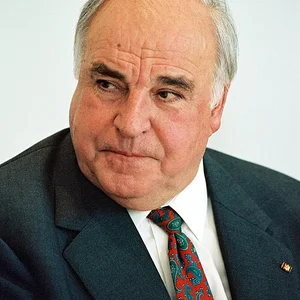

German statesman, Chancellor of the Federal Republic of Germany from 1982 to 1998. The architect of German reunification in 1990, he was also a passionate advocate of European integration and the euro.
Helmut Kohl(1930 — 2017)
Helmut Kohl
Allemagne, Troisième Reich, république de Weimar, Allemagne de l'Ouest
6 min read
Frequently asked questions
Key Facts
- Becomes Chancellor of the Federal Republic of Germany in 1982
- Steers the reunification of Germany on 3 October 1990 after the fall of the Berlin Wall (1989)
- Signs the Maastricht Treaty in 1992, laying the foundations of the European Union and the single currency
- Remains Chancellor for 16 years, until his defeat by Gerhard Schröder in 1998
- Receives the title of Honorary Citizen of Europe in 1998 for his role in European integration
Works & Achievements
Kohl's major achievement: the peaceful reunion of West Germany and East Germany into a single democratic state, in less than a year.
A roadmap presented to the Bundestag to overcome Germany's division, which outpaced the course of unfolding history.
The extension of the Deutsche Mark to East Germany, a decisive economic step that made reunification irreversible.
Kohl was one of the chief architects of this treaty that founded the European Union and the future single currency.
Kohl championed with conviction the abandonment of the Deutsche Mark in favour of the euro, which he saw as a guarantee of European peace and unity.
With Mitterrand and then Chirac, Kohl consolidated the Franco-German engine of European integration.
Anecdotes
Nicknamed *the giant of the Palatinate* because of his towering height (1.93 m) and heavy build, **Helmut Kohl** physically impressed those he dealt with. His opponents often underestimated him intellectually, and he cleverly used this to win negotiations.
Kohl adored a dish from his native region, *Saumagen* (stuffed pig's stomach), which he served to visiting foreign leaders. He notably offered it to **Mikhail Gorbachev** and to many heads of state, turning this peasant dish from the Palatinate into a tool of diplomacy.
In September 1984, at Verdun, **Helmut Kohl** and French President **François Mitterrand** spontaneously held hands for several minutes in front of the Douaumont ossuary. This image came to symbolize Franco-German reconciliation and travelled around the world.
When the Berlin Wall fell on **9 November 1989**, Kohl was on an official visit to Poland. He immediately cut short his trip to return to Germany, realizing that a historic window had just opened for reunification.
Late in his career, Kohl was caught up in a scandal over secret funding of his party, the **CDU**. He refused to reveal the names of the donors in the name of a “word of honour” he had given, which tarnished the end of his political life despite his historic role.
Primary Sources
No one today knows what a reunified Germany will look like. But I am certain that unity will come if the German people want it.
The Federal Republic of Germany and the German Democratic Republic are establishing a monetary, economic and social union.
Through a common effort, we will soon succeed in turning Saxony-Anhalt, Brandenburg, Saxony, Thuringia and Mecklenburg-Western Pomerania into flourishing landscapes.
United Germany shall comprise the territory of the Federal Republic of Germany, the German Democratic Republic and the whole of Berlin.
Key Places
Industrial city in the Palatinate where Kohl was born in 1930 and to which he remained deeply attached throughout his life.
Seat of West Germany's executive power, where Kohl governed from 1982 until the capital was moved to Berlin.
Symbol of Germany's division and then of its reunification; Kohl celebrated the country's regained unity here in late 1989.
Site of the 1984 handshake between Kohl and Mitterrand, which became a symbol of Franco-German reconciliation.
A city dear to Kohl, whose imperial cathedral hosted his religious funeral in 2017.
Typical Objects

The currency of West Germany, a symbol of West German prosperity, introduced in East Germany in July 1990 to prepare for reunification.

A document allowing all East and West Germans to vote together for the first time in December 1990.

A peasant specialty from the Palatinate made of stuffed pig's stomach, which Kohl served to visiting foreign leaders.

An agreement signed in 1990 between the two Germanys and the four occupying powers, which restored full sovereignty to a united Germany.

A casual garment Kohl was fond of, contributing to his image as a man close to ordinary people despite his stature as a statesman.

A key tool in Kohl's negotiations, notably his decisive calls to Gorbachev, Bush, and Mitterrand during 1989-1990.
School Curriculum
Vocabulary & Tags
Key Vocabulary
Daily Life
Morning
As chancellor, Kohl began early by reading the press and notes from his advisers at the chancellery in Bonn. His mornings were paced by cabinet meetings and appointments with his ministers.
Afternoon
His afternoons filled up with sessions in the Bundestag, diplomatic meetings, and countless phone calls with foreign leaders. A patient negotiator, he preferred substantive discussions to grandstanding.
Evening
In the evening, Kohl gladly welcomed his guests over a meal, mixing politics with conviviality. He liked to return to his house in Oggersheim, near Ludwigshafen, to be with his family.
Food
A bon vivant, Kohl enjoyed the hearty cuisine of his native Palatinate, especially *Saumagen* served with Rhine wine. His stoutness bore witness to his taste for good food.
Clothing
On official occasions, he wore the dark suit and tie of statesmen. In private, he adopted more casual outfits, such as the cardigan, cultivating an image of a simple and approachable man.
Housing
Kohl lived in a suburban house in Oggersheim, a district of Ludwigshafen, which he kept even at the height of his power. To govern, he resided at the chancellery in Bonn, the provisional capital of West Germany.
Historical Timeline
Period Vocabulary
Liens externes & ressources
Références
Œuvres
Réunification de l'Allemagne
3 octobre 1990
Plan en dix points pour l'unité
28 novembre 1989
Union monétaire interallemande
1er juillet 1990
Traité de Maastricht
1992
Introduction de l'euro
1999-2002
Approfondissement du couple franco-allemand
1982-1998