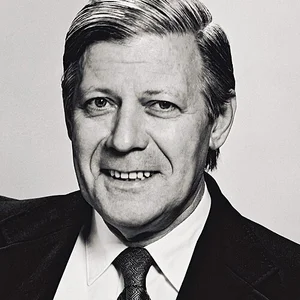

German statesman and Social Democrat (SPD), he served as Chancellor of the Federal Republic of Germany from 1974 to 1982. A pragmatist, he defined his tenure through his handling of economic crises and domestic terrorism.
Helmut Schmidt(1918 — 2015)
Helmut Schmidt
Allemagne
5 min read
Frequently asked questions
Famous Quotes
« Anyone who has visions should go see a doctor.»
Key Facts
- Chancellor of the Federal Republic of Germany from 1974 to 1982, succeeding Willy Brandt
- Managed the Red Army Faction terrorist crisis during the “German Autumn” of 1977
- Confronted the oil shocks of 1973 and 1979 with a policy of economic rigor
- Together with Valéry Giscard d'Estaing, launched the European Monetary System (EMS) in 1979 and the G7 summits
- Backed NATO's Double-Track Decision (1979) on Euromissiles, a source of tensions within the SPD
Works & Achievements
Heroic, improvised coordination of the relief effort that saved thousands of lives and revealed his talent as a crisis manager.
Together with Giscard d'Estaing, he established the regular summits of the major economies, which became the G7.
An exchange-rate stability mechanism co-created with France, a major milestone toward monetary integration and the euro.
A combination of deploying Euromissiles and offering disarmament negotiations, which left a lasting mark on the Cold War.
A firm response to the wave of RAF terrorism, including the rescue of the Landshut flight hostages by the GSG 9.
Major political memoirs in which he analyzes the great leaders and issues of his time.
For more than thirty years, he shaped German public debate through his editorials and essays.
Anecdotes
During the great Hamburg flood of February 1962, Helmut Schmidt, then the city senator in charge of police, took command of the rescue operations. He did not hesitate to requisition the federal army and NATO units without legal authorization to do so, saving thousands of lives. This crisis management made him famous throughout Germany.
An inveterate smoker, Schmidt lit up menthol cigarettes even on television sets and during official meetings. When the ban on smoking in public places was tightened in Germany, he kept smoking publicly, becoming something of an icon of quiet defiance until his death at the age of 96.
In October 1977, during the “German Autumn,” Schmidt refused to give in to the demands of the Red Army Faction (RAF), which had kidnapped employers' association leader Hanns Martin Schleyer. When a Palestinian commando hijacked the “Landshut” airliner and flew it to Mogadishu, he ordered the GSG 9 special forces to storm the plane, and they freed the hostages. Schleyer, sadly, was murdered by the RAF.
A talented pianist, Schmidt recorded concertos by Mozart and Bach with professional orchestras. Music remained an essential refuge for him from the pressures of power.
After leaving the chancellery, Schmidt became co-publisher of the weekly newspaper Die Zeit in 1983, extending his influence through his writing for more than thirty years. Nicknamed “Schmidt-Schnauze” (Schmidt the Lip) for his cutting wit, he remained a voice Germany listened to.
Primary Sources
The rule of law must defend itself, but in doing so it must not abandon what defines its very nature: respect for the law.
The security of Western Europe demands a balance of forces; negotiating disarmament first requires not letting oneself fall behind.
I have always believed that governing means, above all, choosing between several evils, rarely between a good and an evil.
Key Places
Schmidt's birthplace and the setting for his political rise, notably during his handling of the 1962 flood; he lived there until his death.
Capital of West Germany and seat of the chancellery from which Schmidt governed from 1974 to 1982.
Site of the first summit of the major industrial powers (G6) in 1975, co-organized by Schmidt and Giscard d'Estaing.
In 1977, the GSG 9 commando unit freed the hostages of the hijacked plane “Landshut” here on Schmidt's orders.
After leaving the chancellery, Schmidt became co-publisher of the influential weekly Die Zeit in 1983.
Typical Objects

Schmidt smoked in public relentlessly, including on television sets; the pack of menthol cigarettes became an attribute inseparable from his image.

An accomplished pianist, Schmidt recorded concertos by Mozart and Bach; the instrument symbolized his inner balance in the face of power.

A native of the port city of Hamburg, Schmidt often wore a sailor's cap, a symbol of his Hanseatic roots.

Schmidt also took snuff and used a small snuffbox, a gesture that became one of his famous habits.

During the “German Autumn” of 1977, coordinating the crisis units by telephone was decisive in handling the RAF terrorism.

A prolific author, Schmidt published many political and economic books, including his memoirs “Men and Powers.”
School Curriculum
Vocabulary & Tags
Key Vocabulary
Daily Life
Morning
An early riser and methodical, Schmidt began his day by carefully reading the press and his advisers' notes. He liked to work through his economic files with rigour, coffee in hand, from the very first hours.
Afternoon
His afternoons were punctuated by ministerial meetings, international summits, and negotiations. Pragmatic, he made decisions quickly and hated empty rhetoric, demanding hard figures.
Evening
In the evening, he often relaxed at the piano, playing Mozart or Bach. He frequently extended political discussions late into the night, cigarette in hand, in the company of his wife Loki.
Food
A Hanseatic devoted to the simple cuisine of northern Germany, he enjoyed no-fuss dishes. But it was above all tobacco, in the form of cigarettes and snuff, that defined his daily habits.
Clothing
Schmidt wore plain, functional suits, often topped with his famous sailor's cap evoking Hamburg. His style reflected his temperament: understated, serious, and without ostentation.
Housing
With his wife Loki, he lived in a modest house in the Langenhorn district of Hamburg, which he kept all his life. This retreat, far from any pomp, embodied his attachment to the simple bourgeois life of the north.
Historical Timeline
Period Vocabulary
Liens externes & ressources
Références
Œuvres
Gestion de l'inondation de Hambourg
1962
Sommet de Rambouillet et création du G6/G7
1975
Système monétaire européen (SME)
1978-1979
Double décision de l'OTAN
1979
Gestion de l'« automne allemand »
1977
Menschen und Mächte (Hommes et puissances)
1987
Coédition de Die Zeit
1983-2015