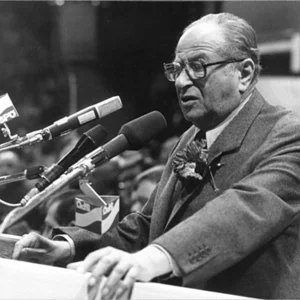

Anwar Sadat was President of Egypt from 1970 to 1981. The architect of the Yom Kippur War and then of peace with Israel, he signed the Camp David Accords and received the Nobel Peace Prize in 1978. He was assassinated in 1981 by Islamists opposed to this peace.
Anwar Sadat(1918 — 1981)
Anwar Sadat
Égypte, royaume d'Égypte, République arabe unie, sultanat d'Égypte, République d'Égypte
6 min read
Frequently asked questions
Famous Quotes
« Peace is much more precious than a piece of land.»
Key Facts
- 1970: succeeds Nasser as President of Egypt
- 1973: launches the Yom Kippur War against Israel
- 1977: travels to Jerusalem, an unprecedented gesture by an Arab leader
- 1978: signs the Camp David Accords and receives the Nobel Peace Prize
- 1981: assassinated during a military parade in Cairo
Works & Achievements
A surprise offensive against Israel that, despite its uncertain military outcome, shattered the myth of Israeli invincibility and restored pride to the Arab world.
A major decision that reoriented Egypt away from the Soviet alliance and toward the United States, upsetting the Cold War balance in the Middle East.
An economic opening that ended Nasserite socialism, encouraging private and foreign investment in Egypt.
A bold diplomatic gesture that launched the peace process and broke a thirty-year-old taboo in the Arab world.
A peace framework negotiated with Israel under American mediation, which earned Sadat the Nobel Peace Prize.
The first peace treaty between Israel and an Arab country; Egypt recovered the Sinai but was isolated from the Arab world.
A memoir in which Sadat traces his journey from a young imprisoned nationalist to a head of state who became an architect of peace.
Anecdotes
On 19 November 1977, Sadat made an unprecedented gesture: he traveled in person to Jerusalem and delivered a speech before the Knesset, the Israeli parliament. No Arab leader had ever recognized Israel in such a spectacular way, which stunned the entire world.
In his youth, Sadat was imprisoned several times by the British for his nationalist activities against the occupation of Egypt. It was in prison that his political ideas matured, and he later described cell 54 as a formative experience.
Sadat launched the Yom Kippur War in October 1973 by attacking during the Jewish holiday of Yom Kippur, taking the Israeli army by surprise. Even though Egypt did not win militarily, the crossing of the Suez Canal restored immense pride to the Arab world.
In 1978, Sadat was awarded the Nobel Peace Prize jointly with Israeli Prime Minister Menachem Begin, following the Camp David Accords negotiated under the auspices of American President Jimmy Carter over thirteen days.
Sadat was assassinated on 6 October 1981 during a military parade celebrating the 1973 war, gunned down by Islamist soldiers who leapt from a truck. His successor Hosni Mubarak, wounded that day, survived him and led Egypt for thirty years.
Primary Sources
I have come to you so that together we may build a lasting peace founded on justice. None of us should shed, or cause the shedding of, the blood of a single soldier.
The parties undertake to recognize each other's right to live in peace within secure and recognized boundaries.
I discovered in prison, in Cell 54, that true freedom is inner freedom and that no jailer can chain it.
The state of war between the two countries ends and peace is established between them upon the entry into force of this treaty.
Key Places
Village in the Nile Delta where Sadat was born in 1918. He returned there regularly and maintained a deep attachment to his rural origins.
Capital of Egypt, seat of the presidency and of the Military Academy where Sadat was trained. The center of his power for eleven years.
American presidential retreat in Maryland where the 1978 peace accords were negotiated, under the mediation of Jimmy Carter.
In November 1977, Sadat delivered his historic speech here before the Israeli parliament, becoming the first Arab leader to publicly recognize Israel.
Strategic waterway crossed by the Egyptian army during the Yom Kippur War in 1973, a feat that restored Sadat's prestige.
Monument near which the parade of 6 October 1981 was held; Sadat was assassinated there and is buried there, facing the site of his death.
Typical Objects

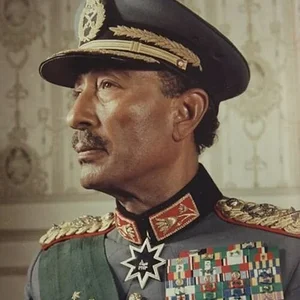
Ceremonial military attire adorned with decorations, which Sadat wore during parades and official ceremonies. It was in uniform that he was assassinated in 1981.
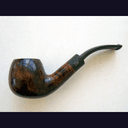
Sadat was often photographed with a pipe in his mouth, an image that became a defining trait of his public persona and his thoughtful demeanor.
📷 CC BY-SA 3.0 · Wikimedia Commons ↗
An award received in 1978 for the Camp David Accords. It symbolizes his transformation from war leader into peacemaker.

The pen used to sign the 1979 peace treaty on the White House lawn, which became a symbol of the Israeli-Egyptian reconciliation.

A small staff of command that Sadat, a former officer, sometimes held during parades. A traditional emblem of military authority inherited from the British army.
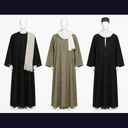
A long traditional Egyptian tunic that Sadat liked to wear in his native village, displaying his attachment to his peasant roots.
📷 CC0 · Wikimedia Commons ↗School Curriculum
Vocabulary & Tags
Key Vocabulary
Tags
Daily Life
Morning
An early riser, Sadat liked to begin his day with a walk through his native village or around his residences. He would then devote the morning to government meetings and to reading state files.
Afternoon
His afternoons were paced by official audiences, diplomatic meetings, and discussions with his ministers. In times of crisis, as in 1973, he spent long hours at military headquarters.
Evening
In the evening, Sadat enjoyed retreating with his family or meditating. A devout man, he placed great importance on prayer and personal reflection, a legacy of his years in prison.
Food
Sadat followed a simple and frugal diet, attached to Egyptian peasant cooking such as foul (fava beans) and bread. He was known for his moderation at the table.
Clothing
In public, he alternated between the ceremonial military uniform covered in decorations and the elegant Western suit. In his village, he gladly donned the traditional galabeya.
Housing
As president, he resided in palaces and official residences in Cairo and elsewhere in Egypt, but kept a house in his village of Mit Abu al-Kom, where he loved to recharge.
Historical Timeline
Period Vocabulary
Liens externes & ressources
Références
Œuvres
Guerre du Kippour (guerre d'Octobre)
1973
Expulsion des conseillers soviétiques
1972
Politique de l'Infitah
1974
Visite à Jérusalem et discours à la Knesset
1977
Accords de Camp David
1978
Traité de paix israélo-égyptien
1979
In Search of Identity (autobiographie)
1977