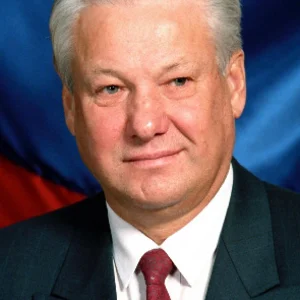

Russian statesman, first President of the Russian Federation (1991-1999). A key figure in the fall of the USSR, he opposed the August 1991 coup before leading Russia's transition to a market economy.
Boris Yeltsin(1931 — 2007)
Boris Yeltsin
Russie, Union soviétique
6 min read
Frequently asked questions
Key Facts
- Elected President of the Russian Soviet Federative Socialist Republic in June 1991
- Opposed the coup by communist hardliners in August 1991, standing atop a tank in Moscow
- Signed the Belovezha Accords (December 1991) formalizing the dissolution of the USSR
- Led the economic liberalization reforms (shock therapy) during the 1990s
- Resigned on 31 December 1999, naming Vladimir Putin as his successor
Works & Achievements
By leading the civilian opposition to the conservative coup d'état, Yeltsin saved the democratic reforms and hastened the fall of the Soviet regime.
Co-signing of the act that dissolved the USSR and established the Commonwealth of Independent States, redrawing the map of Eastern Europe.
Launch of price liberalization and massive privatizations to shift Russia to a market economy, at the cost of a deep social crisis.
Adoption of a new fundamental law establishing a strong presidential system, still in force today.
Victory over the Communist candidate, which ensured the continuity of the post-Soviet path despite his approval ratings being at an all-time low.
Autobiographical works in which Yeltsin sets out his view of the upheavals at the end of the USSR and the birth of Russia.
An early resignation arranging a peaceful succession, a major event that lastingly shaped 21st-century Russia.
Anecdotes
In August 1991, during the coup attempt by communist conservatives against Gorbachev, Boris Yeltsin climbed onto a tank in front of the White House (the Russian Parliament) in Moscow and rallied the crowd. This image traveled around the world and came to symbolize the successful resistance against the coup plotters.
Yeltsin was known for his problems with alcohol, which led to embarrassing episodes. In 1994, during a stopover at Shannon Airport in Ireland, the Irish Prime Minister waited in vain on the tarmac: Yeltsin, indisposed, never came off the plane.
In December 1991, Yeltsin signed the Belovezha Accords with the leaders of Ukraine and Belarus at a hunting lodge tucked away in a Belarusian forest. This document declared the end of the USSR and created the CIS, catching off guard Gorbachev, who was still president of the Union.
In October 1993, during a serious conflict with the Parliament, which was rejecting his reforms, Yeltsin had tanks fire their cannons on the White House—the very building he had defended two years earlier. The crisis left several hundred people dead.
On December 31, 1999, in a surprise televised New Year's Eve address, Yeltsin announced his resignation and asked the Russian people for forgiveness for the hardships of the transition. He handed power to a still little-known Prime Minister: Vladimir Putin.
Primary Sources
We are dealing with a reactionary, unconstitutional coup attempt… We call upon the citizens of Russia to give a fitting response to the coup plotters and to demand that the country be restored to lawful order.
The Union of Soviet Socialist Republics, as a subject of international law and a geopolitical reality, ceases to exist.
I am leaving. I have done everything I could… I ask your forgiveness, for many of our shared dreams did not come true.
The Russian Federation is a democratic federal law-governed state with a republican form of government.
Key Places
Village in the Urals where Boris Yeltsin was born in 1931 into a peasant family. The industrial Ural region shaped the beginning of his career.
Yeltsin trained here as an engineer and led the regional Communist Party before rising to Moscow. This was his original political stronghold.
Seat of Russia's legislative power, the scene of Yeltsin's resistance to the 1991 coup and later of the shelling he ordered in 1993. An emblematic site of his two major crises.
Center of Russian power where Yeltsin held the presidency from 1991 to 1999. It was from here that he steered the post-Soviet transition.
Nature reserve where the agreements formalizing the dissolution of the USSR were signed in December 1991. Here Yeltsin sealed the end of the Union together with the Ukrainian and Belarusian leaders.
Prestigious Moscow necropolis where Boris Yeltsin was buried after his death in 2007. His grave is topped by a monument in the colors of the Russian flag.
Typical Objects

During the 1991 coup attempt, Yeltsin climbed onto a tank in front of the White House to call for resistance. The military vehicle paradoxically became a symbol of the defense of democracy.

The white-blue-red flag, banned during the Soviet era, was reinstated by Yeltsin as the emblem of the new Russia. It replaced the red flag bearing the hammer and sickle.

Distributed to all citizens in 1992-1993, these coupons represented a share of the state assets to be privatized. Many were bought up cheaply, contributing to the rise of the oligarchs.

Yeltsin governed extensively by decree to bypass a hostile Parliament. The ukase, a document signed by his own hand, became a central instrument of his power.

The Russian currency went through runaway inflation and then a redenomination in 1998. Its collapse during the financial crisis left a lasting mark on the memory of Russians.

It was during a New Year's televised address that Yeltsin announced his resignation. Television, omnipresent in 1990s Russia, was his main link with the people.
School Curriculum
Vocabulary & Tags
Key Vocabulary
Daily Life
Morning
As president, Yeltsin often started his days late, his declining health forcing him into an irregular schedule. His mornings were devoted to meetings at the Kremlin and reading notes from his advisers and the security services.
Afternoon
Afternoons were spent receiving ministers, signing decrees, and negotiating with deputies or regional leaders. The recurring crises of the 1990s made his schedule unpredictable.
Evening
In the evening, Yeltsin sometimes received foreign heads of state or retreated to his government dacha on the outskirts of Moscow. A lover of the banya (the Russian sauna) and of good company, he tended to his political relationships there.
Food
Traditional Russian cuisine featured at his table: soups such as borscht, meats, fish, and zakuski (hors d'oeuvres). His alcohol consumption, vodka in particular, was notorious and caused several public incidents.
Clothing
In public, Yeltsin wore the dark suit and tie of the statesman, broad-shouldered and commanding in appearance. In private or while traveling, he adopted more casual attire.
Housing
Besides the official Kremlin apartments, he lived in state dachas reserved for the country's leaders, inherited from the Soviet nomenklatura. Surrounded by forests, these residences offered quiet and privacy.
Historical Timeline
Period Vocabulary
Liens externes & ressources
Références
Œuvres
Résistance au putsch d'août
1991
Accords de Belaveja et création de la CEI
1991
Thérapie de choc économique
1992
Constitution de la Fédération de Russie
1993
Réélection présidentielle de 1996
1996
Mémoires (Jusqu'au bout / Mémoires d'un président)
1994
Transmission du pouvoir à Vladimir Poutine
1999