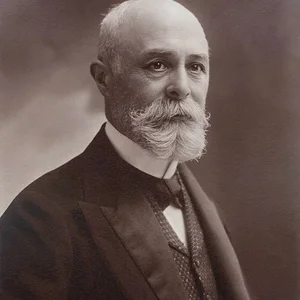

French physicist (1852–1908), Henri Becquerel discovered radioactivity in 1896 by observing that uranium salts exposed photographic plates without any exposure to light. This fundamental discovery earned him the Nobel Prize in Physics in 1903, shared with Pierre and Marie Curie.
Henri Becquerel(1852 — 1908)
Henri Becquerel
France
8 min read
Frequently asked questions
Key Facts
- 1852: born in Paris into a family of physicists (his father and grandfather were also scientists)
- 1896: accidental discovery of radioactivity by leaving uranium salts on photographic plates
- 1903: Nobel Prize in Physics shared with Pierre and Marie Curie
- The unit of radioactivity, the becquerel (Bq), bears his name
- 1908: death at Le Croisic (Loire-Atlantique)
Works & Achievements
Becquerel's principal contribution to science: by proving that uranium salts spontaneously emitted radiation without any external energy source, he opened an entirely new field of physics that would lead to nuclear physics and the theory of atomic disintegration.
A series of publications in the Comptes Rendus de l'Académie des sciences, in which Becquerel demonstrated that the radiation penetrated matter, ionized air, and could be deflected by a magnetic field, thereby distinguishing between different types of radiation.
Becquerel proved that certain radioactive emissions (the future "beta rays") were deflected by a magnet, confirming their nature as negatively charged particles (electrons) and distinguishing them from X-rays and gamma rays.
Before his major discovery, Becquerel continued the family tradition of research into phosphorescence, infrared absorption, and the rotation of the plane of polarization of light — work that naturally led him to study uranium salts.
A lecture delivered in Stockholm in which Becquerel retraced the history of his discovery and highlighted its implications for understanding the atomic structure of matter, laying the conceptual foundations of nuclear physics.
Anecdotes
In February 1896, Becquerel was preparing an experiment to expose uranium salts to sunlight, convinced that solar light was necessary to trigger their radiation. As the Parisian sky remained overcast for several days in a row, he stored his uranium salts — wrapped in black paper — on top of photographic plates inside a drawer. When he developed the plates out of curiosity, he discovered they had been exposed without ever having seen light: radioactivity had just been discovered almost by accident.
Henri Becquerel belonged to a true dynasty of physicists: his grandfather Antoine César, his father Alexandre-Edmond, and he himself successively held the same chair of physics at the Muséum national d'Histoire naturelle in Paris. It was his father who had introduced him to the study of phosphorescence, directly steering his research toward uranium salts and their luminous behavior.
Becquerel noted with surprise that non-phosphorescent uranium salts emitted just as much radiation as phosphorescent ones. He concluded that the phenomenon was linked to the element uranium itself, not to phosphorescence. This decisive observation proved that radioactivity was an intrinsic property of matter, and not a reaction to light.
In 1901, Becquerel carried a tube of radium — on loan from Pierre and Marie Curie — in his waistcoat pocket. After a few hours, a burn appeared on his skin where the tube had rested. He reported the incident to Pierre Curie, who deliberately reproduced the experiment on his own arm: it was one of the very first recorded observations of the harmful effects of ionizing radiation on the human body.
At the Nobel ceremony in Stockholm in December 1903, Becquerel shared the prize with Pierre and Marie Curie — a historic first, as no married couple had ever been honored together with this distinction. Becquerel had opened the door in 1896, but it was the Curies' tireless work in isolating polonium and radium that had confirmed and greatly expanded his foundational discovery.
Primary Sources
Plates coated with various phosphorescent substances were placed on photographic plates wrapped in black paper. Among the substances studied, uranium salts produced notable impressions, independently of any prior light excitation.
Subsequent experiments established that the radiations emitted by uranium salts persist in complete darkness and do not diminish over time, unlike ordinary phosphorescence, which fades rapidly.
The radiation emitted by radium salts and uranium compounds can be deflected by an intense magnetic field, demonstrating that these rays consist of electrically charged particles, distinct from Röntgen's X-rays.
The discovery of these new radiations has opened an entirely new field of investigation whose scientific consequences are far from exhausted. They reveal a property of matter hitherto unknown: the spontaneous and continuous emission of energy.
Key Places
Becquerel's main workplace, where three generations of his family held the chair of physics. It was in this laboratory that he conducted his landmark experiments on radioactivity in 1896.
The prestigious grande école where Becquerel studied from 1874 and later taught applied physics. The rigorous mathematical and experimental training of the École Polytechnique shaped his scientific method.
The institution where Becquerel presented his discoveries in the Comptes Rendus and was elected a member in 1889, then president in 1908. The crowning venue of his entire scientific career.
The city where Becquerel received the Nobel Prize in Physics in December 1903, jointly with Pierre and Marie Curie, for the discovery of spontaneous radioactivity.
The Breton seaside resort where Henri Becquerel died on 25 August 1908 during a period of rest, at the age of 55, leaving behind a body of scientific work that would lay the foundations of twentieth-century nuclear physics.
Typical Objects

The central tool of the discovery of radioactivity: Becquerel used plates coated with silver bromide to detect invisible radiation emitted by uranium salts, which exposed the plates even when wrapped in opaque paper.

Chemical compounds containing uranium that Becquerel studied for their phosphorescence; it was while observing them that he discovered the spontaneous emission of radiation, a fundamental property tied to the uranium atom itself.

An instrument for measuring static electricity that Becquerel used to quantify the ionization of air produced by uranic rays, enabling a precise measurement of their intensity.

A device Becquerel used to demonstrate that uranic rays could be deflected by a magnetic field, proving their corpuscular nature and distinguishing them from X-rays.

A container used to store and transport radioactive substances; it was while carrying such a tube of radium in his pocket that Becquerel noticed the first radiation burns on his skin.

The register in which Becquerel meticulously recorded each experiment, along with its conditions, materials, and observations, in keeping with the family tradition of scientific rigor inherited from his father and grandfather.
School Curriculum
Vocabulary & Tags
Key Vocabulary
Daily Life
Morning
Becquerel began his day early in his laboratory at the Muséum national d'Histoire naturelle, preparing his experiments with great care. He recorded every observation in laboratory notebooks — atmospheric conditions, materials used, results obtained — as a faithful heir to a family tradition of experimental rigour passed down through three generations.
Afternoon
In the afternoons, he wrote scientific papers for the Comptes Rendus de l'Académie des sciences and attended the Academy's weekly sessions, where discoveries were presented and debated by the foremost French scientists. He also supervised his students and corresponded with foreign physicists such as Röntgen and the Curies.
Evening
In the evenings, Becquerel returned to his family in their Parisian apartment, living the cultivated bourgeois life of a grande école professor during the Belle Époque. He regularly attended academic dinners and receptions that marked the rhythm of Parisian intellectual life, moving in the circles of the École polytechnique and the Académie des sciences.
Food
Like the Parisian bourgeoisie of his time, Becquerel enjoyed a plentiful and varied diet: multi-course meals featuring meats, fish, seasonal vegetables, cheeses, and table wines. Family dinners were important social occasions, and meals with his fellow academicians often served as opportunities for informal scientific exchange.
Clothing
Becquerel wore the understated and dignified attire of a Belle Époque academician: a black frock coat for official occasions, a lounge suit for everyday life, a stiff white collar, and a cravat. In his laboratory, he wore an apron or smock to protect his clothes — the concept of protection against radiation did not yet exist.
Housing
Becquerel lived in a bourgeois apartment in the 5th arrondissement of Paris, close to the Muséum national d'Histoire naturelle where his family had been established for several generations. His home reflected the comfort of the upper middle class: dark wood furniture, a well-stocked library, a reception room, and a private study for his scientific reading.
Historical Timeline
Period Vocabulary
Liens externes & ressources
Références
Œuvres
Découverte de la radioactivité naturelle
1896
Série de mémoires sur les propriétés des rayons uraniques
1896–1900
Démonstration de la déviation magnétique des rayons bêta
1900
Travaux sur la phosphorescence et la lumière polarisée
1878–1895
Conférence Nobel de physique
11 décembre 1903