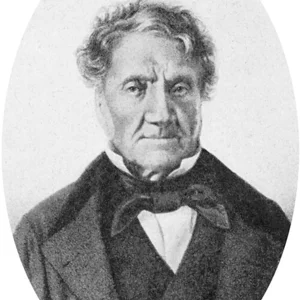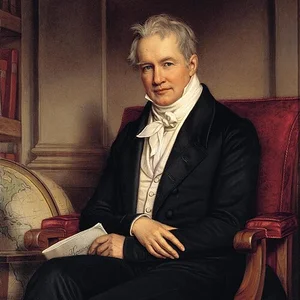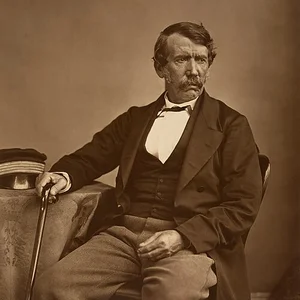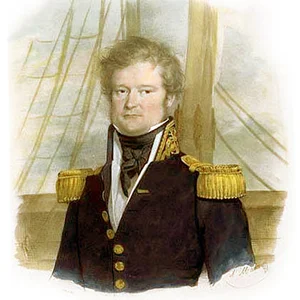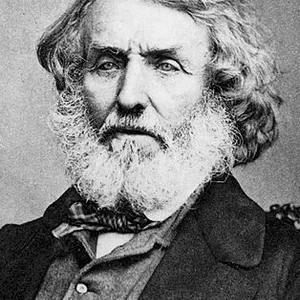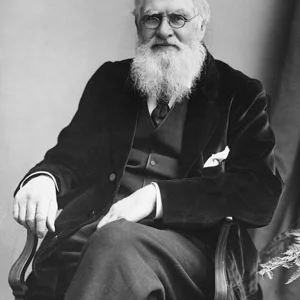

British naturalist and geographer (1823-1913), Wallace independently developed the theory of natural selection alongside Darwin. His explorations in the Amazon and Southeast Asia led him to formulate fundamental laws in biogeography.
Alfred Russel Wallace(1823 — 1913)
Alfred Russel Wallace
Royaume-Uni de Grande-Bretagne et d'Irlande
8 min read
Frequently asked questions
Famous Quotes
« Nature is the great laboratory where living forms are shaped.»
« If we wish to improve the condition of humanity, we must begin by improving society itself.»
Key Facts
- 1848: Departure for the Amazon, his first major naturalist expedition
- 1858: Sending Darwin his essay on natural selection, leading to the joint publication of the theory
- 1859: Beginning of eight years of exploration in Southeast Asia (the Malay Archipelago)
- 1876: Publication of 'The Geographical Distribution of Animals', a founding work in biogeography
- 1868: Definition of the Wallace Line separating Asian and Australasian fauna
Works & Achievements
An account of his Amazonian expedition, written despite the loss of most of his notes in the fire aboard the Helen. This first work already reveals his interest in the geographical distribution of species.
The founding essay, sent to Darwin from Ternate, which independently formulated the principle of natural selection and was read alongside Darwin's own papers at the Linnean Society.
A masterpiece of Victorian natural history writing, this account of eight years of exploration describes the fauna, flora, and peoples of the Indonesian archipelago, and sets out the famous Wallace Line in biogeography.
A founding treatise of modern biogeography, systematically mapping the worldwide distribution of animals into major faunal regions that ecologists still use today.
A pioneering study of island fauna, exploring the mechanisms of colonisation and species isolation on islands, anticipating many concepts central to contemporary island ecology.
A clear-headed synthesis and rigorous defence of Darwinian theory, written after Darwin's death to answer critics and explain the mechanisms of evolution to a broad audience.
An autobiography in which Wallace looks back on his expeditions and discoveries, as well as his social, political, and spiritual commitments, offering a first-hand account of the Victorian era.
Anecdotes
In 1852, after four years spent collecting thousands of specimens in the Amazon, Wallace watched his ship catch fire in the middle of the Atlantic. He lost nearly his entire collection — insects, fish, birds — in the flames. He survived on a raft for ten days before being rescued, saving only a few notes and sketches. Far from being discouraged, he set off on another expedition two years later, this time to Southeast Asia.
In February 1858, bedridden with a high fever on the island of Ternate (in present-day Indonesia), Wallace had a sudden insight while reflecting on Malthus's work on overpopulation: individuals best adapted to their environment survive and reproduce more. In a matter of hours he drafted an essay laying out this principle of natural selection and sent it to Darwin. That letter hastened the publication of On the Origin of Species.
While traveling through the Malay Archipelago, Wallace noticed that the animals east of Bali and west of Lombok were radically different, as if an invisible boundary separated two distinct faunal worlds. This imaginary line, spanning a strait of only 35 km, was named the “Wallace Line” by scientists. It remains one of the most famous biogeographical boundaries in the world.
Unlike Darwin, who long avoided controversy, Wallace openly and publicly championed the theory of evolution, going so far as to title his 1889 work simply “Darwinism.” He readily acknowledged that Darwin had worked more deeply and for longer on the subject — a rare display of humility from a scientist whose own scientific priority was nonetheless beyond dispute.
Wallace was one of the first prominent scientists to take up social causes: he advocated for land access for the poor, sharply criticized compulsory vaccination (out of distrust of official statistics), and embraced spiritualism. These positions brought him controversy, but they reveal a figure far more complex than a simple armchair naturalist.
Primary Sources
The life of wild animals is a struggle for existence. The full exertion of all their faculties and all their energies is required to preserve their own existence and provide for that of their infant offspring.
I have myself felt the danger of this error, in having unconsciously assumed the constancy of species when reasoning upon the diversities of form and colour which they exhibit.
Natural selection is not a force in the ordinary sense of the word; it is rather the name we give to the result of a series of natural processes which lead to the preservation of the best-adapted individuals.
I was then living at Ternate, a small volcanic island... I thought of Malthus's 'Principles of Population'... and it suddenly flashed upon me that this self-acting process would necessarily improve the race.
I have been so repeatedly struck by the utter inability of numbers of intelligent persons to see clearly, or at all, the self-acting and necessary effects of Natural Selection.
Key Places
Wallace's birthplace in 1823, a small Welsh town where he spent his childhood before his family's financial difficulties cut short his education.
Between 1848 and 1852, Wallace explored the Brazilian Amazon, collecting thousands of specimens and forming his earliest thoughts on the geographical distribution of species.
It was on this volcanic island that Wallace, struck down by fever, wrote his 1858 essay on natural selection — the paper that would transform the history of natural science.
On 1 July 1858, the essays by Darwin and Wallace on natural selection were read jointly before this learned society, marking the official birth of the theory of evolution.
Singapore served as the departure and return point for many of Wallace's expeditions across the archipelago between 1854 and 1862, acting as a staging post for shipping his collections to British museums.
Wallace settled here in his final years and died in 1913 at the age of 90, having devoted his old age to writing and to social and political causes.
Typical Objects

An indispensable tool for Wallace on his expeditions, it allowed him to capture thousands of insects, particularly butterflies, and several newly discovered species still bear his name today.

Used to kill and preserve insects without damaging their wings or colors, this airtight jar was the essential companion to the net in every Victorian naturalist-traveler's kit.

Wallace recorded his field observations, measurements, and sketches on a daily basis; his Malay notebooks stand as a first-rate scientific and ethnographic source.

Nineteenth-century naturalists shot birds to prepare museum specimens; Wallace used his shotgun to build ornithological collections representing the species of each island he visited.

A reinforced wooden chest containing cork, entomological pins, and compartments for storing dried bird skins or mounted insects, designed to withstand sea voyages and tropical humidity.

Wallace relied on imprecise nautical charts that he corrected himself as he traveled, helping to map several poorly explored islands of present-day Indonesia more accurately.

A lightweight yet precise instrument, it allowed Wallace to examine the anatomical details of small invertebrates and compare structures between closely related species discovered on neighboring islands.
School Curriculum
Vocabulary & Tags
Key Vocabulary
Tags
Daily Life
Morning
On expedition in the Malay Archipelago, Wallace rose at dawn to take advantage of the cool morning air. He would head into the forest with his insect net and rifle as early as 6 a.m., accompanied by local assistants he recruited and trained to identify useful species. The early hours of the day were the most productive for catching butterflies and birds.
Afternoon
Afternoons were devoted to specimen preparation: pinning insects, carefully cleaning and stuffing bird skins, and meticulously labelling each specimen with its location, date, and capture conditions. Wallace would often work at this task until the tropical heat became unbearable, then take a short nap in keeping with local custom.
Evening
Evenings were reserved for writing: detailed scientific notes on the day's species, his personal journal, and letters sent to British naturalists (including Darwin) and to the museums that purchased his collections. Back in London, his evenings were more often spent debating at learned societies or writing his books.
Food
In Malaysia, Wallace frequently shared local food: rice, tropical fruits (he was particularly enthusiastic about durian, which he describes with great passion in *The Malay Archipelago*), dried fish, and vegetables. In England, his diet matched that of the Victorian middle class: boiled meat, puddings, strong tea, and biscuits.
Clothing
In the field, Wallace wore light cotton or linen clothing, often white or pale-coloured to cope with the heat, with wide pockets for stowing his tools and early catches. He wore a cork pith helmet to shield himself from the sun, and tall boots to guard against reptiles and insects in the undergrowth.
Housing
On expedition, Wallace lodged in local stilt houses, colonial bungalows, or shelters built by his assistants. He would systematically set aside one room as a field laboratory, equipped with his specimen boxes, tools, and notebooks. Back in London, he lived in several modest middle-class houses, ending his life in a villa in Dorset that he had built to his own tastes.
Historical Timeline
Period Vocabulary
Liens externes & ressources
Références
Œuvres
Narrative of Travels on the Amazon and Rio Negro
1853
On the Tendency of Varieties to Depart Indefinitely from the Original Type
1858
The Malay Archipelago
1869
The Geographical Distribution of Animals
1876
Island Life
1880
Darwinism: An Exposition of the Theory of Natural Selection
1889
My Life: A Record of Events and Opinions
1905