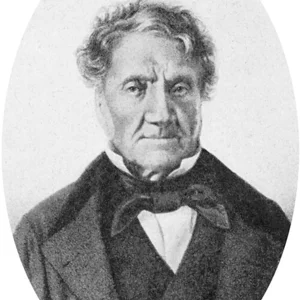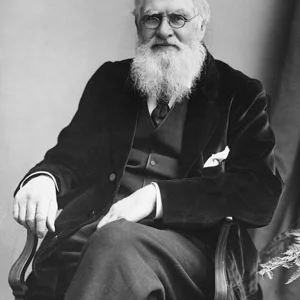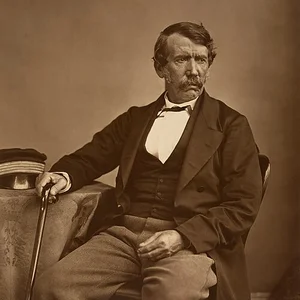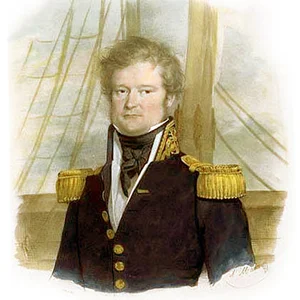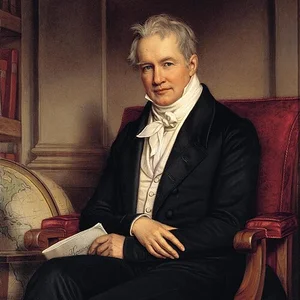

German naturalist, geographer, and explorer (1769–1859), he carried out a monumental expedition to Latin America (1799–1804) that revolutionized the natural sciences. A pioneer of modern geography and ecology, he was one of the last great universal scholars.
Alexander von Humboldt(1769 — 1859)
Alexander von Humboldt
royaume de Prusse
9 min read
Frequently asked questions
Famous Quotes
« Nature is a living whole, animated, in which all its parts are interconnected.»
« The cruelest and most barbarous peoples on earth are those who have the least contact with other peoples.»
Key Facts
- 1769: born in Berlin
- 1799–1804: expedition to South America and Central America with Aimé Bonpland
- 1802: ascent of the Chimborazo volcano (Ecuador), a world altitude record at the time
- 1807: publication of Essay on the Geography of Plants, a founding work of phytogeography
- 1845–1862: publication of Cosmos, an encyclopedic synthesis of knowledge about the natural world
Works & Achievements
A scientific monument in 30 illustrated volumes, documenting the expedition to Latin America with Aimé Bonpland. This colossal work revolutionized botany, geography, geology, and climatology, and profoundly influenced Darwin and many naturalists of the nineteenth century.
A founding work of phytogeography and modern ecology, accompanied by the famous *Tableau physique des Andes*. Humboldt demonstrates that the distribution of plant life follows climatic and altitudinal zones, and that nature forms an interconnected whole.
A collection of descriptions that are at once poetic and scientific, covering the great natural landscapes of the globe. Translated into many languages, this book made Humboldt an international celebrity and inspired an entire generation of travelers, writers, and painters.
A geographical, economic, and social analysis of colonial Mexico, richly documented with statistics and detailed maps. This work provided Latin American independence movements with geographical and demographic arguments, making Humboldt a hero to American patriots.
A masterpiece of nineteenth-century scientific thought in 5 volumes, attempting a unified synthesis of all knowledge about the physical universe. Humboldt demonstrates the interdependence of all natural phenomena, foreshadowing ecology and systems thinking.
Anecdotes
In June 1802, Humboldt attempted to climb Chimborazo in Ecuador, then considered the highest peak in the world. He reached an altitude of 5,878 meters — a world record at the time — before being stopped by a crevasse. Despite severe symptoms of altitude sickness, he continued taking scientific measurements throughout the ascent, which allowed him to develop his theory on the altitudinal zonation of vegetation.
On his return to Europe in 1804, Humboldt made a stop of several weeks in Washington, where he met President Thomas Jefferson. The two men shared a common passion for natural sciences and had lengthy conversations about the geography and botany of the Americas. Jefferson, himself an amateur naturalist, was deeply impressed by the breadth of the young German scholar's knowledge.
Humboldt identified the cold ocean current running along the western coast of South America by systematically measuring seawater temperature from his ship. This current, which supports the rich marine ecosystems of the South Pacific, now bears his name: the Humboldt Current. This discovery illustrates his method: turning an ordinary observation into a general scientific law.
During his Russian expedition in 1829, Humboldt predicted to the tsar that diamonds would be found in the Urals, reasoning by analogy with the geological formations he had observed in Brazil. Just a few months after his departure, diamonds were indeed discovered at the very location he had indicated, further cementing his reputation as a scientific genius.
Having arrived in South America with a considerable personal fortune inherited from his mother, Humboldt spent most of his wealth funding his expeditions and his monumental illustrated scientific publications. By the end of his life he was nearly ruined, yet he continued to correspond with hundreds of scientists around the world, answering every letter he received. It is estimated that he exchanged more than 50,000 letters over the course of his lifetime.
Primary Sources
Nature is a living whole, not a mere accumulation of organized beings. Plants, animals, and physical forces form a system whose parts are intimately connected; it is in this universal connection that the great character of the life of nature resides.
We left the coast of Spain on June 5, 1799, and on July 16 we sighted the coasts of Tierra Firme. Never had I felt such a vivid sense of nature's grandeur as in that moment, at the sight of those shores covered with dense vegetation.
The principal aim of this work is to sketch, in their most general outlines, a picture of nature in all its grandeur, to show the coexistence of phenomena and the connection of the natural forces that animate the globe.
The steppes and deserts, the virgin forests of the equator and the eternal snows of the high mountains — all contribute to awakening in us the sense of nature's infinity and the close interdependence of all phenomena.
What a fantastic wealth of vegetation! I rush through the cacao plantations, I feel so at ease in this new world. I am so happy, so giddy with joy that I cannot yet judge clearly what affects me most.
Key Places
Humboldt's birthplace, where he was born in 1769 and died in 1859. He served there as chamberlain to the King of Prussia and delivered landmark public lectures at the University of Berlin, free and open to all — men and women alike.
The first port of call in South America in July 1799, and the launching point for a five-year expedition across the tropics. Humboldt witnessed a powerful earthquake there and began his first botanical collections.
The summit Humboldt attempted to climb in 1802, whose ascent led him to develop his theory on the altitudinal zonation of vegetation, illustrated in his famous *Tableau physique des Andes*.
Humboldt spent many years in Paris after returning from the Americas, working on the publication of his 30-volume travel series. He moved in Europe's leading scientific circles and was elected to the French Académie des sciences.
The main stop on the 1829 Russian expedition commissioned by Tsar Nicholas I. Humboldt studied the geology of the Urals there and predicted the existence of diamonds in the region — a prediction confirmed just months after his departure.
Typical Objects

Humboldt used a barometer to measure atmospheric pressure and calculate altitude during his Andean ascents. With this instrument, he established an altitudinal map of vegetation, showing how plants are distributed in zones according to altitude and climate.

Essential for calculating latitude and longitude at sea and in the wilderness, the sextant allowed Humboldt to produce accurate maps of the territories he explored in Latin America, correcting many errors found in the Spanish maps of the time.

Humboldt was fascinated by terrestrial magnetism and always carried instruments to measure the intensity and inclination of the magnetic field. His readings taken at numerous points across the globe laid the foundations of modern geomagnetism.

Together with his botanical companion Aimé Bonpland, Humboldt collected more than 60,000 plant specimens in South America. The herbarium press allowed plants to be dried and preserved between sheets of paper for transport to European laboratories.

While sailing along the coast of Peru, Humboldt used a thermometer to measure water temperature at various depths and distances from shore, allowing him to identify and scientifically describe the cold current that bears his name today.

Humboldt kept extraordinarily detailed travel notebooks throughout his expeditions, recording measurements, observations, botanical and geological sketches, as well as ethnographic notes. These notebooks, preserved in Berlin, constitute a scientific and historical source of immeasurable value.
School Curriculum
Vocabulary & Tags
Key Vocabulary
Daily Life
Morning
Humboldt rose before dawn to take his scientific measurements during the best hours of the day. On his expeditions, he devoted the early hours to astronomical observation and to barometric and magnetic readings, meticulously recording data in his notebooks before even sitting down to his first meal.
Afternoon
Afternoons were dedicated to botanical and geological excursions in the surroundings of the camp or the day's stopping point. Humboldt would collect plant specimens with Bonpland, gather rock samples, question local inhabitants about their natural environment, and sketch landscapes and newly discovered species with an energy his contemporaries described as prodigious.
Evening
In the evening, Humboldt wrote up the day's observations, organized the collections, and replied to his voluminous correspondence. In Paris or Berlin, evenings were often devoted to scientific salons and meetings with scholars, artists, and statesmen. He slept little — rarely more than four to five hours a night.
Food
In the field, Humboldt ate whatever the regions he traveled through had to offer: cacao, maize, plantain, and dried meat in the Venezuelan llanos. Little drawn to the pleasures of the table, he ate frugally and bore the expedition's food deprivations remarkably well. In Europe, he attended intellectuals' dinner parties without any particular ostentation.
Clothing
On expedition, Humboldt wore practical, sturdy attire: a dark cloth coat, tall boots, and a wide-brimmed hat to shield himself from the tropical sun. For high-altitude ascents such as Chimborazo, he equipped himself with thick woolen clothing. Back in Europe, he adopted the elegant dress of the scholarly gentleman — a buttoned frock coat and white cravat — suited to the royal courts he frequented.
Housing
During his five years of travel in the Americas, Humboldt slept in widely varied conditions: Franciscan missions, indigenous huts where he lay in a hammock, open-air camps deep in the jungle, and makeshift shelters high in the mountains. In Paris, he lived in a modest apartment cluttered with books and specimens. In Berlin, he resided at the royal court as a chamberlain, in an apartment his visitors described as a veritable laboratory-cum-cabinet of curiosities.
Historical Timeline
Period Vocabulary
Liens externes & ressources
Références
Œuvres
Voyage aux régions équinoxiales du Nouveau Continent
1807-1839
Essai sur la géographie des plantes
1807
Ansichten der Natur (Tableaux de la Nature)
1808
Essai politique sur le royaume de la Nouvelle-Espagne
1811
Kosmos : Essai d'une description physique du monde
1845-1862