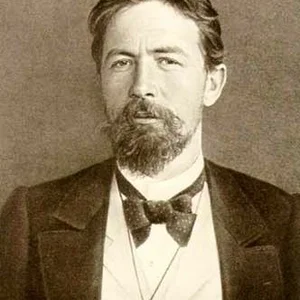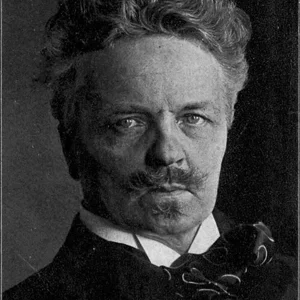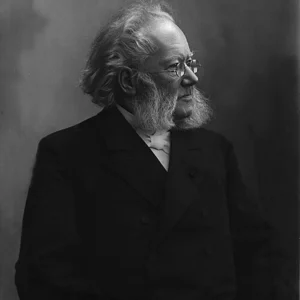

Henrik Ibsen (1828-1906) was a Norwegian playwright and poet, considered the father of modern theatre. His realist plays explore social hypocrisies and the condition of women, notably in A Doll's House.
Henrik Ibsen(1828 — 1906)
Henrik Ibsen
Norvège
6 min read
Frequently asked questions
Key Facts
- Born in 1828 in Skien, Norway
- Created Peer Gynt in 1867, a poetic drama later set to music by Grieg
- Published A Doll's House (Et dukkehjem) in 1879, a landmark play on the emancipation of women
- Wrote An Enemy of the People (1882) and Hedda Gabler (1890)
- Died in 1906 in Christiania (Oslo)
Works & Achievements
A sweeping verse drama about the uncompromising zeal of a pastor; the first major success that established Ibsen's reputation.
A rich, fantastical dramatic poem, made popular by Edvard Grieg's incidental music.
The first play of the realist cycle, exposing the lies on which bourgeois respectability rests.
A landmark work: Nora walks out on her household, raising the question of women's freedom and dignity.
A drama about hereditary disease and moral hypocrisy, long banned for its boldness.
A doctor defies his town to reveal an inconvenient truth; a reflection on the individual against the majority.
A play in which Ibsen in turn questions truth, showing that illusions are sometimes necessary in order to live.
The portrait of a complex heroine stifled by her circumstances, one of the greatest female roles in theatre.
Anecdotes
When Henrik is seven or eight years old, his merchant father's business goes bankrupt: the family, once well-off, has to leave its fine house in Skien and falls on hard times. This social downfall would mark Ibsen deeply, and throughout his life he would depict the hypocrisy and pretenses of the middle class.
As a teenager, Ibsen is placed as an apprentice with an apothecary in the small town of Grimstad. At sixteen he grinds powders and prepares remedies, but he prefers to write verse in secret and to study on his own for the university entrance exams.
On his desk, during his long stay in Italy, Ibsen kept a live scorpion under an upturned beer glass. He used to tell how, when the creature seemed sick, he would slip it a piece of soft fruit into which the scorpion would discharge its venom — and then feel better. To him, this was an image of the writer who frees himself of his inner poison by writing.
The ending of *A Doll's House*, in which Nora slams the door and abandons her husband and children, so scandalized Europe that some German theatres refused to stage it. To keep his play from being distorted, Ibsen reluctantly wrote an “alternative” ending himself, in which Nora stays — one he later called an “act of barbarism.”
In his final years in Christiania (Oslo), Ibsen was so rigorously punctual on his daily walk to the Grand Café that the townspeople said they could set their watches by his passing. Dressed in an impeccable frock coat and wearing his decorations, the great man with white side-whiskers was like a living monument.
Primary Sources
I believe that before all else I am a human being, just as much as you are — or at least that I must try to become one.
The fact is, you see, that the strongest man in the world is the one who stands most alone.
I am almost inclined to think we are all of us ghosts. It is not only what we have inherited from our parents that lives on in us, but also old dead ideas and all kinds of old, extinguished beliefs.
I thank you, but I must decline the honour of having consciously worked for the cause of women. I am not even entirely clear as to just what this movement really is. To me it has been a cause of humanity.
Key Places
Ibsen's birthplace, where his father's bankruptcy marked his childhood and fed his critical view of the bourgeoisie.
A small coastal town where the teenager worked as an apothecary's apprentice and began writing in secret.
Ibsen learned the craft of the stage at the Det norske Theater from 1851, working as both author and director.
A key location during his long voluntary exile, where he wrote works such as Brand and Peer Gynt far from Norway.
Another major stage of his exile, where he composed several of his great realist dramas.
The Norwegian capital where Ibsen returned in glory in 1891 and where he died in 1906; he was a regular at the Grand Café.
Typical Objects

Everyday tools of the playwright, who wrote his plays by hand, tirelessly crossing out and recopying his lines.

The text of his most famous play, whose ending caused such a scandal that Ibsen had to write an alternative version.

An essential part of Ibsen's impeccable attire, which he wore for his daily walks through Christiania.

Ibsen was proud of the orders and distinctions he received from several European courts and gladly displayed them on his frock coat.

The central piece of furniture for his solitary work, on which he is said to have kept a live scorpion in a glass while in Italy.

Beneath thick, bushy eyebrows, Ibsen wore spectacles that were part of his utterly unmistakable silhouette.
School Curriculum
Vocabulary & Tags
Key Vocabulary
Daily Life
Morning
In his final years in Christiania, Ibsen rose early and devoted his mornings to writing, seated at his desk with the discipline of a clockmaker. He worked slowly, crossing out a great deal, and could not bear to be disturbed.
Afternoon
In the afternoon, he left his apartment at a fixed hour to head to the Grand Café, walking so regularly that passersby said they set their watches by him. There he read the newspapers, observed the world, and savored his reputation as a national celebrity.
Evening
In the evening, more withdrawn, he returned home to dine alongside his wife Suzannah, who looked after his comfort. He read, mulled over his plays, and kept up an abundant correspondence with all of Europe.
Food
His diet was that of the Scandinavian bourgeoisie of the era: fish such as herring, simple and nourishing dishes, and coffee in abundance. At the café, he enjoyed a glass of strong spirits, cognac or aquavit.
Clothing
Ibsen took extreme care with his appearance: an impeccable black frock coat, a top hat, a waistcoat, and carefully trimmed white side-whiskers. He sometimes displayed his decorations on his chest and wore thin-rimmed spectacles.
Housing
After twenty-seven years of exile in lodgings and boarding houses across Italy and Germany, he settled into a well-appointed apartment in Christiania. The setting, comfortable and bourgeois, reflected the status of the famous writer he had become.
Historical Timeline
Period Vocabulary
Liens externes & ressources
Références
Œuvres
Les Piliers de la société
1877
Maison de poupée
1879
Les Revenants
1881
Un ennemi du peuple
1882
Le Canard sauvage
1884