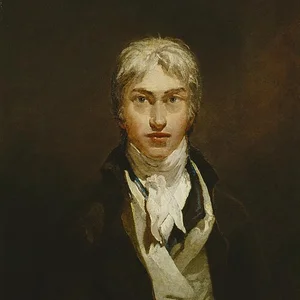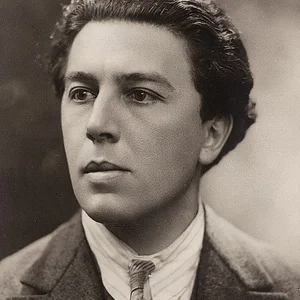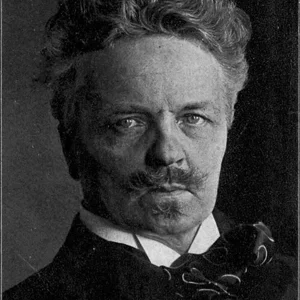

Swedish writer, playwright and painter (1849-1912), a major figure of Scandinavian literature. A pioneer of naturalism and later a forerunner of expressionism and modern theatre, he profoundly renewed European dramatic art.
August Strindberg(1849 — 1912)
August Strindberg
Suède
6 min read
Frequently asked questions
Key Facts
- Born in 1849 in Stockholm, died in 1912 in the same city.
- Published in 1879 the novel 'The Red Room', regarded as the first modern Swedish realist novel.
- Wrote the naturalist play 'Miss Julie' in 1888, accompanied by a manifesto-like preface on naturalist theatre.
- Took a mystical and experimental turn after his so-called 'Inferno' crisis (around 1894-1897), recounted in 'Inferno' (1897).
- Late works such as 'A Dream Play' (1902) foreshadowing the expressionist and symbolist theatre of the 20th century.
Works & Achievements
A satirical novel about Stockholm society that made him famous and marked a milestone in modern Swedish literature.
An autobiographical account in which he analyzes his childhood and upbringing without indulgence, in a naturalist vein.
A taut naturalist drama about marital conflict and the battle of the sexes, hailed by champions of modern theatre.
A major work of theatrical naturalism, accompanied by a preface that became a manifesto on drama and the actor's craft.
An autobiographical account of his spiritual crisis in Paris, caught between science, mysticism and anguish.
An innovative dramatic trilogy blending dream and reality, regarded as a source of expressionist theatre.
A dreamlike play in which time and space distort as in a dream, highly influential on twentieth-century theatre.
An enigmatic chamber play premiered at the Intima Teatern, foreshadowing the theatre of the absurd and expressionism.
Anecdotes
In the mid-1890s, in Paris, Strindberg went through what he called his “Inferno crisis”: convinced he could manufacture gold, he turned his hotel room into an alchemy laboratory and burned his hands from constantly handling chemicals. He also believed he was the target of invisible, persecuting forces.
Strindberg was a self-taught painter who mostly painted seascapes and storms, often using a palette knife rather than a brush, spreading the paint in thick layers. Long scorned, his canvases are today considered remarkably ahead of their time and are exhibited in major museums.
Passionate about science, he made “celestographs”: he placed photographic plates directly under the night sky, without any camera or lens, convinced he was thereby photographing the stars. The spots he obtained were in reality only dust and chemical flaws, but the experiment shows his overflowing scientific curiosity.
His play *Miss Julie* (1888) caused a scandal with its rawness and was banned or censored in several countries. Strindberg added a famous preface to it that became a true manifesto of European naturalist theatre.
In 1907, in Stockholm, he founded the *Intima Teatern* (Intimate Theatre) with the director August Falck, a tiny hall of barely 160 seats designed to perform his own plays as close to the audience as possible, like an experiment in chamber theatre.
Primary Sources
My souls (my characters) are conglomerations of past and present, scraps of books and newspapers, fragments of humanity, shreds torn from Sunday clothes turned to rags.
With a feeling of savage joy I leave Paris, as if I were tearing myself away from a cross of torture, for I have suffered in this Babel as much as a man can suffer without dying of it.
He was always afraid. Afraid of being beaten, afraid of displeasing, afraid of being in the way, afraid of existing.
He gazed at Stockholm spreading out at his feet in the smoke and fog, and he felt that everything in this city was nothing but appearance and pretense.
Key Places
Strindberg's native city, the setting of many works such as The Red Room, and the place of his death in 1912. It is also where he founded the Intima Teatern.
Strindberg pursued irregular studies here from 1867, never obtaining a degree. The university town marks the start of his intellectual life.
Site of the “Inferno crisis” in the 1890s, a period of alchemy, occultism and anguish. Paris was then the capital of the naturalist theatre that fascinated him.
Strindberg stayed here from 1892 and frequented the tavern “Zum schwarzen Ferkel”, a gathering place for avant-garde Scandinavian and German artists and writers.
A small theatre founded in 1907 to perform his chamber plays before a limited audience. Here he premiered, among others, The Ghost Sonata.
Typical Objects

Strindberg painted his storm landscapes by spreading thick layers of paint with a palette knife rather than a brush. This technique gives his canvases an almost sculpted texture.

A light-sensitive glass support used for photography at the time. Strindberg also used it for his “celestographs,” laid directly on the ground beneath the night sky.

Crucibles, retorts, and chemicals stored in his Paris room during the Inferno crisis. He hoped to transmute metals into gold there.

The everyday writing tools of an author of extraordinary productivity, who turned out novels, plays, essays, and thousands of letters. Strindberg often wrote feverishly and at great speed.

The small stage of a chamber theatre founded in 1907, designed to perform his plays as close as possible to the audience. The spare set brought the actor nearer to the spectators.

A small keyboard instrument that Strindberg was fond of and used to accompany certain performances at his intimate theatre. Music held an important place in his conception of drama.
School Curriculum
Vocabulary & Tags
Key Vocabulary
Daily Life
Morning
A tireless worker, Strindberg often set to writing early, in a feverish state, filling page after page at great speed. Depending on the period, he began the day by reading the newspapers or with his scientific experiments.
Afternoon
The afternoon might be devoted to painting seascapes, to scientific reading, or to long walks, particularly in the Stockholm archipelago he loved. During the Inferno crisis, he also carried out his chemical manipulations there.
Evening
In the evening, he frequented the cafés and artists' taverns, as in Berlin, where people discussed literature and art late into the night. In his later years, he attended rehearsals of his plays at the *Intima Teatern*.
Food
Strindberg shared the Scandinavian bourgeois diet of his time: bread, fish, potatoes, and simple dishes. A great lover of cafés, he would have coffee, beer, and wine there throughout his discussions.
Clothing
He wore the dark attire of the late-nineteenth-century man of letters: frock coat or jacket, stiff-collared shirt, necktie or *lavallière*. His thick moustache and abundant hair became a familiar image.
Housing
He led an often unstable life, frequently changing lodgings between Stockholm, Paris, Berlin, and Switzerland. At the end of his life, he settled into an apartment in Stockholm, the “Blue Tower” (*Blå tornet*), now a museum.
Historical Timeline
Period Vocabulary
Liens externes & ressources
Références
Œuvres
La Chambre rouge (Röda rummet)
1879
Le Fils de la servante (Tjänstekvinnans son)
1886
Père (Fadren)
1887
Mademoiselle Julie (Fröken Julie)
1888
Le Chemin de Damas (Till Damaskus)
1898
Le Songe (Ett drömspel)
1901