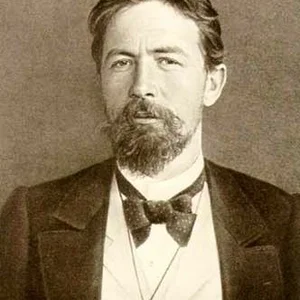

Russian writer and playwright, a master of the short story and of modern theatre. Trained as a physician, he renewed dramatic art with plays built on atmosphere and the unspoken rather than on plot, such as The Cherry Orchard and The Three Sisters.
Anton Chekhov(1860 — 1904)
Anton Chekhov
Empire russe
6 min read
Frequently asked questions
Famous Quotes
« Medicine is my lawful wife and literature is my mistress.»
« If in the first act you hang a gun on the wall, then in the last it must go off.»
Key Facts
- Born in 1860 in Taganrog, in southern Russia, into a modest family of shopkeepers.
- He graduated in medicine in Moscow in 1884 and practised while publishing short stories in the press.
- Failure then triumph of The Seagull: jeered in 1896, it was hailed in 1898 by Stanislavski's Moscow Art Theatre.
- He wrote his great plays between 1899 and 1904: Uncle Vanya, The Three Sisters (1901) and The Cherry Orchard (1904).
- Died of tuberculosis in 1904 in Badenweiler, Germany, at the age of 44.
Works & Achievements
A long short story following a child's journey across the Russian countryside, which established Chekhov as a serious, award-winning writer.
A striking short story about a doctor confined in his own asylum, read as a critique of Tsarist society.
An investigative account of the penal colony, based on his census of the prisoners, which raised public awareness of their plight.
The play that launched his theatre of atmosphere and the unspoken; a failure at its premiere, it later triumphed in Moscow.
A famous short story about an adulterous love affair in Yalta, a masterpiece of psychological subtlety.
A drama of missed opportunities and wasted lives on a country estate.
A play about three women dreaming of returning to Moscow, trapped in a provincial life.
His last play: a family of ruined nobility loses its orchard, a symbol of a world collapsing.
Anecdotes
In 1890, Chekhov undertook an extraordinary journey: he crossed the whole of Siberia by horse-drawn cart and by boat, over nearly three months, to reach the island of Sakhalin, a penal colony at the far end of the Empire. There, alone, he carried out a census of thousands of convicts, filling out thousands of cards himself, out of a sense of duty as a doctor and a citizen.
The premiere of The Seagull in Saint Petersburg in 1896 was a resounding fiasco: the audience jeered, and a humiliated Chekhov fled the theatre, swearing never to write for the stage again. Two years later, the very same play triumphed at the Moscow Art Theatre directed by Stanislavski — and the seagull went on to become that theatre's emblem.
Chekhov led a double life: “Medicine is my lawful wife, literature my mistress,” he liked to say. A qualified doctor, he treated poor peasants for free, had schools built, and fought the cholera epidemic of 1892, all while writing his short stories and plays.
Stricken with tuberculosis, Chekhov died in 1904 at a German spa town. According to his wife Olga, he drank a glass of champagne, declared in German “Ich sterbe” (“I am dying”), lay down, and quietly passed away.
The ultimate irony for a writer: his body was brought back from Germany to Moscow in a refrigerated railway car bearing the label “Fresh Oysters.” The writer Maxim Gorky, present at the funeral, was deeply outraged by it.
Primary Sources
Medicine is my lawful wife and literature my mistress. When I get tired of one, I spend the night with the other.
Don't tell me the moon is shining; show me the glint of light on broken glass.
Life has gone by, as if I had never lived… I'll lie down a while… You have no strength left, nothing is left, nothing…
Sakhalin is a place of unbearable suffering, such as only man, whether free or in chains, is capable of enduring.
To Moscow! To Moscow! To Moscow!
Key Places
Russian port on the Sea of Azov where Chekhov was born in 1860 and spent an austere childhood in his father's grocery shop.
Intellectual capital where Chekhov studied medicine and built his career as a writer. His plays triumphed there at the Art Theatre.
Remote penal colony in the Pacific, where Chekhov conducted a survey on the condition of the convicts in 1890.
Country estate near Moscow where Chekhov lived from 1892 to 1899, treating the peasants and having schools built.
Crimean seaside resort where Chekhov, suffering from tuberculosis, had the “White Dacha” built to treat his lungs.
Small German spa town where Chekhov died of tuberculosis in July 1904.
Typical Objects

An instrument used to listen to patients' hearts and lungs. Chekhov, a country doctor, examined thousands of peasants, often without charging them.

Small armless spectacles that pinch onto the nose, a typical accessory of nineteenth-century intellectuals. Chekhov wore them, as did many of his cultured male characters.

The writer's tools for composing short stories, plays, and Chekhov's vast correspondence. He wrote mostly in the morning, in the quiet.

A large metal kettle that keeps water hot for brewing tea, the heart of Russian domestic life. It appears again and again in the family scenes of his plays.

A small notebook in which Chekhov jotted down observations, lines of dialogue, and story ideas caught on the spot. His notebooks are a treasure trove of phrases and portraits.

The bird that gives its title to the 1896 play and became the emblem of the Moscow Art Theatre. It symbolizes broken freedom and lost dreams.
School Curriculum
Vocabulary & Tags
Key Vocabulary
Daily Life
Morning
At Melikhovo, Chekhov rose early and devoted his first hours to writing, in the quiet, before the household stirred to life. Tea from the samovar accompanied this moment of work.
Afternoon
In the afternoon, he traded the pen for the doctor's bag: he treated sick peasants free of charge, traveled through the surrounding villages, and tended his garden, which he loved to plant.
Evening
Evenings were enlivened by family and the many visitors — friends, writers, actors. They read, they talked, and Chekhov, modest and full of humor, listened more than he spoke.
Food
The food was that of Russia at the time: tea in abundance, soups (shchi, borscht), fish, black bread, and jams. Chekhov, a passionate angler, enjoyed fresh fish.
Clothing
He wore the dark suits of a cultivated man, shirt and tie, and his inseparable pince-nez. In Yalta, he adopted lighter outfits suited to the southern climate.
Housing
He lived in turn in a Moscow apartment, at the country estate of Melikhovo with its ponds and orchard, then in the “White Dacha” that he had built in Yalta to treat his tuberculosis.
Historical Timeline
Period Vocabulary
Liens externes & ressources
Références
Œuvres
La Steppe
1888
La Salle n°6
1892
L'Île de Sakhaline
1895
La Dame au petit chien
1899
Oncle Vania
1899
Les Trois Sœurs
1901