 flip
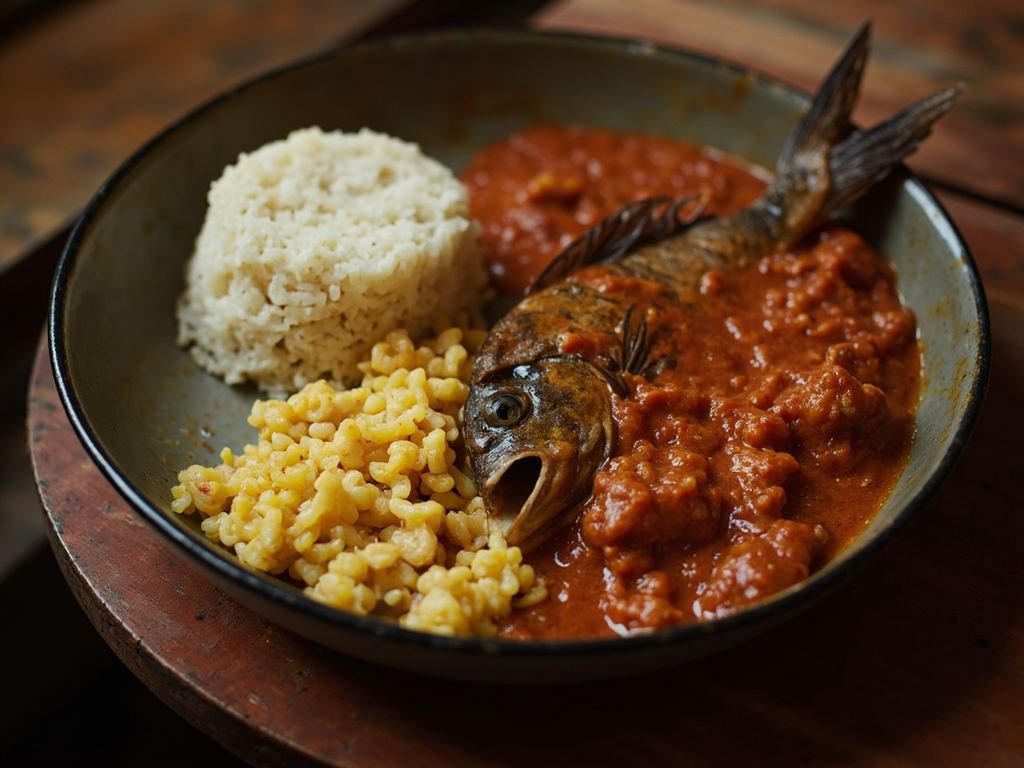
flipKuon kod ngege — ugali and stewed tilapia from Lake Victoria
Kuon kod ngege — ugali and stewed tilapia from Lake Victoria
Why this dish? Oruka was born in Luo country, in Ugenya, on the western shores of Kenya, and Lake Victoria tilapia with ugali is THE memory-dish of his Luo childhood — the one he would find again when returning to listen to the village sages.
A white, dense maize dough, shaped by hand, dipped into a whole tilapia stewed with onion and tomato. The heart of the Luo family meal.
You see this white ball in the hollow of my hand? We call it kuon. We don't eat ngege with a fork, no — we pinch the kuon between three fingers, make a little well, and scoop up the fish with its sauce. My father used to say that Lake Victoria feeds the Luo man before he even learns to speak. When I went to the old sages to listen to their thought, this is the dish they served me, and it was while sharing it that speech would loosen.
- •White ground maize (kuon) — two full handfuls of flour per person (starchy base)
- •Whole lake tilapia (ngege) — one fish (main protein)
- •Onion — one (aromatic base)
- •Ripe tomato — two (sauce)
- •Oil — a drizzle (cooking)
- •Salt — to taste (seasoning)
Kuon kod ngege — ugali and stewed tilapia from Lake Victoria
A white, dense maize dough, shaped by hand, dipped into a whole tilapia stewed with onion and tomato. The heart of the Luo family meal.
Why this dish? Oruka was born in Luo country, in Ugenya, on the western shores of Kenya, and Lake Victoria tilapia with ugali is THE memory-dish of his Luo childhood — the one he would find again when returning to listen to the village sages.
You see this white ball in the hollow of my hand? We call it kuon. We don't eat ngege with a fork, no — we pinch the kuon between three fingers, make a little well, and scoop up the fish with its sauce. My father used to say that Lake Victoria feeds the Luo man before he even learns to speak. When I went to the old sages to listen to their thought, this is the dish they served me, and it was while sharing it that speech would loosen.
Ingredients (period version)
- White ground maize (kuon) — two full handfuls of flour per person (starchy base)
- Whole lake tilapia (ngege) — one fish (main protein)
- Onion — one (aromatic base)
- Ripe tomato — two (sauce)
- Oil — a drizzle (cooking)
- Salt — to taste (seasoning)
Ingredients
- White maize meal (ugali flour) — 300 g (starchy base)
- Water — 750 ml (for cooking ugali)
- Tilapia fillets or whole fish — 600 g (main protein)
- Onion — 1 large, sliced (aromatic base)
- Tomatoes — 3, chopped (sauce)
- Garlic — 2 cloves (aromatic)
- Vegetable oil — 3 tbsp (cooking)
- Fresh coriander (dania) — a few sprigs (finish)
- Salt — 1 tsp (seasoning)
Method
- Salt the fish and sear it a few minutes on each side in hot oil, then set aside.
- In the same pan, brown the onion, add garlic then chopped tomatoes; let melt into sauce for 10 min.
- Return the fish to the sauce, cover halfway with water and simmer 15 min on low heat.
- For the ugali: bring water to a boil, lightly salt, pour in the flour in a rain while stirring vigorously with a spatula.
- Continue turning and folding the dough for 8 to 10 min until it pulls away from the sides and becomes smooth and firm.
- Turn out the ugali in a dome on a plate; serve alongside the tilapia coated in sauce and sprinkled with coriander.
How it was made : In the old days, white maize was ground by stone or at the village mill, and tilapia came directly from Luo fishermen's canoes. Ugali was cooked in a cast-iron pot on three stones, stirred with a large wooden spatula (oluth). People ate sitting together, from a shared dish.
The contemporary twist : For plating, unmold the ugali in a bowl for a neat dome, place the whole tilapia across it and slide a lime wedge — a nod to 'Kisumu street food'.
Henry Odera Oruka · Charactorium