 flip
flipSplanchna Grilled on the Altar Embers
Splanchna Grilled on the Altar Embers
Why this dish? As the Hephaestus profile says: like all Immortals, he feeds on sacrifices offered in temples, especially grilled portions of cattle. The splanchna — noble offal (heart, liver) — were skewered and grilled on the altar embers, then tasted by the faithful. What dish could be more fitting for the god of fire, whose altar and forge are one?
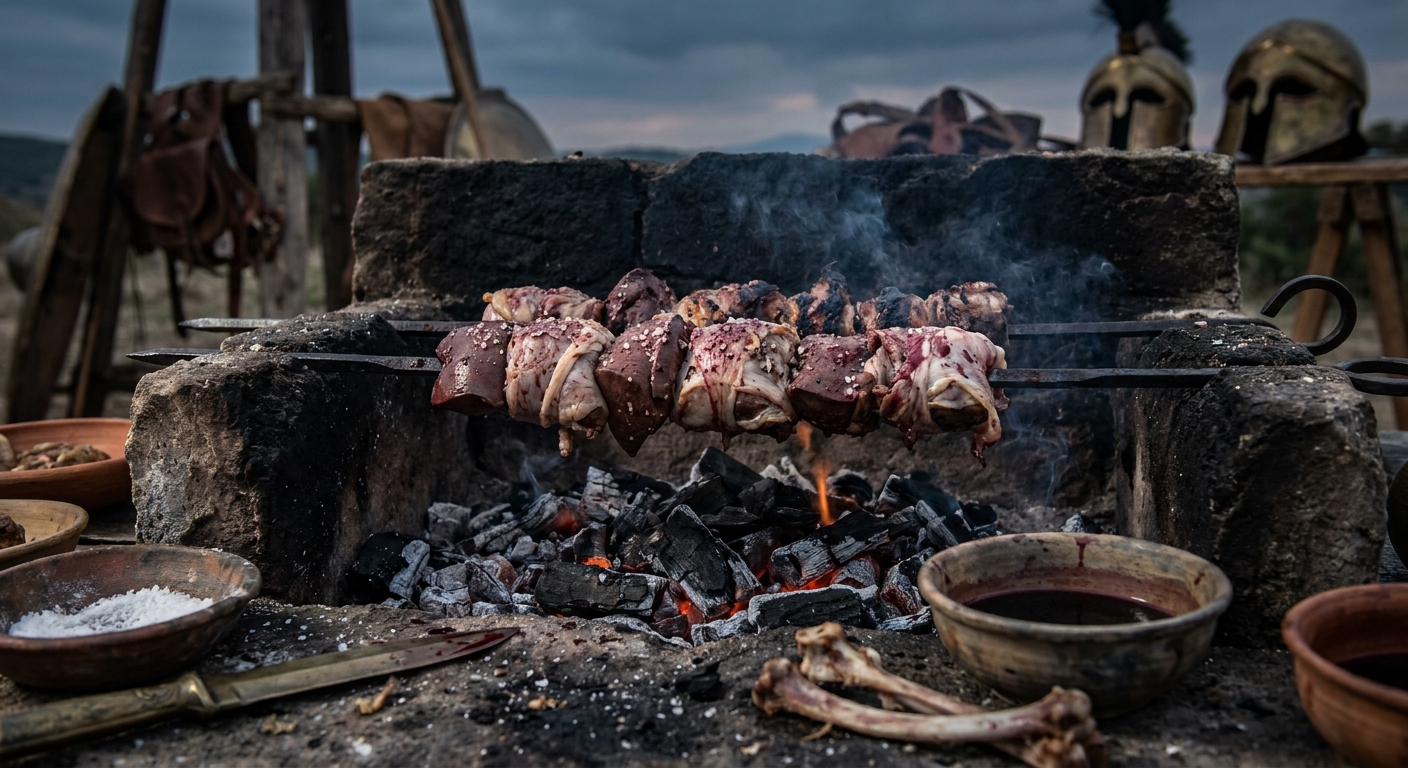
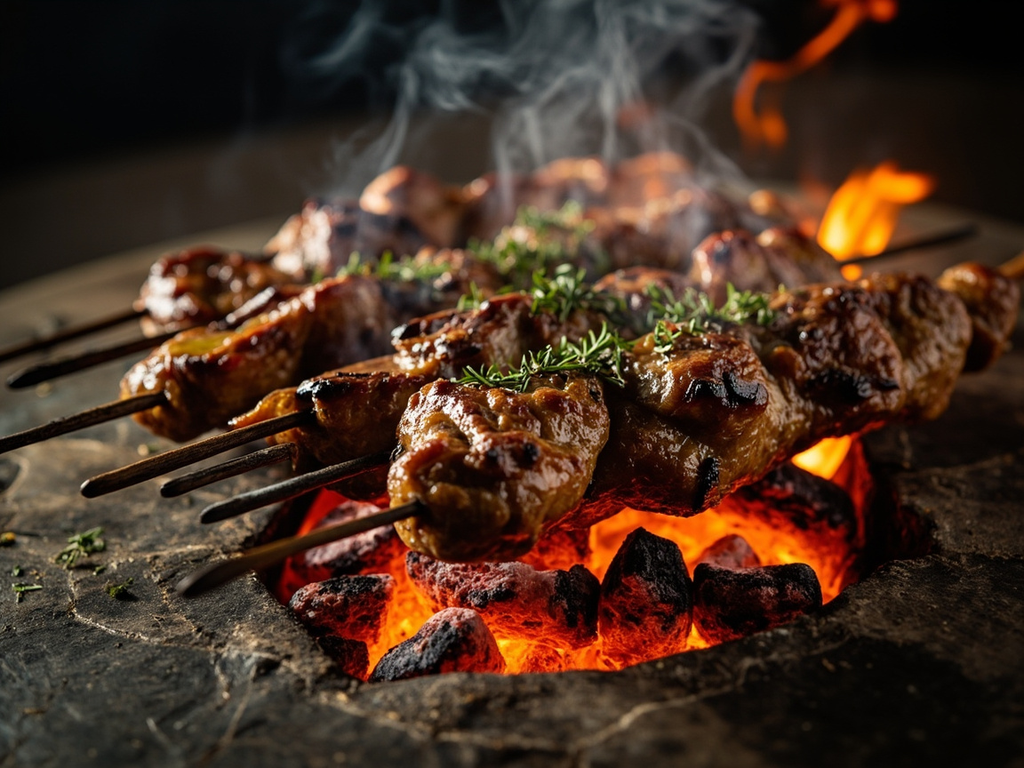
Skewers of offal and meat cuts, seared over hot coals, salted and drizzled with olive oil and herbs. This is the part of the sacrifice that men consumed — the smoke rising to the gods, the flesh returning to mortals. A bold, seared, smoky flavor.
Know, you who listen to me, that the smoke of your skewer reaches me better than any prayer. When you place the heart and liver on the coals — those same red coals from which I draw my wonders — grease the flesh with oil, throw in a sprig of oregano, and turn it without burning it. Fire is my domain: respect it, do not rush it. The part that sizzles and browns, you eat; the smoke that rises, that is my portion. Thus the custom has been since the first altars.
- •Beef (or lamb) liver and heart — in pieces (centerpiece)
- •Olive oil — for brushing (searing and shine)
- •Fresh oregano and thyme — a few sprigs (aroma)
- •Sea salt — to taste (seasoning)
- •Animal fat (caul fat) — for wrapping (moisture during cooking)
Splanchna Grilled on the Altar Embers
Skewers of offal and meat cuts, seared over hot coals, salted and drizzled with olive oil and herbs. This is the part of the sacrifice that men consumed — the smoke rising to the gods, the flesh returning to mortals. A bold, seared, smoky flavor.
Why this dish? As the Hephaestus profile says: like all Immortals, he feeds on sacrifices offered in temples, especially grilled portions of cattle. The splanchna — noble offal (heart, liver) — were skewered and grilled on the altar embers, then tasted by the faithful. What dish could be more fitting for the god of fire, whose altar and forge are one?
Know, you who listen to me, that the smoke of your skewer reaches me better than any prayer. When you place the heart and liver on the coals — those same red coals from which I draw my wonders — grease the flesh with oil, throw in a sprig of oregano, and turn it without burning it. Fire is my domain: respect it, do not rush it. The part that sizzles and browns, you eat; the smoke that rises, that is my portion. Thus the custom has been since the first altars.
Ingredients (period version)
- Beef (or lamb) liver and heart — in pieces (centerpiece)
- Olive oil — for brushing (searing and shine)
- Fresh oregano and thyme — a few sprigs (aroma)
- Sea salt — to taste (seasoning)
- Animal fat (caul fat) — for wrapping (moisture during cooking)
Ingredients
- Lamb (or veal) liver — 400 g, cubed (centerpiece)
- Lamb heart (optional) — 200 g (variety)
- Pork or lamb caul fat — a few sheets (protective wrap)
- Olive oil — 3 tbsp (searing)
- Dried oregano + fresh thyme — 2 tsp + a few sprigs (aroma)
- Salt and a dash of garum (fish sauce) or lemon juice — to taste (umami boost / acidity)
Method
- Cut the offal into even pieces and optionally wrap in caul fat (ancient style to keep them moist).
- Skewer onto sticks (soak wooden ones if using).
- Brush with olive oil, sprinkle with oregano.
- Cook over bright red embers (or a very hot griddle/grill) for 2 to 3 minutes per side: the flesh should remain pink in the center, never dry.
- Salt upon leaving the fire, add a dash of garum or lemon juice and fresh thyme. Serve immediately, with barley maza.
How it was made : During a Greek sacrifice, the fat and wrapped bones were burned for the gods (the "divine" portion, fragrant smoke), while the splanchna — noble offal — were grilled first on the altar and tasted by the officiants. The rest of the meat was boiled or roasted and shared. Meat was eaten in abundance only on these ritual or festive occasions.
The contemporary twist : Present as "altar skewers" on a hot stone, smoking oregano at the table under a glass cloche — sacred smoke revisited. For timid palates, replace offal with cubes of lamb shoulder.
Sources : Homer, Iliad, Book I (sacrifice and grilling of splanchna) · Hesiod, Theogony (division of the sacrifice, myth of Prometheus) · J.-L. Durand, Sacrifice et labour en Grèce ancienne (1986)
Hephaestus · Charactorium