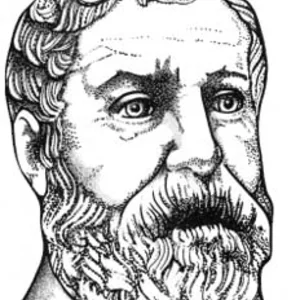

A Greek engineer and mathematician of the 1st century AD, Hero of Alexandria authored numerous mechanical inventions and foundational mathematical works. He designed the aeolipile, the first device to harness the power of steam, as well as automata and theatrical machines.
Hero of Alexandria(10 — 75)
Hero of Alexandria
8 min read
Frequently asked questions
Key Facts
- 1st century AD: active in Alexandria under the Roman Empire
- Invented the aeolipile, a sphere set in rotation by steam — the earliest known steam engine
- Designed automata driven by systems of pulleys, ropes, and water for use in theaters
- Wrote the Metrica, a treatise on calculating areas and volumes still in use today (Heron's formula)
- Wrote the Pneumatica and the Mechanica, encyclopedias of the machines of his time
Works & Achievements
A treatise in two books describing more than a hundred mechanical devices powered by air and steam pressure, including the aeolipile. It is the primary source for the study of Hero's machines and a founding milestone in fluid mechanics.
A mathematical work in three books devoted to calculating areas and volumes, containing the famous Hero's formula for the area of a triangle from its three sides. Rediscovered in 1896 in Constantinople, it is still taught in schools today.
An engineering treatise preserved in its Arabic version, covering the five simple machines (lever, wheel, wedge, screw, pulley) and their combinations for lifting loads. The principal engineering manual of Greek antiquity.
A construction manual for theatrical automata describing two types of self-operating mechanical scenes. The first treatise on robotics in history, unmatched in antiquity for its precision and inventiveness.
A surveying treatise describing the construction and use of the dioptra to measure angles, distances, and elevations. It includes a famous problem about tunneling through a mountain from both ends simultaneously.
A treatise on geometric optics studying the properties of flat, concave, and convex mirrors. Hero states the principle that light follows the shortest path, anticipating Fermat's principle by sixteen centuries.
Anecdotes
Hero of Alexandria invented the aeolipile, a metal sphere connected to a boiler by pipes. When the water boiled, steam escaped through two small bent nozzles and made the sphere spin on its axis. This scientific toy, which the Alexandrians admired without grasping its full potential, is considered the world's first steam engine — eighteen centuries before the Industrial Revolution.
To impress temple worshippers, Hero devised an ingenious mechanism: when a priest lit a sacred fire on the outdoor altar, the heat expanded the air inside a sealed vessel, triggered hidden counterweights, and caused the heavy temple doors to slowly swing open. Visitors, unaware of the mechanism, believed they were witnessing a divine miracle.
The “Hero's fountain” is a hydraulic device that seems to defy gravity: water rises on its own in a jet through a system of communicating vessels and differences in air pressure. This invention shows how Hero turned natural phenomena into scientific spectacles, and Hero's fountain is still reproduced in physics classes around the world.
In his treatise the Metrica, Hero demonstrated a formula for calculating the area of a triangle knowing only the lengths of its three sides, without measuring its height. This formula, which still bears his name, is taught in schools around the world more than two thousand years after its discovery.
Hero designed automata for the theater of Alexandria: a small mechanical stage capable of performing an entire play on its own through systems of ropes, counterweights, and toothed wheels. Audiences watched characters move, lightning flash, and ships sail across a simulated sea — all without a single human actor present.
Primary Sources
If a spherical globe is suspended so as to rotate on itself, and two tubes bent in opposite directions are fixed to it pointing toward the ends of the horizontal diameter, steam introduced into the globe will escape through these tubes and cause the device to spin.
Let there be a triangle whose sides measure 7, 8, and 9. Add the three sides together: you get 24. Take half of that: 12. Subtract each side from this semi-perimeter and multiply the remainders together; the square root of the resulting product gives the area.
We shall now describe an automatic theatrical scene: the figures move of their own accord, perform their actions, and the stage closes when the performance is complete — without any human hand intervening during the show.
The five powers by which a weight is moved with lesser force are: the windlass, the lever, the pulley, the wedge, and the endless screw. Each can be understood through the circle, for it is in the nature of the circle that the marvellous resides.
To measure the distance between two inaccessible points, the instrument is positioned so that the line of sight passes through both points; by rotating the graduated disk, the angles are read and the distance is calculated by geometry.
Key Places
City founded by Alexander the Great and the intellectual capital of the Hellenistic and later Roman world, where Heron lived, taught, and conducted most of his research. It was home to the Mouseion and the Great Library, unique centers of ancient science.
A Ptolemaic royal institution funded by the state and the forerunner of the university, where scholars and engineers from across the Mediterranean world were housed and free to pursue their research. It was here that Heron wrote his treatises and taught his students.
A repository of several hundred thousand papyrus scrolls, holding the texts of Archimedes, Euclid, and Ctesibius that Heron drew on directly in his work on mechanics and mathematics.
Capital of the Roman Empire in Heron's time, a city that drove vast construction projects requiring the lifting machines described in the *Mechanica*, thus ensuring the practical spread of Heronian knowledge.
Typical Objects

A metal sphere mounted on an axis and connected to a boiler, spinning the sphere through steam escaping from two opposing nozzles. It is Hero's most famous invention, considered the first prototype of a steam engine in history.

A topographical measuring instrument consisting of a graduated disc, an alidade, and a water level, enabling precise measurement of angles and distances. Hero devoted an entire treatise to it, describing its use for surveying terrain and boring tunnels.

Small mechanical scenes driven by systems of ropes, counterweights, and flowing sand, capable of performing entire short plays without human intervention. Hero describes their construction in his treatise Automata, offering the oldest robotics manual from Antiquity.

A hydraulic device with three communicating vessels in which water appears to rise on its own, thanks to differences in air pressure between the compartments. This scientific toy illustrates Hero's mastery of pneumatics and hydrostatics.

A musical instrument whose pipes were supplied not by a hand bellows but by the pressure of water flowing into a reservoir compressing an air chamber. Hero describes its construction in his Pneumatica as a musical application of fluid mechanics.

A two-branched articulated tool used to reproduce or enlarge geometric figures with precision. Hero describes several variants of it in his mathematical treatises, attesting to the importance of practical geometry in the Alexandrian engineer's workshop.
School Curriculum
Vocabulary & Tags
Key Vocabulary
Tags
Daily Life
Morning
Hero began his day early in the Mouseion's workshops, surrounded by apprentices and craftsmen. He dictated his observations onto papyrus scrolls in Greek, the international language of scholars. Mornings were devoted to practical demonstrations: lighting a boiler, measuring pressures, and checking the previous day's calculations on volumes and angles.
Afternoon
Afternoons were spent on lessons and discussions with other scholars at the Museum. Hero expounded his theories on the five simple machines, commented on Archimedes or Ctesibius, and supervised the construction of his prototypes by specialized craftsmen — bronze workers, coppersmiths, cabinet-makers. He also carried out field measurements with his dioptra for his treatises on surveying.
Evening
In the evenings, Hero took part in the scholarly banquets (symposia) of the Mouseion, where philosophy, mathematics, and mechanics mingled with political and literary discussions. He might also devote these hours to correcting his treatises by the light of oil lamps — whose feed mechanism he may himself have improved.
Food
Like any well-off inhabitant of Alexandria in the 1st century, Hero's diet consisted mainly of wheat bread, olive oil, vegetables (lentils, chickpeas, broad beans), fresh or dried fish from the Mediterranean, and fruit (figs, dates, grapes). Meat, being more costly, was reserved for festivals and official banquets.
Clothing
Hero likely wore the *chiton*, a linen or wool tunic belted at the waist, covered by a *himation*, a large rectangle of fabric draped over the shoulder in the Greek manner. In the workshop, he presumably wore a leather apron to protect himself from metal shards and the heat of the furnaces.
Housing
As a scholar housed at the Mouseion, Hero very likely had lodgings within the grounds of the royal institution, close to the gardens and lecture halls. His workspace included a workshop equipped with a forge and measuring instruments, as well as a personal library of papyrus scrolls.
Historical Timeline
Period Vocabulary
Liens externes & ressources
Références
Œuvres
Pneumatica
vers 60 apr. J.-C.
Metrica
vers 60-70 apr. J.-C.
Mechanica
vers 60 apr. J.-C.
Automata
vers 60-70 apr. J.-C.
Dioptra
vers 60-70 apr. J.-C.
Catoptrica
vers 60-70 apr. J.-C.