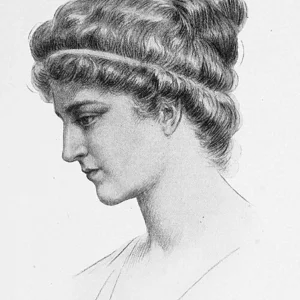

Mathematician, astronomer, and Neoplatonist philosopher from Alexandria (c. 360–415). Considered the first known female scientist in history, she led the philosophical school of Alexandria and was murdered by a fanatical Christian mob.
Hypatia(360 — 415)
Hypatia
Empire byzantin
7 min read
Frequently asked questions
Key Facts
- c. 360: born in Alexandria, daughter of the mathematician Theon of Alexandria
- c. 400: leads the Neoplatonist school of Alexandria, attracting students from across the Empire
- Wrote commentaries on the works of Diophantus, Apollonius, and Ptolemy, contributing to their preservation and transmission
- 415: murdered by a mob of fanatical Christian monks, a crime attributed to the influence of Bishop Cyril
- Her killing has become a symbol in historiography of the end of classical learning and the destruction of the Library of Alexandria
Works & Achievements
A revision and annotation of Ptolemy's great astronomical treatise, produced together with her father Theon. This version is largely the one that was transmitted through the Middle Ages.
Pedagogical annotations on the algebraic treatise by Diophantus of Alexandria. This commentary is one of the few direct testimonies to Hypatia's intellectual activity.
An explanation of the foundational treatise on conic sections (ellipse, parabola, hyperbola). Attested by the Suda, this text has unfortunately been lost.
Astronomical calculation tables mentioned by Synesius in his letters. Their practical use reflects Hypatia's interest in applied astronomy.
Technical texts transmitted orally or in writing to her students, attested by the correspondence of Synesius, who asked her to send him a hydrometer she had reportedly designed.
Anecdotes
Hypatia taught her students that they should subject every belief to rational examination. When a young man fell in love with her, she is said to have shown him her menstrual cloths, telling him: 'This is what you are in love with — there is nothing beautiful here.' This anecdote, recorded by Damascius, illustrates her conviction that the philosopher must free themselves from passion in order to reach truth.
The daughter of the mathematician Theon of Alexandria, Hypatia worked closely with her father to revise and annotate the great scientific texts of antiquity. Their edition of Ptolemy's astronomical treatise, the Almagest, is largely the version that has come down to us — without their work, this foundational text might well have been lost.
Hypatia was one of the rare women of antiquity to correspond as an equal with bishops and Roman governors. Her former student Synesius of Cyrene, who became a bishop, wrote her letters in which he submitted philosophical and mechanical problems for her consideration, consulting her as his most cherished teacher until the end of his life.
According to Byzantine sources, Hypatia improved upon the plane astrolabe, an instrument used to measure the position of celestial bodies and calculate the time. She is also said to have developed a hydrometer — a graduated tube for measuring the density of liquids. These instruments reflect an intellect that was both theoretical and practical, a rare combination in the ancient scholarly world.
In March 415, Hypatia was attacked by a mob of parabalani — a militia in the service of Bishop Cyril of Alexandria. She was dragged from her carriage, killed in the church of the Caesareum, and her body burned. The Christian historian Socrates Scholasticus, himself a contemporary, condemned the murder as a disgrace to the Church and to Cyril personally.
Primary Sources
There was a woman at Alexandria named Hypatia, daughter of the philosopher Theon, who had attained such a level of learning that she surpassed all the philosophers of her time.
I address you as a mother, a sister, a teacher, and by all these names I honor you. Send me a hydroscope if you have one available, as mine is broken.
Hypatia, Alexandrian philosopher, daughter and disciple of Theon the mathematician. She commented on Diophantus, the Conics of Apollonius, and contributed to Ptolemy's Almagest.
And in those days there was at Alexandria a female philosopher, a pagan woman named Hypatia, devoted at all times to magic, astrolabes, and musical instruments.
Key Places
The intellectual capital of the ancient world, where Hypatia was born, lived, and taught throughout her life. Its library and schools made it the leading center of Greek learning in late antiquity.
A philosophical institution led by Hypatia at the turn of the 5th century, where she welcomed students from across the Roman Empire to study mathematics, astronomy, and philosophy.
The great center for research and preservation of ancient knowledge, whose intellectual legacy permeated Hypatia's teaching. She likely had access to it for her commentary work.
A former imperial basilica converted into a Christian church, and the site where Hypatia was murdered by the parabalani in March 415 — transforming a symbol of imperial power into the scene of a crime.
The hometown of Synesius, one of Hypatia's most celebrated students. Their exchange of letters between Alexandria and Cyrene bears witness to the international reach of Hypatia's teaching.