
First known composer, visionary, Doctor of the Church
Hildegard von Bingen(1098 — 1179)
Hildegard von Bingen
Saint-Empire romain germanique
9 min read
Frequently asked questions
Key Facts
- Née en 1098 dans le Saint-Empire romain germanique, Hildegard von Bingen est confiée dès l'enfance à un monastère bénédictin.
- À partir de 1141, elle reçoit l'autorisation papale de consigner ses visions mystiques dans l'œuvre Scivias, rédigée entre 1141 et 1151.
- Elle fonde son propre couvent au Rupertsberg vers 1150, affirmant son indépendance spirituelle et institutionnelle.
- Compositrice prolifique, elle crée plus de 70 chants liturgiques regroupés dans la Symphonia armonie celestium revelationum, premier corpus musical attribué à une femme identifiée.
- Canonisée et proclamée docteur de l'Église par le pape Benoît XVI en 2012, elle est l'une des quatre femmes à porter ce titre.
Works & Achievements
Major visionary work in three books describing 26 visions on creation, redemption and the last things, accompanied by 35 miniatures in the original manuscript. Approved by Pope Eugene III, it established Hildegard's spiritual authority.
Collection of 77 liturgical pieces (antiphons, hymns, responsories, sequences) composed by Hildegard, making her the first identified female composer in the history of Western music. Her music is distinguished by melodies of exceptional vocal range.
Musical liturgical drama in 82 melodies, considered one of the earliest forms of opera in history. It stages the struggle between the Virtues and the Devil for possession of the human Soul.
Encyclopedia of natural sciences in nine books covering plants, stones, fish, birds and their medicinal properties. One of the first treatises on natural medicine in the medieval West.
Medical treatise describing the causes and remedies of diseases, integrating physiology, pharmacopoeia and a Christian vision of the human body. It demonstrates a remarkable knowledge of humoral medicine inherited from Hippocrates and Galen.
Hildegard's third major visionary work in three parts, exploring the relationships between the cosmos, the human body and the history of salvation through ten visions. Considered her most accomplished theological work.
Hildegard maintained a correspondence with the most important figures of her time: popes (Eugene III, Anastasius IV), emperors (Frederick Barbarossa), abbots (Bernard of Clairvaux) and kings. These letters reveal her considerable political and spiritual influence.
Anecdotes
From the age of eight, Hildegard was entrusted to Abbess Jutta of Sponheim in an anchorite cell adjoining the abbey of Disibodenberg. There she learned reading, liturgical chant, and the psalter, laying the foundations of an exceptional monastic education for a woman of her time.
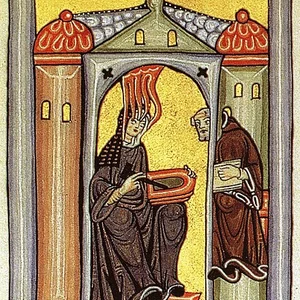
Hildegard claimed to have received luminous visions since childhood, which she called the 'living light'. It was not until the age of 42, after receiving a divine injunction, that she obtained permission from her confessor and Pope Eugene III to commit her visions to writing, giving birth to the Scivias.
In 1150, Hildegard made the bold decision to leave Disibodenberg with her nuns to found her own monastery on the Rupertsberg, near Bingen. Such independence was exceedingly rare for a woman in the 12th century, and initially earned her the opposition of the abbot of Disibodenberg, before he yielded to her determination.
Hildegard undertook four public preaching tours between 1158 and 1170, preaching before clergy and laity in cathedrals and monastic chapters. This was an extraordinary act for a woman, normally excluded from public preaching in the medieval Church.
Near the end of her life, her monastery was placed under interdict by the Archbishop of Mainz because she had permitted the burial of an excommunicated man. Hildegard stubbornly refused to have the body exhumed, arguing that the man had reconciled with the Church before dying. The interdict was lifted a few months before her death in 1179.
Primary Sources
And behold, in my forty-third year, as I was looking with great fear and trembling attention at a heavenly vision, I saw a great splendor in which a voice from heaven said to me: 'O fragile human being, ash of ashes, decay of decay, say and write what you see and hear.'
Father, I am greatly troubled by a vision that appeared to me through the Spirit of God, a vision I have never seen with the eyes of the flesh. I am miserable and more than miserable in my existence as a woman.
These visions I do not perceive in sleep, nor in a dream, nor in a state of madness, nor with bodily eyes or outward ears, nor in hidden places: but I receive them while awake, conscious, looking with a pure gaze, according to the will of God.
Venison is wholesome for healthy people, for the deer is warm and lives in pure places. It is also suitable for the sick, as it is digestible and does not produce bad humors.
O viridissima virga, ave, que in ventoso flabro sciscitationis sanctorum prodisti. (O greenest branch, hail, you who came forth in the swirling breath of the quest of the saints.)
Key Places
Hildegard's birthplace in Rhineland-Palatinate, where she was born in 1098 as the tenth child of a noble family. She spent her early childhood there before being entrusted to monastic life.
A hermitage and later Benedictine abbey where Hildegard lived from the age of 8 until 1150. It was there that she developed her thought, received her first visions, and began writing the Scivias under the guidance of the monk Volmar.
Monastery founded by Hildegard in 1150 on a hill overlooking the confluence of the Rhine and Nahe rivers. It was the site of her creative maturity: she composed most of her music, scientific treatises, and correspondence there.
Second monastery founded by Hildegard in 1165, on the right bank of the Rhine opposite Bingen. It houses her relics today and serves as an active place of pilgrimage, perpetuating Hildegardian spirituality.
Site of the 1147–1148 synod where Pope Eugene III, advised by Bernard of Clairvaux, officially approved Hildegard's writings. This papal validation was decisive for the authority and influence of her work.