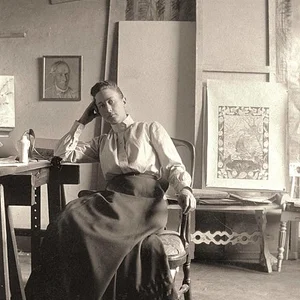

Swedish painter, theosophist, and pioneer of abstract art (1862–1944)
Hilma af Klint(1862 — 1944)
Hilma af Klint
Suède
8 min read
Frequently asked questions
Key Facts
- Hilma af Klint naît en 1862 en Suède et se forme à l'Académie royale des beaux-arts de Stockholm, où elle excelle dans le portrait et la peinture botanique.
- Entre 1906 et 1915, elle réalise une série monumentale de 193 tableaux abstraits intitulée « Les Peintures pour le Temple », considérée aujourd'hui comme l'une des premières œuvres abstraites de l'histoire de l'art occidental.
- Profondément influencée par la théosophie et l'anthroposophie, elle développe un langage pictural symbolique mêlant formes géométriques, spirales et couleurs vives pour représenter des forces spirituelles invisibles.
- Elle choisit de ne pas exposer ces œuvres de son vivant, estimant que le monde n'était pas encore prêt à les comprendre, et demande dans son testament qu'elles ne soient pas montrées avant vingt ans après sa mort.
- Hilma af Klint meurt en 1944 ; sa redécouverte au XXe siècle, notamment lors de l'exposition « The Spiritual in Art » à Los Angeles en 1986, bouleverse l'histoire de l'art abstrait, jusqu'alors dominée par Kandinsky, Mondrian et Malevitch.
Works & Achievements
A series of 193 paintings on canvas, organized into thematic subgroups (The Ten Largest, The Swans, The Evolution…), which constitutes af Klint's major work and one of the earliest expressions of abstract art in the history of world art.
A sub-series of ten monumental canvases (some 3.28 m tall) representing the stages of human life — childhood, youth, adulthood, old age — through organic forms and intense symbolic colors.
A series of paintings exploring duality and the union of opposites (masculine/feminine, light/shadow) through fluid biomorphic forms, often in black and white, of a strikingly modern formal language.
A series of small-format works symbolically exploring spiritual growth and the structure of life, blending plant-like forms and sacred geometry in compositions of great delicacy.
Small abstract paintings inspired by discoveries in early atomic physics, reflecting af Klint's interest in contemporary science, which she wove together with her spiritual intuitions.
Among the earliest fully abstract paintings in the series, representing the opposing and complementary principles of existence through spiral forms and contrasting colors, with no reference to the visible world.
Anecdotes
Hilma af Klint painted her monumental series 'The Paintings for the Temple' between 1906 and 1915, several years before Kandinsky, Mondrian, or Malevich were recognized as the fathers of abstract art. She was convinced that her works were guided by superior spirits she called the 'Masters', and she almost never showed them publicly during her lifetime.
Hilma af Klint was part of a secret group of five women artists and mediums called 'De Fem' (The Five), who gathered in Stockholm for spiritualist séances. It was during one of these séances, in 1906, that she reportedly received the mission to paint a series of large canvases symbolizing the evolution of humanity.
In her will, Hilma af Klint stipulated that her approximately 1,200 works and 150 notebooks should not be shown to the public until twenty years after her death, as she feared the world was not yet 'ready' to understand them. It was only from the 1980s onward that her works began to be truly exhibited.
Hilma af Klint sized her large canvases according to the space she envisioned for an ideal temple. Some paintings from the series 'The Swans' or 'The Ten Largest' reach more than three meters in height. She often worked alone in her studio, in silence, as if in a meditative trance.
Although Swedish, Hilma af Klint stayed several times on the island of Munsö on Lake Mälaren, where she painted and meditated. Toward the end of her life, she joined the anthroposophical community founded by Rudolf Steiner, whose spiritual ideas on the evolution of humanity profoundly influenced her work.
Primary Sources
The Masters asked me to paint what cannot be seen, what lies beyond the veil of the visible world. I must be the channel, not the author.
These paintings belong to a future world. I do not seek glory during my lifetime; what matters is that the work exists and is passed on.
I bequeath all my works, notebooks and documents to the Hilma af Klint Foundation. These paintings shall not be exhibited to the public until twenty years after my death.
Hilma af Klint developed an entirely autonomous visual vocabulary, rooted in theosophy and spiritualism, well before the major male figures of European abstraction.
Key Places
This is where af Klint received her classical artistic training between 1882 and 1888, mastering portraiture and naturalistic drawing before venturing into abstraction.
Her personal studio in Stockholm was the creative space for virtually all of her abstract works. It was here that she painted the immense canvases of the 'Paintings for the Temple', often in a state of meditative concentration.
Hilma af Klint owned a retreat house on this tranquil island west of Stockholm, where she found renewal, meditated, and pursued her spiritual and pictorial research away from the bustle of the city.
World headquarters of the Anthroposophical Society founded by Rudolf Steiner, which Hilma af Klint visited. The Goetheanum, with its organic forms and spiritual conception of architecture, resonated with her own vision of a 'temple' for her paintings.
This museum hosted the first major posthumous retrospective of the artist in 1986, marking the beginning of international recognition of her pioneering work.
Typical Objects

For her monumental paintings, af Klint used large unprimed canvases, sometimes pinned directly to the floor or wall of her studio. These imposing supports allowed her to work at the architectural scale she envisioned for her 'temple'.

Hilma af Klint filled more than 150 sketchbooks with drawings, symbols, formulas, and spiritual reflections that form a true key to understanding her pictorial work. These notebooks are today held by the Hilma af Klint Foundation in Stockholm.

Her abstract compositions are built on precise geometric forms — spirals, circles, ovals — drawn with rigor. The compass and ruler were essential tools in her studio, reflecting an approach that was both intuitive and mathematical.

Af Klint prepared some of her color mixtures herself, seeking vibrant hues — pinks, electric blues, luminous yellows — that did not exist in the commercial ranges of the time.

During the meetings of 'De Fem', a round table served as the support for sessions of automatic communication and mediumistic writing. It was around this table that the first impulses for the major pictorial series are said to have been transmitted.

Hilma af Klint worked as a scientific illustrator for the Stockholm Veterinary Institute. Her botanical and animal anatomy plates demonstrate a mastery of naturalistic drawing that paradoxically fed into her abstract vocabulary (organic forms, plant spirals).
School Curriculum
Vocabulary & Tags
Key Vocabulary
Daily Life
Morning
Hilma af Klint rose early, in keeping with the discipline of the anthroposophical communities she frequented. She began her day with a period of meditation or reading from the writings of Rudolf Steiner or Madame Blavatsky, seeking to place herself in a state of spiritual receptivity before entering her studio.
Afternoon
The afternoon was devoted to pictorial work, often during long hours of silent concentration. On her large canvases laid on the floor or hung on the wall, she worked with fine and broad brushes, blending intuition with geometric rigour. She would sometimes pause her session to jot symbols or inspired phrases in her notebooks.
Evening
In the evening, Hilma af Klint would sometimes gather with the group 'De Fem' for spiritualist sessions or shared readings. She recorded in her notebooks the 'messages' received during the day and planned the next stages of her major series. She led a simple, unworldly life, turned inward toward spiritual inquiry.
Food
In keeping with the anthroposophical practices she gradually adopted, af Klint favoured a simple, largely meat-free diet — dark bread, Nordic vegetables, fish, milk, and Swedish cheeses. She ate frugally, regarding moderation as a spiritual virtue.
Clothing
Hilma af Klint dressed with the bourgeois sobriety typical of educated Swedish women of her era: dark high-necked dresses, a work apron in the studio, and sometimes a wool shawl during group meditation sessions. She made no effort to draw attention to herself through her appearance.
Housing
She lived in a studio apartment in Stockholm, functional and unadorned, where canvases occupied most of the space. The walls were covered with her own works and symbolic diagrams. She also had a rural retreat on the island of Munsö, which she regarded as a place of renewal and contemplation.
Historical Timeline
Period Vocabulary
Visual Style
Formes organiques monumentales aux contours fluides, aplats de couleurs vives et symbolisme théosophique : un style abstrait unique, entre géométrie sacrée et sensibilité Art Nouveau.
Sound Ambience
Ambiance d'un atelier suédois silencieux du début du XXe siècle, entre méditation spirite et travail pictural concentré, avec les sons discrets d'une ville nordique hivernale en arrière-plan.
Liens externes & ressources
Références
Œuvres
Les Dix Plus Grands (De tio största)
1907
L'Arbre de la Connaissance (Kunskapsträdet)
1913–1915