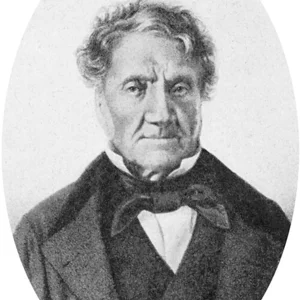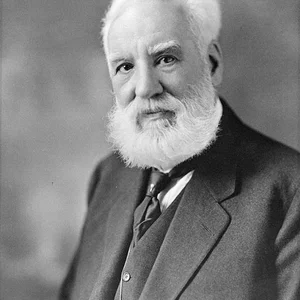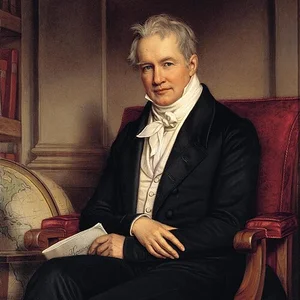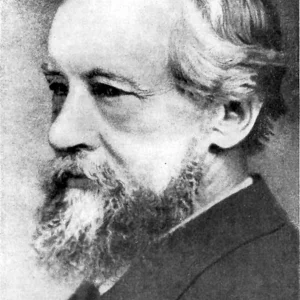

Dutch botanist (1848–1935), Hugo de Vries was one of the rediscoverers of Mendel's laws in 1900. He is best known for his mutation theory, which he developed from his work on evening primrose.
Hugo de Vries(1848 — 1935)
Hugo de Vries
Royaume des Pays-Bas
7 min read
Frequently asked questions
Key Facts
- Born on 16 February 1848 in Haarlem (Netherlands), died on 21 May 1935
- In 1900, he independently rediscovered Mendel's laws, simultaneously with Correns and Tschermak
- Developed the mutationist theory of evolution in *Die Mutationstheorie* (1901–1903)
- His experiments on *Oenothera lamarckiana* allowed him to observe sudden, heritable variations
- Professor at the University of Amsterdam, he helped lay the foundations of modern genetics
Works & Achievements
A theoretical work in which de Vries postulates the existence of distinct intracellular hereditary particles, which he calls 'pangenes'. This work directly foreshadows the modern concept of the gene.
A landmark paper in which de Vries rediscovers and confirms Mendel's laws based on his own crossbreeding experiments. It was published the same week as similar articles by Correns and Tschermak.
His magnum opus in two volumes, in which de Vries develops the idea that evolution proceeds through sudden, discontinuous mutations. Although his conception of mutations in the evening primrose later proved partially incorrect (the phenomenon involved polyploidy), the theoretical framework remains foundational.
A revised English version of his American lectures, intended to spread mutation theory throughout the English-speaking world and connect it to Darwin's work on natural selection.
An applied handbook presenting Mendelian genetics methods for agronomists and plant breeders, illustrating the practical impact of his fundamental research.
Anecdotes
In 1886, Hugo de Vries stumbled upon a wild population of evening primroses (*Oenothera lamarckiana*) in an abandoned field near Amsterdam, displaying remarkably varied forms. Fascinated, he collected seeds and began cultivating the plants in his experimental garden, laying the groundwork for his mutation theory.
In 1900, while preparing to publish his work on heredity, Hugo de Vries came across Gregor Mendel's long-forgotten 1866 paper. He realized that the Austrian monk had anticipated his own conclusions — some historians believe he initially tried to downplay Mendel's discovery before acknowledging it under pressure from colleagues.
That same year, 1900, two other botanists — the German Carl Correns and the Austrian Erich von Tschermak — independently published their own rediscoveries of Mendel's laws. This remarkable coincidence is one of the most famous in the history of science, illustrating how a field can reach maturity simultaneously among several researchers.
During his lecture tour of the United States in 1904, de Vries was received as a scientific celebrity: hundreds of students and professors packed in to hear him speak about his evening primrose mutations. His visit helped make the United States one of the first countries to adopt Mendelian genetics as an official research program.
In his 1889 work, Hugo de Vries coined the word 'pangene' to describe the hereditary units inside the cell. The term was later shortened to 'gene' by the Danish scientist Wilhelm Johannsen in 1909 — modern scientific vocabulary thus owes part of its terminology to de Vries, even though the concept was refined by others.
Primary Sources
I assume that hereditary characters are carried by distinct material particles inside the cell, which I call pangenes. Each pangene corresponds to an observable character of the organism.
The results of my crossing experiments fully agree with the rules formulated by Mendel for peas, which I find applicable to many other plant species.
Species do not transform through small, gradual, and imperceptible variations, but through sudden and discontinuous jumps which I propose to call mutations. These mutations are hereditary and can form the basis of new species.
Mutations arise suddenly, they do not in the beginning show any tendency to return to the original type, and they breed true from the very first generation.
Key Places
Birthplace of Hugo de Vries, born on February 16, 1848, into a cultivated middle-class family. His liberal family environment fostered an early passion for the natural sciences.
De Vries's primary workplace for forty years (1878–1918). It was here that he led his experimental research on heredity and wrote his major works.
The natural site where de Vries discovered in 1886 a wild population of evening primroses displaying spontaneous variants. This chance find triggered his entire reflection on mutations.
The institution where de Vries earned his doctorate in 1871, following a complete course of study at one of the oldest and most prestigious universities in the Netherlands.
A village in Gelderland where de Vries owned a country retreat. He settled there permanently after 1918 and died there on May 21, 1935.
Typical Objects

The central instrument in de Vries's laboratory, it allowed him to observe plant cells and study the intracellular structures he believed to be the carriers of heredity.

De Vries carefully preserved dried specimens of his evening primroses mounted on cardboard, enabling him to document and compare the various mutant forms observed across successive generations.

Filled with sketches, crossing tables, and meticulous counts, these notebooks formed the living record of his multi-year experiments on plant heredity.

The star specimen of his research, grown in large numbers in his experimental garden in Amsterdam; its spontaneous mutant forms were at the heart of his entire theory.

Like Mendel before him, de Vries systematically tallied the offspring of his crosses and drew up ratio tables to verify the regularities of hereditary transmission.

De Vries exchanged detailed letters with botanists and biologists around the world — Carl Correns, Francis Darwin, Wilhelm Johannsen — to compare results and disseminate his ideas.
School Curriculum
Vocabulary & Tags
Key Vocabulary
Daily Life
Morning
De Vries began his day very early with a careful inspection of his experimental garden or the university greenhouse. He would examine his evening primrose plants, note the appearance of new forms, and collect seeds. These morning observations formed the backbone of his research.
Afternoon
Afternoons were devoted to the laboratory: microscope work, measurements, counting the hybrids produced by crossings, and recording results in his notebooks. He also supervised his students and assistants, discussing ongoing experiments with them.
Evening
Evenings were reserved for reading foreign scientific journals — in German, English, and French — and for writing his voluminous correspondence. De Vries was known for the detailed, well-argued letters he sent to colleagues across Europe.
Food
As a practicing nineteenth-century botanist from the Dutch Protestant bourgeoisie, de Vries followed a plain and regular diet. His meals consisted mainly of bread, vegetables, fish, and dairy products, in keeping with Dutch eating habits of the time.
Clothing
Like most university professors of the late nineteenth century, de Vries wore a dark, understated suit, often complemented by a waistcoat and tie. In the laboratory or garden, he put on an apron or work coat to protect his clothes during botanical tasks.
Housing
De Vries lived in a middle-class house in Amsterdam, close to the university, with a personal garden where he grew some of his experimental plants. Later in life he also owned a country property in Lunteren, which became his main residence after his retirement.
Historical Timeline
Period Vocabulary
Liens externes & ressources
Références
Œuvres
Intracellular Pangenesis
1889
Sur la loi de disjonction des hybrides
1900
Die Mutationstheorie (La Théorie des mutations)
1901-1903
Species and Varieties: Their Origin by Mutation
1905
Plant Breeding
1907