
Eileithyia (Ilithyia) is the Greek goddess of childbirth and labor. The daughter of Zeus and Hera, she presides over births and either eases or prolongs the pains of women in labor. She plays a decisive role in several myths, notably during the births of Heracles and Apollo.
Eileithyia
Eileithyia
6 min read
Frequently asked questions
Key Facts
- The daughter of Zeus and Hera, she belongs to the Greek Olympian pantheon
- According to Homer, the Eileithyiai are sometimes invoked in the plural as goddesses of the pains of childbirth
- In the myth of Heracles' birth, Hera holds her back to delay Alcmene's labor
- She assists Leto during the birth of Apollo and Artemis on Delos
- An ancient cult was devoted to her in Crete, at the cave of Amnisos, mentioned as early as the Mycenaean period
Works & Achievements
After nine days of labor pains, Eileithyia finally allows Leto to give birth to the divine twins. Without her, the birth of the two Olympians was impossible.
Forced by Hera to block Alcmene's delivery, Eileithyia is tricked by Galanthis and lets the greatest Greek hero be born.
Pindar describes her seated alongside the goddesses of destiny, for it is through her that every mortal comes into life and thus to their fate.
Plato compares the art of Socrates, who helps to "give birth" to ideas, to Eileithyia's role with pregnant women.
Her Cretan sanctuary makes her one of the most anciently venerated deities of the Greek world, spanning nearly two millennia.
The Romans identify Eileithyia with Juno Lucina, perpetuating her functions as protector of childbirth in the Latin world.
Anecdotes
According to mythology, when Leto wanted to give birth to Apollo and Artemis, the jealous Hera kept Eileithyia on Olympus to prevent the delivery. Leto suffered for nine days and nine nights on the island of Delos until the other goddesses convinced Eileithyia to come to her aid.
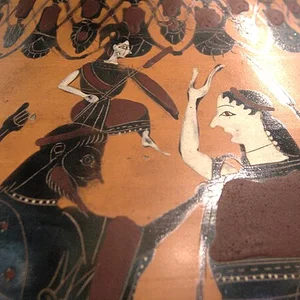
To delay the birth of Heracles and favor that of Eurystheus, Hera ordered Eileithyia to cross her legs and fingers in front of Alcmene's door, magically blocking the delivery. A cunning servant, Galanthis, falsely announced that the child had been born: startled, Eileithyia sprang up, unclasped her limbs, and the birth was able to take place.
In Crete, near Knossos, there was a sacred cave called the Cave of Eileithyia, mentioned as early as the Linear B tablets of the Mycenaean era. This shows that her cult is one of the oldest in the Greek world, dating back more than a thousand years before our era.
The Greeks sometimes depicted Eileithyia holding a torch, a symbol of the daylight toward which she leads the newborn, or stretching out her arms to welcome the child. Pregnant women offered her clothing and prayers to obtain a painless delivery.
The poet Pindar invokes her as the goddess “seated beside the Moirai,” the divinities of fate, because birth determines the destiny of every mortal. Without Eileithyia, it was believed, no child could come into the world.
Primary Sources
The Eileithyiai, who preside over painful childbirth and who are the daughters of Hera, goddesses of bitter pains.
Only Eileithyia, goddess of the pains of childbirth, had heard nothing; for she sat atop Olympus, beneath golden clouds, held back by the will of Hera.
Hera, joined with Zeus, gave birth to Hebe, Ares, and Eileithyia.
Eileithyia, daughter of mighty Hera, seated beside the deep-thinking Fates, hear me: without you no one beholds the light.
Lucina (Eileithyia), seated before the altar, knees crossed and fingers interlaced, held back the delivery of Alcmene by her spells.
Key Places
Sacred cave near the harbour of Knossos, a place of worship of Eileithyia from Minoan times. Pausanias and the *Odyssey* mention it as one of her most ancient sanctuaries.
Sacred island where Leto gave birth to Apollo and Artemis with the belated help of Eileithyia. A sanctuary there was dedicated to the goddess of childbirth.
Home of the gods where Eileithyia lived alongside Hera, her mother. It was from there that Hera held her back to prevent the birth of Apollo.
Athens had an ancient temple dedicated to Eileithyia, housing three wooden statues (*xoana*) according to Pausanias. Athenian women came there to pray for a safe delivery.
City where Alcmene gave birth to Heracles, despite the schemes of Eileithyia, sent by Hera to delay the delivery.
Several sanctuaries of Eileithyia are attested there; the Spartans devoted an important cult to her, tied to fertility and the survival of newborns.
Typical Objects

Eileithyia is often depicted holding a lit torch, a symbol of the daylight toward which she leads the newborn. The flame evokes the passage from the darkness of the womb to life.

Women who had given birth safely would leave their garments in Eileithyia's sanctuaries as a sign of gratitude. These textile ex-votos were a common form of thanksgiving.

Small terracotta figurines representing pregnant women or infants were offered in her temples. They served to request or give thanks for a happy pregnancy.

The untied girdle symbolizes deliverance: by crossing or unbinding ties, Eileithyia could block or release childbirth. Women would loosen their girdle at the moment of delivery.

In the sanctuaries, lustral water was used to purify women before or after childbirth. As birth was a source of ritual impurity, these objects accompanied the cult.

Saffron, linked to blood and to women's pains, was associated with Eileithyia and the rites of childbirth. She was sometimes offered fabrics or crowns dyed in this yellow-orange color.
School Curriculum
Vocabulary & Tags
Key Vocabulary
Daily Life
Morning
As an immortal goddess, Eileithyia knows nothing of the routine of mortals. One imagines her on Olympus, attentive to the prayers of women who, on earth, feel the first pangs at dawn.
Afternoon
She answers invocations by descending from Olympus, sometimes carried by the winds, to come to the bedside of women in labor. Her presence or her absence decides the course of every birth.
Evening
In the evening, she is prayed to at the hearths of homes where a woman is about to give birth. Sanctuaries light up with torches in her honor, an echo of the light she brings to newborns.
Food
Like all the Olympians, she feeds on ambrosia and nectar, the foods of immortality. On earth, it is the offerings of the faithful — cakes, libations, garments — that are consecrated to her.
Clothing
Greek art shows her clad in a long chiton and a draped himation, holding a torch. She is sometimes shown with her arms outstretched in the gesture of welcoming the child coming into the world.
Housing
Her dwelling is Olympus, among the gods, beside her mother Hera. On earth, her “houses” are the sacred caves such as the one at Amnisos and the temples that the cities dedicate to her.
Historical Timeline
Period Vocabulary
Liens externes & ressources
Références
Œuvres
Délivrance d'Apollon et Artémis à Délos
mythe archaïque
Naissance d'Héraclès
mythe archaïque
Assistance aux Moires
tradition poétique
Inspiration de la maïeutique socratique
Ve-IVe siècle av. J.-C.
Culte continu d'Amnisos
depuis l'âge du bronze
Assimilation à Junon Lucina
époque romaine