
Io is a figure from Greek mythology, a priestess of Hera and daughter of the river-god Inachus. Loved by Zeus, she was transformed into a heifer and pursued across the world by Hera's jealousy before regaining her human form in Egypt.
Io
Io
6 min read
Frequently asked questions
Key Facts
- Daughter of the river-god Inachus and priestess of Hera at Argos
- Loved by Zeus, transformed into a heifer to escape Hera's wrath
- Watched over by hundred-eyed Argus, who was slain by Hermes on Zeus's orders
- Pursued by a gadfly across the world, she gives her name to the Ionian Sea and to the Bosphorus ('passage of the cow')
- Taking refuge in Egypt, she becomes human again and gives birth to Epaphus, ancestor of a heroic lineage (including Heracles)
Works & Achievements
Tragedy in which Io, driven to wander, converses with Prometheus, who foretells her destiny and her descendants.
Tragedy centered on the Danaids, descendants of Io who have returned from Egypt to Greece.
The most complete Latin poetic account of Io's metamorphosis and the death of Argus.
Mythographic compilation that establishes the canonical version of the myth of Io.
A rationalized version of the abduction of Io, presented as an episode in the conflicts between Greeks and Easterners.
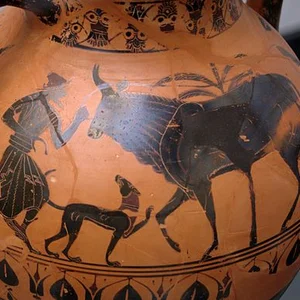
A rich iconography of Io's liberation by Hermes, attesting to the popularity of the myth.
Wall paintings showing Io welcomed by Isis on the banks of the Nile.
Anecdotes
In the myth, Zeus turns Io into a white heifer to hide her from his wife Hera. But the suspicious goddess demands the animal as a gift and places it under the watch of Argus of the hundred eyes, fifty of which always stayed open.
To free Io, Zeus sends Hermes to lull Argus to sleep with his music and his storytelling, then beheads him. In memory of her faithful guardian, Hera sets the hundred eyes of Argus on the tail of the peacock, her favorite bird.
Still in the shape of a heifer, Io is tormented by a gadfly sent by Hera that stings her without respite. Driven mad, she wanders across the world and crosses a strait that will take her name: the Bosphorus, literally the “passage of the cow.”
In Aeschylus's *Prometheus Bound*, Io meets the Titan crucified on his rock in the Caucasus. Two victims of divine wrath share their plight: Prometheus foretells her long wanderings and announces that one of her distant descendants will one day set him free.
Having reached Egypt, Io finally regains her human form on the banks of the Nile and gives birth to Epaphus. The Greeks identified her with the Egyptian goddess Isis, and some of her descendants, such as Danaus, would later return to settle in Greece.
Primary Sources
A gadfly stings me, a goad forged without fire; it pursues me with its assaults. Gripped by terror, my heart leaps and pounds against my chest.
The god strips her of her beauty and turns her into a heifer; even in this form, she remains lovely. Argus of the hundred eyes guards her, and a part of his eyes was always watching.
We glory in being descended from Io, the cow beloved of Zeus, who once wandered across this land, tormented by the gadfly.
Zeus, caught with Io, transformed her into a white heifer. Hera asked for her and set as her guardian Argus, whose body was covered with eyes.
Key Places
City in the Peloponnese where Io was a priestess at the sanctuary of Hera (the Heraion). It is her homeland and the starting point of the myth.
Strait linking the Black Sea to the Sea of Marmara, crossed by Io in the form of a heifer. Its name means “the ford of the cow.”
Mountain range where Prometheus is chained; Io meets him there during her wanderings and receives his prophecies.
Sea lying to the west of Greece, which tradition holds was named after Io's wanderings.
The end of Io's journey, where she regains her human form on the banks of the Nile and gives birth to Epaphus. The Greeks identified her there with Isis.
Typical Objects

Visual attribute of the transformed Io, a sign of the metamorphosis imposed by Zeus to disguise her. On vases, Io is often depicted as a woman wearing small horns.

The winged staff of the messenger of the gods, sent by Zeus to lull and then slay Argus. It accompanies the episode of Io's liberation.

The instrument Hermes plays to soothe and lull to sleep the hundred-eyed Argus. Music is the weapon that leaves the guardian vulnerable.

The tail adorned with the hundred eyes of Argus, which Hera places upon it after his death. The peacock becomes the goddess's emblematic bird.

Ritual ornaments and bands worn by Io as a priestess of Hera at Argos before her metamorphosis. They mark her sacred status.

The gadfly (oestrus) sent by Hera to sting the heifer Io relentlessly and doom her to wander. It symbolizes the torment of divine jealousy.
School Curriculum
Vocabulary & Tags
Key Vocabulary
Daily Life
Morning
Before her metamorphosis, Io began her day at the sanctuary of Hera at Argos, wearing the headbands of a priestess. She tended to the purity of the temple and prepared the first offerings of the morning.
Afternoon
Her afternoons were divided between the rites in honor of the goddess, the upkeep of the altars, and the welcoming of worshippers who came to pray to Hera, guardian of marriage.
Evening
In the evening, in the myth, Io endured the visits of Zeus in disguise and the troubling dreams sent by the god. After her transformation, her evenings became those of a wandering beast, without rest.
Food
As a priestess, Io shared the frugal diet of the Greek world: barley cakes, olives, figs, and a little wine cut with water. Turned into a heifer, she fed only on grass and leaves.
Clothing
As a priestess, she wore a long woolen *peplos*, belted at the waist, and the sacred fillets marking her office. Artists later depict her as a woman with the small horns of a heifer.
Housing
She lived within the precinct of the sanctuary of Hera, near Argos, a consecrated dwelling. In the form of a heifer pursued by the gadfly, she had no roof other than the sky of the lands she crossed.
Historical Timeline
Period Vocabulary
Liens externes & ressources
Références
Œuvres
Prométhée enchaîné (Eschyle)
Ve s. av. J.-C.
Les Suppliantes (Eschyle)
vers 463 av. J.-C.
Les Métamorphoses, livre I (Ovide)
vers 8 ap. J.-C.
Bibliothèque (Apollodore)
Ier-IIe s. ap. J.-C.
Histoires, livre I (Hérodote)
vers 440 av. J.-C.
Vases attiques figurant Io et Argos
Ve-IVe s. av. J.-C.
Fresques pompéiennes d'Io en Égypte
Ier s. ap. J.-C.