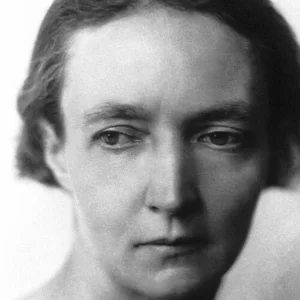

French physicist and chemist, daughter of Pierre and Marie Curie. With her husband Frédéric Joliot-Curie, she discovered artificial radioactivity in 1934, which earned them the Nobel Prize in Chemistry in 1935.
Irène Joliot-Curie(1897 — 1956)
Irène Joliot-Curie
France
6 min read
Frequently asked questions
Key Facts
- Born in 1897 in Paris, daughter of Marie and Pierre Curie
- Discovers artificial radioactivity with Frédéric Joliot-Curie in 1934
- Receives the Nobel Prize in Chemistry in 1935 with her husband
- Becomes Under-Secretary of State for Scientific Research in 1936 under the Popular Front
- Dies in 1956 of leukaemia linked to her exposure to radiation
Works & Achievements
Research work that established Irène as a leading physicist, in direct continuity with her mother's discoveries about polonium.
With Frédéric, she proved that stable elements can be made radioactive: a revolution that paved the way for radioelements manufactured for medicine and industry.
Recognition from the scientific community for the synthesis of new radioactive elements, shared with her husband Frédéric Joliot-Curie.
With Pavel Savitch, she identified unexpected products from the bombardment of uranium, a decisive contribution toward understanding nuclear fission.
A pioneering political commitment: Irène took part in structuring French public research, laying the foundations for the future CNRS.
She led the famous institute and designed a major nuclear physics center at Orsay, completed after her death, to give France modern research facilities.
Anecdotes
During World War I, Irène was only 17-18 years old when she accompanied her mother Marie Curie to the front. Together, they set up and operated the "petites Curies
(little Curies)
mobile radiology vehicles that allowed surgeons to locate shrapnel and bullets in the bodies of wounded soldiers.
In 1935, Irène and her husband Frédéric received the Nobel Prize in Chemistry for artificial radioactivity. The family became a true Nobel dynasty: with Marie Curie's two prizes and Pierre's, the Curie-Joliots held a unique record for scientific awards within a single family.
In 1936, Irène became Undersecretary of State for Scientific Research in Léon Blum's Popular Front government. She was one of the first three women to join a French government — even though French women did not yet have the right to vote, which they would only obtain in 1944.
Together with Frédéric, Irène observed strange radiation during her experiments in 1932, but it was the English physicist James Chadwick who drew the conclusion: the neutron. Frustrated at having "missed" this discovery, the couple redoubled their efforts, which led them two years later to artificial radioactivity.
In 1938, by bombarding uranium with neutrons, Irène and her colleague Pavel Savitch detected a strange element that resembled lanthanum. Without realizing it, they had brushed against nuclear fission, which would be explained shortly afterward by Hahn, Strassmann and Lise Meitner.
Primary Sources
Certain light elements, such as boron, magnesium, and aluminum, when bombarded by the alpha rays of polonium, continue to emit radiation even after the source is removed: they have themselves become radioactive.
We have shown that it is possible to artificially create radioactive elements by transmuting stable atoms, thus opening a new field to chemistry and nuclear physics.
Aluminum irradiated by alpha particles transforms into a radioactive isotope of phosphorus, which then decays by emitting positrons.
Key Places
Irène's birthplace, where she spent most of her life and where she died in 1956. The heart of French scientific research at the time.
The laboratory founded by Marie Curie where Irène carried out her research and which she eventually came to lead from 1946. It was there that she discovered artificial radioactivity.
The university where Irène pursued her higher studies in physics and chemistry before defending her thesis on the alpha rays of polonium in 1925.
A seaside hamlet near Ploubazlanec where the Curie family spent their holidays, nicknamed “Fort-la-Science” because of the many scholars who gathered there.
The capital where Irène and Frédéric received the Nobel Prize in Chemistry in December 1935 and where she delivered her Nobel lecture.
Typical Objects

An instrument that detects and counts the particles emitted by radioactive bodies through tiny electrical discharges. It was essential for measuring the artificial radioactivity created by the Joliot-Curies.

A device filled with supersaturated vapour that makes the paths of particles visible as fine trails. The Joliot-Curies used it to observe positrons and neutrons.

A small amount of polonium, the element discovered by Marie Curie, used as a source of alpha particles. It was by bombarding light metals with these particles that Irène obtained artificial radioactivity.

A book in which experiments, measurements and hypotheses are recorded day after day. Those of the Curies are so radioactive that they are kept today in lead-lined boxes.

A working garment worn by researchers to protect themselves from chemicals. At the time, no one yet knew that it offered no protection at all against invisible radiation.

A car fitted with an X-ray machine and a dynamo, deployed near the front during the First World War. There Irène trained the operators and herself X-rayed many wounded soldiers.
School Curriculum
Vocabulary & Tags
Key Vocabulary
Daily Life
Morning
Irène began her day early at the Radium Institute, slipping on her lab coat to prepare her radioactive sources and measuring instruments. Methodical and quiet, she carefully recorded every experiment in her notebooks.
Afternoon
Afternoons were spent in the laboratory, bombarding light metals with alpha particles and watching the counters and the cloud chamber. She discussed the results with Frédéric, her husband and research partner.
Evening
In the evening, back at the Paris apartment, she rejoined her two children, Hélène and Pierre. A keen reader, swimmer, and hiker, she also loved poetry and music.
Food
The Joliot-Curies ate much like the intellectual middle class of interwar Paris: simple, regular meals. On holiday in Brittany, they enjoyed the local seafood.
Clothing
In the laboratory, Irène wore the plain white lab coat of researchers. In town, she dressed with the quiet simplicity inherited from her mother, with no taste for luxury or high society.
Housing
The family lived in a Paris apartment close to the laboratories and spent summers at the family home in Arcouest, in Brittany, a place of relaxation and reflection among scholars.
Historical Timeline
Period Vocabulary
Liens externes & ressources
Références
Œuvres
Thèse de doctorat sur les rayons alpha du polonium
1925
Découverte de la radioactivité artificielle
1934
Prix Nobel de chimie
1935
Travaux sur la fission de l'uranium
1938
Sous-secrétariat d'État à la Recherche scientifique
1936
Direction de l'Institut du radium et projet du laboratoire d'Orsay
1946-1956