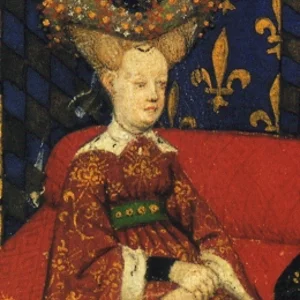

Queen of France through her marriage to Charles VI, Isabeau of Bavaria played a major political role during the king's bouts of madness. Regent and a central figure in the civil war between the Armagnacs and the Burgundians, she remains associated with the Treaty of Troyes of 1420.
Isabeau of Bavaria(1370 — 1435)
Isabeau of Bavaria
France
6 min read
Frequently asked questions
Key Facts
- Born around 1370 in Munich, she married King Charles VI of France in 1385.
- From 1392 onward, during Charles VI's bouts of insanity, she took part in governing the kingdom and presided over councils.
- She was caught up in the civil war between the Armagnacs and the Burgundians that tore France apart from 1407 onward.
- In 1420, she was associated with the Treaty of Troyes, which recognized Henry V of England as heir to the throne, setting aside the dauphin Charles.
- Mother of Charles VII and Catherine of Valois, she died in Paris in 1435.
Works & Achievements
During Charles VI's bouts of madness, Isabeau took part in and then presided over the councils tasked with governing the kingdom in the king's name.
Charles VI officially entrusted her with the role of arbiter in the conflicts between the princes of the blood, granting her exceptional political power for a queen.
Her daughter Isabella married King Richard II of England, an alliance that sealed a truce in the Hundred Years' War.
Isabeau patronized Christine de Pizan and received a sumptuous illuminated collection of her works, a testament to royal patronage.
On behalf of the incapacitated king, she appeared among the signatories of the agreement that made Henry V the heir to the French crown and married her daughter Catherine to the English king.
The union of her daughter Catherine with Henry V of England, provided for by the Treaty of Troyes, would give birth to the future Henry VI, claimant to both crowns.
Anecdotes
In July 1385, Isabeau, a Bavarian princess of about fifteen, was presented to the young Charles VI at Amiens. According to the chronicler Froissart, the king fell in love with her at once and hastened the marriage, which was celebrated only three days after their meeting.
On 22 August 1389, Isabeau made her solemn entry into Paris for her coronation. The chroniclers describe a lavish procession: fountains flowing with wine, living tableaux, and tapestries hung along the streets. A man dressed as an angel descended from a scaffold by a mechanism to place a crown upon her head.
In January 1393, during the infamous "Ball of the Burning Men
(Bal des Ardents)
dancers disguised as wild men covered in flammable hair caught fire near Charles VI. The king was saved at the last moment by the Duchess of Berry
who threw her gown over him. Isabeau
terrified
believed her husband was dead.
In 1405, the writer Christine de Pizan addressed a famous letter to Isabeau, the "Epistle to the Queen
(Epistre à la reine)
imploring her to use her authority to reconcile the dukes of Orléans and Burgundy and to prevent civil war.
After her death, a "black legend" grew up around Isabeau, accusing her of debauchery and treason. Modern historians have shown that these accusations stem mostly from propaganda born of the civil war rather than from established facts.
Primary Sources
The abbey's official chronicler describes the queen's triumphal entry into Paris in 1389 and, later, the bouts of madness afflicting the king that threw the governance of the realm into turmoil.
“To the most high, most excellent and most revered lady, my lady Ysabel, by the grace of God queen of France” — the author implores the queen to act as a mediator for peace among the princes.
Froissart recounts the meeting at Amiens in 1385 and the dazzlement of the young Charles VI before Isabeau, as well as the splendour of her joyous entry into Paris.
The agreement stipulates that King Henry V of England will marry Catherine of France and become heir and regent of the realm, excluding the Dauphin Charles from the succession.
The Burgundian chronicler reports the episodes of the civil war between the Armagnacs and the Burgundians, the queen's exile to Tours in 1417 and her rallying to the Burgundian party.
Key Places
Isabeau's birthplace, at the heart of the Duchy of Bavaria-Ingolstadt ruled by her family.
The city where Isabeau met Charles VI and married him in 1385.
The royal Parisian residence where the court of Charles VI and Isabeau lived; she died in Paris in 1435.
The city where Isabeau was exiled and kept away from power by the Armagnacs in 1417.
Where the 1420 treaty was signed, in which Isabeau and the Burgundians recognized Henry V as heir to the throne.
The necropolis of the kings of France where Isabeau was buried after her death in 1435.
Typical Objects

Symbol of her dignity as queen of France, worn at her coronation and at the great ceremonies.

Tall conical headdress of the court ladies, whose extravagant fashion has remained associated with the reign of Charles VI and Isabeau's entourage.

Matrix used to validate her acts and ordinances, indispensable when she exercised power in the name of the ailing king.

Lavish illuminated manuscript gathering the works of Christine de Pizan, made for Isabeau around 1414 (today at the British Library).

Covered, richly adorned carriage in which the queen paraded during solemn entries, such as the one into Paris in 1389.

Jewelry, goldsmith's work, and precious court objects, signs of splendor and instruments of diplomatic gift-giving.

Ceremonial garment of precious cloth and furs that displayed the queen's rank and wealth.
School Curriculum
Vocabulary & Tags
Key Vocabulary
Daily Life
Morning
The queen begins her day with prayer and Mass in her private chapel, attended by her ladies-in-waiting. Then come her careful grooming and dressing, lengthy rituals befitting her rank.
Afternoon
The afternoon is devoted to audiences, to receiving ambassadors and, in times of crisis, to council sessions. When the weather allows, she strolls through the gardens of the Hôtel Saint-Pol or oversees the education of her many children.
Evening
Evening gathers the court around banquets, music and dancing. People also play chess, dice or cards, and minstrels entertain the assembly.
Food
The royal table is rich in roasted meats, game and, on days of abstinence, fish, seasoned with costly spices brought from the East. Wine flows abundantly, and desserts of candied fruits and spices close the meals.
Clothing
Isabeau wears long gowns of precious cloth and silk, lined with fur and embroidered with gold thread. Tall headdresses and jewels signal her rank, and the fashion of the court of **Charles VI** is famed for its extravagance.
Housing
The queen resides chiefly at the Hôtel Saint-Pol in Paris, a vast royal residence equipped with gardens, galleries and even a menagerie. The court also moves between royal castles according to the seasons and political unrest.
Historical Timeline
Period Vocabulary
Liens externes & ressources
Références
Œuvres
Présidence du conseil de régence
à partir de 1393
Ordonnance d'arbitrage entre les princes
1402
Mariage diplomatique d'Isabelle de France
1396
Commande du Livre de la Reine
vers 1414
Traité de Troyes
1420
Mariage de Catherine de France
1420