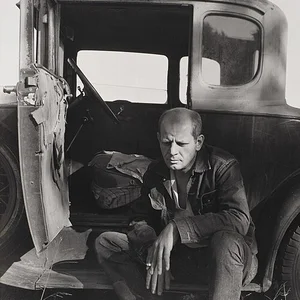

American painter (1912-1956), a major figure of Abstract Expressionism. The inventor of “dripping,” he revolutionized painting by flinging color onto canvases laid on the floor.
Jackson Pollock(1912 — 1956)
Jackson Pollock
États-Unis
6 min read
Frequently asked questions
Famous Quotes
« When I am in my painting, I'm not aware of what I'm doing.»
Key Facts
- Born in 1912 in Cody (Wyoming), died in 1956 in a car accident.
- From 1947 onward, developed the “dripping” technique (flinging and pouring paint).
- Central figure of American Abstract Expressionism (Action Painting).
- Created famous works such as “Number 1, 1948” and “Autumn Rhythm” (1950).
- A 1949 Life Magazine feature made him a star of American art.
Works & Achievements
An early, still-figurative work influenced by Surrealism and Picasso, before his shift to total abstraction.
A huge canvas commissioned by Peggy Guggenheim for her entrance hall; a turning point toward large-scale gestural painting.
One of the first major drip paintings, embedding nails, coins, and cigarette butts into the painted surface.
An iconic drip painting in which Pollock left the imprint of his hands at the top of the canvas.
A canvas that became famous for fetching record-breaking prices on the art market decades later.
A vast web of black, brown, and white drips, regarded as a high point of Abstract Expressionism.
A subtle interlacing of colors evoking a mist; one of the artist's most admired works.
A large canvas given rhythm by eight tilted blue “poles,” a major late work marking a return to color.
Anecdotes
In 1947, in his studio in Springs (Long Island), Pollock stopped painting on an easel and laid his canvases directly on the floor. He moved around them, letting paint flow from sticks, trowels, and hardened brushes: this was the birth of *dripping*, his signature technique.
In August 1949, *Life* magazine published an article with a provocative title: “Is Jackson Pollock the greatest living painter in the United States?” Overnight, this marginal painter became a national celebrity, which only deepened his anxiety and his troubled relationship with fame.
Pollock hated being told that he painted at random. He insisted: “I can control the flow of paint; there is no accident.” He compared his work to that of Native American sand painters, who also draw on the ground in a ritual gesture.
The photographer **Hans Namuth** filmed Pollock painting in 1950, sometimes on a sheet of glass seen from below. These images, showing the painter in full motion, contributed enormously to building the myth of the “gestural” painter.
Pollock died on **August 11, 1956**, at the age of 44, in a car accident near his home while driving drunk. His reputation, already immense, became almost legendary after his untimely death.
Primary Sources
On the floor I am more at ease. I feel nearer, more a part of the painting, since this way I can walk around it, work from the four sides and literally be in the painting.
Modern painting expresses the world we live in — the airplane, the atom bomb, the radio. Each age finds its own technique.
An article introducing the painter and his paint-pouring technique to the American public, propelling him to national fame.
Key Places
Town in the American West where Jackson Pollock was born in 1912, into a modest family that would move frequently to Arizona and California.
New York school where Pollock studied from 1930 under the Regionalist painter Thomas Hart Benton.
Home and studio where Pollock settled in 1945 with Lee Krasner; it was there that he invented drip painting and created his major works.
Peggy Guggenheim's gallery where Pollock held his first solo exhibition in 1943, launching his career.
Liens externes & ressources
Références
Œuvres
Mâle et femelle (Male and Female)
1942
Full Fathom Five
1947
Number 1A, 1948
1948
Number 5, 1948
1948
Autumn Rhythm (Number 30)
1950
Lavender Mist (Number 1, 1950)
1950