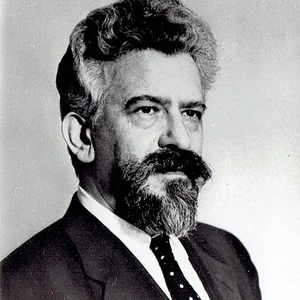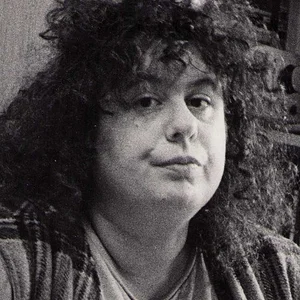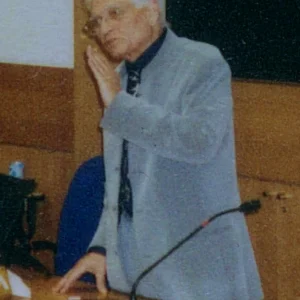

Jacques Derrida is a French philosopher, the founder of deconstruction, a major current of contemporary thought. He profoundly influenced philosophy, literary criticism, and the humanities throughout the world.
Jacques Derrida(1930 — 2004)
Jacques Derrida
France
5 min read
Frequently asked questions
Famous Quotes
« There is nothing outside the text.»
« Every other is wholly other.»
Key Facts
- Born in 1930 in El-Biar, in French Algeria, into a Sephardic Jewish family
- Published three founding works in 1967: “Of Grammatology,” “Writing and Difference,” and “Voice and Phenomenon”
- Developed the concept of deconstruction, a method for critically analyzing texts and the oppositions of metaphysics
- Co-founded the International College of Philosophy in Paris in 1983
- Died in 2004 in Paris, leaving behind a body of work translated and debated worldwide
Works & Achievements
A collection of essays in dialogue with philosophy, psychoanalysis, and literature that establishes deconstruction.
A foundational work that critiques the primacy granted to speech over writing in Western thought.
A critical reading of Husserl's phenomenology, in which Derrida refines the concept of différance.
A collection containing the lecture “Différance,” a text central to understanding his method.
An experimental two-column book interweaving Hegel and Jean Genet, pushing philosophical writing toward literature.
A reflection on Marx's legacy and on justice following the fall of communism in the East.
A lecture, later a book, questioning the boundary between human and animal in the philosophical tradition.
Anecdotes
Jacques Derrida was born in 1930 in El Biar, near Algiers, into an Algerian Jewish family. In 1942, under the Vichy regime and its antisemitic laws, he was expelled from his secondary school because he was Jewish. This experience of exclusion deeply shaped his thinking about identity and belonging.
As a teenager, Derrida dreamed of becoming a professional footballer before developing a passion for philosophy. He failed the entrance exam for the École normale supérieure twice before finally being admitted in 1952 — proof that even the greatest thinkers can have difficult beginnings.
In 1967, Derrida published three books in the same year, including *Of Grammatology*, a feat that propelled him to the forefront of the French intellectual scene. The word “deconstruction” that he coined would become one of the most discussed — and sometimes most misunderstood — concepts of the 20th century.
In 1992, the University of Cambridge wanted to award Derrida an honorary doctorate, but around twenty philosophers from around the world signed a public letter opposing it, judging his work obscure. After a rare vote by the university's members, the title was granted to him nonetheless.
Derrida adored cats and loved to recount how the gaze of his cat, catching him naked in his bathroom, had led him to reflect on the boundary between the human and the animal — the starting point of one of his last great philosophical texts.
Primary Sources
There is nothing outside the text.
We cannot escape a certain closure of metaphysics by remaining within it and displacing it simultaneously.
Différance is what makes the movement of signification possible only if each element said to be present relates to something other than itself.
The animal looks at us, and we are naked before it. And thinking perhaps begins there.
Key Places
Derrida's birthplace, in French Algeria, where he spent his childhood through his teenage years.
The prestigious school where Derrida studied and then taught philosophy for some twenty years.
The institution where he served as director of studies from 1987 and led his famous seminars.
Site of a landmark 1966 conference that opened up a vast American audience for Derrida.
The town where Derrida lived for much of his adult life with his family.
Typical Objects

His most famous work, published in 1967, which lays the foundations of deconstruction and questions the relationship between writing and speech.

A writing tool of 20th-century intellectuals, on which Derrida typed part of his manuscripts before the arrival of the computer.

Derrida filled notebooks with handwritten notes, jotted down by hand, which he regarded as a living material of thought.

Like many intellectuals of his generation, Derrida was often photographed with a pipe in hand, an emblematic attribute of the 20th-century thinker.

Derrida gave countless lectures and seminars in France and abroad; the lectern symbolizes his international influence.

Derrida kept an immense personal archive of drafts and correspondence, today invaluable for studying his thought.
School Curriculum
Vocabulary & Tags
Key Vocabulary
Daily Life
Morning
Derrida rose early and often devoted his mornings to writing, in the quiet of his study cluttered with books and papers. He liked to work at length on each sentence, crossing out and reworking his texts.
Afternoon
The afternoon was dedicated to teaching: seminars at the EHESS, preparing lectures, reading. His seminars drew students and researchers from all over the world.
Evening
In the evening, Derrida would read, host intellectual friends, or keep up his vast correspondence with philosophers and writers from around the world.
Food
Like many French people of his generation, he enjoyed simple, convivial cooking, also shaped by the Mediterranean flavors of his native Algeria. Meals were occasions for exchange and discussion.
Clothing
Derrida took care over his appearance: a suit, jacket, shirt, and his distinctive white hair made him an instantly recognizable figure, at once elegant and intellectual.
Housing
He lived much of his life in Ris-Orangis, on the outskirts of Paris, in a house where his thousands of books and his manuscript archives piled up.
Historical Timeline
Period Vocabulary
Liens externes & ressources
Références
Œuvres
L'écriture et la différence
1967
De la grammatologie
1967
La voix et le phénomène
1967
Marges — de la philosophie
1972
Spectres de Marx
1993
L'animal que donc je suis
1997