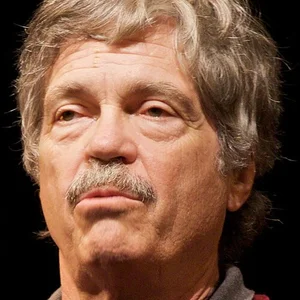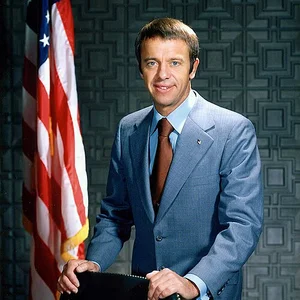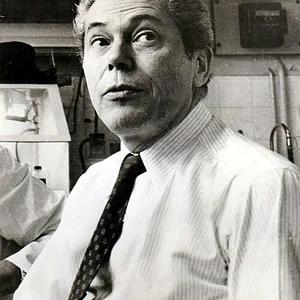

French biologist and biochemist (1910–1976), Nobel Prize in Physiology or Medicine in 1965. Together with François Jacob and André Lwoff, he discovered the mechanisms of genetic regulation, most notably the concept of the operon.
Jacques Monod(1910 — 1976)
Jacques Monod
France
8 min read
Frequently asked questions
Famous Quotes
« What is true for E. coli is true for the elephant.»
« Chance alone is at the source of every innovation, of all creation in the biosphere.»
Key Facts
- 1910: born in Paris
- 1965: Nobel Prize in Physiology or Medicine (shared with Jacob and Lwoff)
- 1961: publication of the operon model in the Journal of Molecular Biology
- 1970: publication of *Chance and Necessity*, a landmark philosophical essay
- 1971: appointed director of the Institut Pasteur
Works & Achievements
Doctoral thesis in which Monod describes the phenomenon of diauxie — bacterial growth in two successive phases depending on available sugars. This observation was the starting point for all his scientific work on genetic regulation.
Landmark paper published in the Journal of Molecular Biology, in which the operon model is described for the first time. This publication is considered one of the cornerstones of modern molecular biology.
Paper in which Monod, Jacob, and Changeux lay the theoretical groundwork for allosteric interactions — mechanisms by which certain proteins change their shape and function. This concept revolutionized the understanding of enzymatic regulation.
Nobel lecture in which Monod traces the intellectual journey that led from enzymatic adaptation to the discovery of allosteric proteins and the operon concept — a key reference for understanding the origins of molecular biology.
A major philosophical essay in which Monod draws out the implications of molecular biology for the meaning of human existence. Translated into more than twenty languages, it became a worldwide bestseller and sparked heated debates among scientists, philosophers, and theologians.
Anecdotes
During World War II, Jacques Monod led a remarkable double life: by day, he continued his research on bacteria at the Sorbonne; by night, he risked his life as an officer in the French Forces of the Interior (FFI). He played an active role in the Resistance and helped coordinate sabotage operations against the Nazi occupiers, never once abandoning his scientific work.
The concept of the operon was born partly from an informal conversation between Monod and François Jacob. Jacob reportedly realized that their two research subjects — phages and lactose — obeyed the same mechanism of genetic regulation. This shared intuition led to one of the greatest discoveries in twentieth-century molecular biology.
Jacques Monod was a passionate music lover who played the clarinet with great skill. He co-founded a chamber music ensemble in Paris and seriously considered a musical career before choosing biology. This artistic sensibility undoubtedly nourished his philosophical thinking, as seen in his major work 'Chance and Necessity'.
At the Nobel Prize ceremony in 1965, Monod, Jacob, and Lwoff shared an exceptionally rare distinction: three researchers from the same laboratory, the Institut Pasteur, honored in the same year for interrelated work. It was celebrated as an extraordinary triumph for French science.
His philosophical book 'Chance and Necessity' (1970) caused a scandal among Marxists and believers alike. Monod argued that humanity arose by pure chance in a universe indifferent to any purpose or goal. The work nonetheless became a worldwide bestseller, translated into more than twenty languages — exceptional for a book of philosophy of science.
Primary Sources
Chance alone is at the source of every innovation, of all creation in the biosphere. Pure chance, absolutely free but blind, at the very root of the stupendous edifice of evolution.
The synthesis of some proteins is under the control of regulator genes acting through cytoplasmic mediators. We propose to designate as 'operon' a group of genes whose expression is coordinated by an operator.
The concept of allosteric interactions emerged from the study of enzyme kinetics and regulatory phenomena. It implies that certain proteins possess specific receptor sites for metabolites which, when bound, alter the protein's conformation and therefore its catalytic or functional activity.
We wish to propose that the interactions between the specific ligand and the protein involve a conformational change of the protein, and that this change is responsible for the modification of the protein's activity toward its substrate.
Key Places
Birthplace of Jacques Monod on February 9, 1910. He grew up in a cultured, bourgeois household — his father was a painter and his mother of American origin, giving him a bilingual French-English childhood.
The setting for Monod's entire scientific career from 1945 onward. It was in these legendary laboratories that he conducted, alongside François Jacob and André Lwoff, the research on genetic regulation that earned them the Nobel Prize. He became Director General of the institute in 1971.
Where Monod studied biology and later taught as a laboratory instructor in the 1940s. It was here that he carried out his earliest research on bacterial diauxie, which ultimately led to the discovery of the operon.
Monod spent time here in 1936 in Thomas Hunt Morgan's laboratory. This formative stay opened his eyes to modern genetics and shaped the direction of his entire scientific career.
The city where Jacques Monod died on May 31, 1976, from aplastic anemia. He had been staying in the south of France, drawn there by the Mediterranean and his lifelong passion for sailing.
Typical Objects

A key instrument in Monod's laboratory for measuring bacterial growth and enzyme production. It was by observing the growth curves of Escherichia coli through a spectrophotometer that he discovered the phenomenon of diauxie, the starting point of his work on genetic regulation.

The bacterium E. coli was the central experimental model throughout Monod's entire career. He used it to elucidate how genes are activated or repressed depending on available nutrients, thereby laying the foundations of the molecular biology of prokaryotes.

Monod was an accomplished clarinettist and co-founder of a Parisian chamber music quartet. His passion for music accompanied him throughout his life and nourished his philosophical thinking on order, chance, and creativity.

Monod meticulously recorded his experiments, hypotheses, and results in his laboratory notebooks. These archives, preserved at the Institut Pasteur, bear witness to the rigorous progression of his ideas on the operon.

Three-dimensional models representing the structure of proteins and DNA were ubiquitous in molecular biology laboratories of the 1950s–1970s. Monod used them to visualize and explain the mechanisms of genetic regulation and the conformational changes of allosteric proteins.

Monod had a passion for sailing and regularly navigated the Mediterranean. This activity allowed him to escape the laboratory and reflect on his work, and embodied his taste for physical and intellectual challenges.
School Curriculum
Vocabulary & Tags
Key Vocabulary
Daily Life
Morning
Monod arrived early at the Institut Pasteur, usually before 8 a.m. He would start his day by checking the bacterial cultures set up the previous evening, recording growth measurements with the spectrophotometer, and discussing results with his collaborators. He was known for his rigor and high standards — both for himself and for his students.
Afternoon
Afternoons were devoted to experiments proper, lab meetings, and scientific exchanges with colleagues at the Institut Pasteur, notably François Jacob and André Lwoff. Monod enjoyed animated discussions and debates of ideas, which he conducted with an intellectual elegance tinged with humor.
Evening
Monod's evenings were often musical: he played clarinet in his chamber quartet or attended concerts. He also welcomed scientists, philosophers, and writers to his home — he was notably close to Albert Camus. Reading, philosophy, and political debate filled his late evenings.
Food
Like many Parisian intellectuals of his era, Monod appreciated French gastronomy, lively lunches at restaurants with his collaborators, and good wine. His passion for sailing and outdoor activities gave him a hearty appetite and a relatively active lifestyle for a laboratory researcher.
Clothing
Monod had the relaxed elegance of the Parisian intellectual of the 1950s–1970s: a dark suit during the day at the lab or at conferences, a sweater and canvas trousers when out sailing. He often wore a tweed jacket, the hallmark of academic seriousness at the time.
Housing
Monod lived in an apartment in the Latin Quarter of Paris, at the heart of the capital's intellectual and scientific life. He also owned a sailboat on which he spent his holidays in the Mediterranean — a passion that allowed him to escape the laboratory and let his scientific and philosophical reflections mature.
Historical Timeline
Period Vocabulary
Liens externes & ressources
Références
Œuvres
La croissance des cultures bactériennes (thèse de doctorat)
1941
Genetic Regulatory Mechanisms in the Synthesis of Proteins (avec François Jacob)
1961
Allosteric Proteins and Cellular Control Systems (avec Changeux et Jacob)
1963
Conférence Nobel : From Enzymatic Adaptation to Allosteric Transitions
1965
Le Hasard et la Nécessité
1970