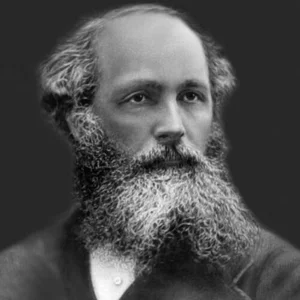

Scottish physicist and mathematician (1831–1879), Maxwell authored the unifying equations of electromagnetism. His work predicted the existence of electromagnetic waves and inspired Einstein in developing the theory of special relativity.
James Clerk Maxwell(1831 — 1879)
James Clerk Maxwell
Royaume-Uni de Grande-Bretagne et d'Irlande
9 min read
Frequently asked questions
Famous Quotes
« The special theory of relativity owes its origins to Maxwell's equations of the electromagnetic field.»
« We can scarcely avoid the conclusion that light consists in the transverse undulations of the same medium which is the cause of electric and magnetic phenomena.»
Key Facts
- 1831: born in Edinburgh, Scotland
- 1861–1862: formulation of the equations of electromagnetism (Maxwell's equations)
- 1864: theoretical prediction of the existence of electromagnetic waves
- 1867: major contribution to the kinetic theory of gases (Maxwell–Boltzmann distribution)
- 1879: died in Cambridge at age 48
Works & Achievements
Prize-winning memoir awarded the Adams Prize at Cambridge, in which Maxwell mathematically demonstrates that Saturn's rings can be neither solid nor liquid, but must consist of separate particles in orbit — a conclusion confirmed by Voyager 1 in 1980.
In this paper Maxwell establishes the law governing the distribution of molecular velocities in a gas (the Maxwell-Boltzmann distribution), placing the kinetic theory of gases on rigorous statistical foundations.
A four-part article in which Maxwell introduces the revolutionary concept of the "displacement current" to make the equations of electromagnetism self-consistent. It is in this work that the prediction of electromagnetic waves appears for the first time.
A landmark theoretical synthesis in which Maxwell presents for the first time his unifying equations of electricity, magnetism, and optics, and identifies light as an electromagnetic wave.
Experimental production of the first permanent colour photographic image, obtained by combining three exposures taken through red, green, and blue filters. Publicly demonstrated at the Royal Institution in London on 17 May 1861.
A monumental two-volume encyclopaedic work that gives formal shape to the whole of electromagnetic theory. A standard reference for an entire generation of physicists, it directly influenced Heinrich Hertz, Oliver Lodge, and later Albert Einstein.
Anecdotes
At just 14 years old, Maxwell submitted a paper to the Royal Society of Edinburgh presenting an original geometric method for drawing elliptical curves using a simple thread and two pins. The society, believing they were dealing with an adult, only discovered afterward that the author was a schoolboy. The text was deemed so rigorous that it was read aloud at a session by a professor on his behalf.
On 17 May 1861, Maxwell produced the first permanent color photograph in history, by simultaneously projecting three images taken through red, green, and blue filters. He chose a Scottish tartan ribbon as his subject. This demonstration before the Royal Institution in London astonished the audience and laid the foundations of modern color photography and the color screen.
While deriving his electromagnetic equations, Maxwell calculated that electromagnetic waves propagated at approximately 310,000 km/s — a value very close to the known speed of light at the time. He boldly concluded that light itself was an electromagnetic wave, thereby uniting optics and electromagnetism within a single theory. Einstein later described this discovery as “the greatest transformation in physics since Newton.”
In 1867, Maxwell conceived of a hypothetical microscopic creature capable of sorting fast molecules from slow ones in a gas without expending any energy, seemingly violating the second law of thermodynamics. Dubbed “Maxwell’s Demon” by Lord Kelvin in 1874, this paradox fueled scientific debate for more than a century and helped lay the foundations of information theory.
Maxwell proved through calculation, in a paper awarded the Adams Prize at Cambridge in 1857, that Saturn’s rings could be neither solid nor liquid, but must be composed of millions of independent particles in orbit. A purely theoretical conclusion, it was not confirmed until 1980 by images from the Voyager 1 probe, a century after his death.
Primary Sources
The present state of electrical science seems peculiarly unfavourable to speculation [...] I have therefore thought it might be of some use to exhibit the electrical and magnetic phenomena from a mechanical point of view, so as to give us [...] clear ideas of the action of the medium.
We have strong reason to conclude that light itself — including radiant heat, and other radiations if any — is an electromagnetic disturbance in the form of waves propagated through the electromagnetic field according to electromagnetic laws.
Before I began the study of electricity I resolved to read no mathematics on the subject till I had first read through Faraday's Experimental Researches in Electricity. I was aware that there was supposed to be a difference between Faraday's way of conceiving phenomena and that of the mathematicians.
If we suppose that [...] the number of particles whose velocities lie between v and v+dv is [...] then we have a law of distribution of velocities among the particles of a gas which, if true, will form one of the most important results of the theory.
The conclusion I have arrived at is that the rings must consist of disconnected particles — either solid or liquid — but necessarily in a state of subdivision. The effect of a continuous solid ring would be to give the whole system an angular velocity incapable of being stable.
Key Places
Maxwell's birthplace, where he was born on 13 June 1831 and received his early education at Edinburgh Academy. It was here that, at the age of 14, he wrote his first mathematical paper, which attracted the attention of the Royal Society.
Maxwell studied here from 1850 to 1854, winning the prestigious Smith's Prize jointly with Lord Kelvin. He returned in 1871 as the first Cavendish Professor to found the experimental physics laboratory.
Maxwell was appointed Professor of Natural Philosophy here in 1856, at just 25 years of age. It was in Aberdeen that he wrote his prize-winning essay on the rings of Saturn and deepened his kinetic theory of gases.
Maxwell taught here from 1860 to 1865, the most productive period of his life. It was here that he produced the first colour photograph, developed his equations of electromagnetism, and wrote his landmark 1865 paper on the dynamical theory of the electromagnetic field.
The family estate inherited by Maxwell, where he spent extended periods between 1865 and 1871. It was here, in the tranquillity of the Scottish countryside, that he wrote much of his *Treatise on Electricity and Magnetism*.
Maxwell was the intellectual architect and first director of this laboratory, founded in 1874, which went on to become one of the most important centres of experimental physics in the world. He trained an entire generation of British physicists here.
Typical Objects

An instrument for measuring weak electric currents, used by Maxwell to verify his theoretical predictions about electromagnetic fields. He employed it in his demonstrations at the Cavendish Laboratory.

A spinning top painted with coloured sectors that Maxwell spun rapidly to demonstrate the additive mixing of colours. This teaching tool illustrated his research into colour perception and colorimetry.

Maxwell used three successive photographic plates with red, green, and blue filters to produce the first colour photograph in 1861. Overlaying the three projected images created a full-colour picture.

Essential devices in electromagnetic experiments, used to study induced currents and verify Faraday's laws, which Maxwell sought to express in mathematical form.

Maxwell's primary working tool for developing and presenting his differential equations. His lectures at the Cavendish Laboratory were renowned for the density and elegance of the mathematical demonstrations he wrote out on it.

A central optical instrument in his research into the nature of light. Maxwell used it to decompose light and connect its optical properties to the electromagnetic phenomena predicted by his equations.
School Curriculum
Vocabulary & Tags
Key Vocabulary
Tags
Daily Life
Morning
Maxwell rose early and often began his day with a Bible reading or a prayer — a man of deep faith, he saw in the laws of nature the expression of a divine order. He would then devote the morning to mathematical research, in the quiet of his study, before visitors or students arrived.
Afternoon
Afternoons were reserved for teaching, experimental demonstrations in his laboratory, and meetings with colleagues. Maxwell was renowned for the intensive private tutorials he gave on Sunday mornings to Cambridge students who struggled with mathematics — an unusual and generous practice.
Evening
In the evenings, Maxwell read poetry (he wrote it himself, often humorous) or works of philosophy and theology. He enjoyed long walks in the countryside, especially across the moorland of his Scottish estate at Glenlair, and corresponded extensively with colleagues such as Lord Kelvin and Peter Guthrie Tait.
Food
Life in Cambridge in the 1860s–1870s revolved around communal meals in college halls, featuring traditional English fare — roast meats, puddings, boiled vegetables. At Glenlair, Maxwell lived more simply, sharing the rustic meals of the Scottish countryside. He is not known for any particular dietary habits.
Clothing
Like any Victorian gentleman of his standing, Maxwell wore a dark three-piece suit, buttoned waistcoat, knotted tie, and top hat for formal occasions. In his laboratory or in the country, he adopted more practical attire. His neatly groomed beard and moustache were characteristic of the masculine style of the era.
Housing
Maxwell lived in the functional rooms of Trinity College, Cambridge, in keeping with the austere style of nineteenth-century English university architecture. His preferred retreat was Glenlair, the family manor in Kirkcudbrightshire inherited from his father, surrounded by farmland, where he returned every summer to think and write away from the bustle of city life.
Historical Timeline
Period Vocabulary
Liens externes & ressources
Références
Œuvres
On the Stability of the Motion of Saturn's Rings
1859
Illustrations of the Dynamical Theory of Gases
1860
On Physical Lines of Force
1861-1862
A Dynamical Theory of the Electromagnetic Field
1865
Première photographie en couleur (tartan écossais)
1861
A Treatise on Electricity and Magnetism
1873