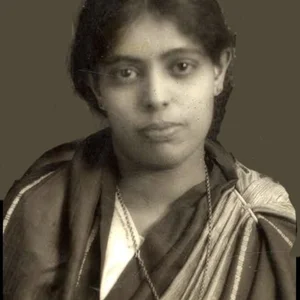

Janaki Ammal was an Indian botanist and cytogeneticist, a pioneer in the study of the chromosomes of cultivated plants. She is especially known for her work on improving sugarcane and for helping to preserve India's native flora.
Janaki Ammal(1897 — 1984)
Janaki Ammal
Inde, Raj britannique, Union indienne
6 min read
Frequently asked questions
Key Facts
- Born in 1897 in Tellicherry (Thalassery), in Kerala, British India.
- Earned a doctorate (DSc) in botany from the University of Michigan, in the United States, in 1931.
- Worked on the hybridization and polyploidy of sugarcane at the Coimbatore institute during the 1930s.
- Co-wrote the *Chromosome Atlas of Cultivated Plants* with the geneticist C. D. Darlington in 1945.
- Received the Indian Padma Shri award in 1977 and died in 1984 in Madras (Chennai).
Works & Achievements
A reference work compiling the chromosome counts of hundreds of cultivated plants and their wild relatives, long used by geneticists.
Crossbreeding work at Coimbatore aimed at producing sweeter sugarcanes suited to India, reducing the country's dependence on sugar imports.
Research showing that plants with multiplied sets of chromosomes can colonize harsher environments, linking genetics to the distribution of species.
An overhaul of the national botanical survey institution, which she led to better understand and protect India's flora.
A magnolia variety bred at Wisley and named in her honour, a lasting tribute to her horticultural work.
Scientific contribution to the campaign that saved this tropical forest in Kerala, one of the first major environmental battles in India.
Anecdotes
During her time at the Wisley garden in England, Janaki Ammal studied magnolias with such care that a variety was named in her honour: the *Magnolia kobus* 'Janaki Ammal'. Every spring, its white flowers continue to open, like a living signature left by the researcher.
In the early 20th century, India imported much of its sugar. At the Sugarcane Breeding Institute in Coimbatore, Janaki Ammal crossed cane species to create varieties that were sweeter and better suited to the Indian climate. Her work on plant chromosomes helped the country depend a little less on imports.
In 1951, Prime Minister **Jawaharlal Nehru**, who took a keen interest in science, personally invited Janaki Ammal to reorganise the Botanical Survey of India, the institution responsible for cataloguing the country's plants. She became its director general, a rare responsibility for a woman at that time.
Already over 80 years old, Janaki Ammal campaigned to save the Silent Valley forest in Kerala, threatened by a hydroelectric dam project. Her expertise as a botanist helped protect one of India's last untouched tropical rainforests.
Janaki Ammal never married and devoted her entire life to science, living simply, often near her laboratories. She was still working on her chromosome preparations almost until her death, at the age of 86, in 1984.
Primary Sources
The book compiles the chromosome counts of cultivated plants and their wild relatives, in order to shed light on the origin and improvement of species useful to humankind.
The study of the chromosomes of cane hybrids shows how to combine different species to obtain varieties better suited to the soils and climate of India.
The government calls on Janaki Ammal to reorganize the country's botanical inventory, in order to better understand and preserve India's flora.
The unique plant richness of this valley justifies protecting it from development projects that would destroy it forever.
Key Places
Coastal town in southern India where Janaki Ammal was born in 1897, into a large and cultured family.
This is where she earned her doctorate in botany in 1931, thanks to the Barbour Scholarship.
Research center in southern India where she carried out her work on sugarcane hybridization and cytogenetics.
Garden where she studied magnolias and other garden plants; a magnolia variety there bears her name.
Tropical forest she helped protect from a dam project near the end of her life.
City where she died in 1984, still active in her research laboratory.
Typical Objects

Optical instrument used to observe the cells and chromosomes of plants. It was Janaki Ammal's everyday tool for her cytogenetic studies.

Thin glass plates on which plant tissues are placed and stained. They make chromosomes visible under the microscope.

A sheet on which a dried plant is mounted and preserved with its label. It is the foundation of the botanical inventory work carried out at the Botanical Survey of India.

A notebook in which the researcher recorded observations, chromosome counts and sketches. It keeps a faithful record of every experiment.

A tropical plant whose chromosomes Janaki Ammal studied in order to create sweeter varieties. It was at the heart of her research in Coimbatore.

A traditional Indian garment made from a long draped cloth. Janaki Ammal wore it, including in the laboratories of England and the United States.
School Curriculum
Vocabulary & Tags
Key Vocabulary
Daily Life
Morning
Janaki Ammal started early, often at the laboratory by dawn. She prepared her slides of plant tissue and adjusted her microscope to observe chromosomes before the heat of the day set in.
Afternoon
The afternoon was devoted to counting, sketching chromosomes, and crossbreeding plants in greenhouses or test fields. When she led the Botanical Survey of India, she also managed collections and the organization of herbaria.
Evening
In the evening, she read scientific journals, wrote her articles, and kept up a correspondence with colleagues around the world. She lived simply, without expensive hobbies, with work occupying most of her time.
Food
A native of Kerala, she ate South Indian cuisine based on rice, lentils, vegetables, and spices. Her diet was modest and largely vegetarian.
Clothing
She wore the sari, the traditional Indian garment, which she kept even in the laboratories of England and the United States as a mark of her identity.
Housing
She lived in simple accommodations, often provided by the institutions where she worked, close to the laboratories. She placed little importance on material comfort.
Historical Timeline
Period Vocabulary
Liens externes & ressources
Références
Œuvres
Chromosome Atlas of Cultivated Plants (avec C. D. Darlington)
1945
Hybrides et variétés améliorées de canne à sucre
années 1930
Études sur la polyploïdie et la géographie des plantes
années 1930-1940
Réorganisation du Botanical Survey of India
1951-1954
Magnolia kobus 'Janaki Ammal'
1948
Engagement pour la préservation de la Silent Valley
vers 1980