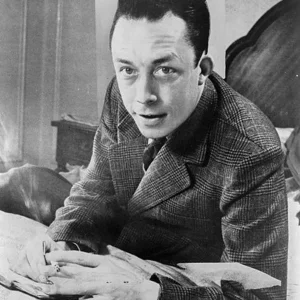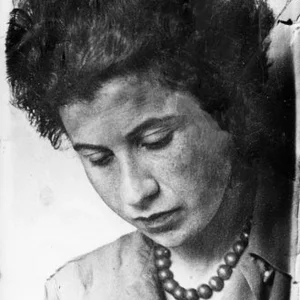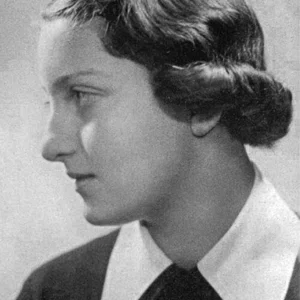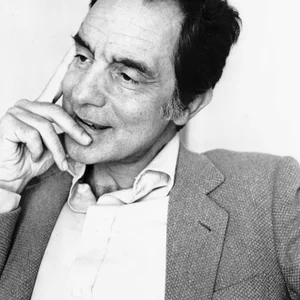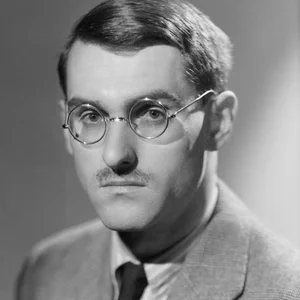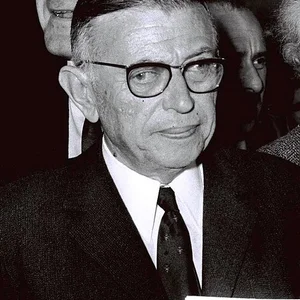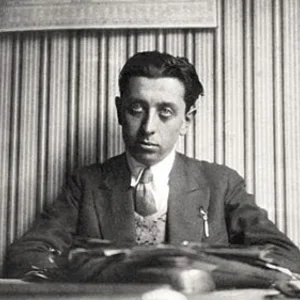

French poet (1900–1945) and major figure of Surrealism, celebrated for his wordplay and innovative poetry. A committed member of the French Resistance during World War II, he was deported and died at the Terezín concentration camp in 1945.
Robert Desnos(1900 — 1945)
Robert Desnos
France
8 min read
Frequently asked questions
Famous Quotes
« I dream and I write to set myself free»
Key Facts
- 1924: joins the Surrealist movement alongside André Breton
- 1930s: publishes his major collections including 'Liberty or Love!' and 'Corpse and Dream'
- 1940–1943: joins the French Resistance during the Nazi Occupation
- 1944: arrested by the Gestapo and deported
- June 8, 1945: dies at the Terezín concentration camp at the age of 44
Works & Achievements
Desnos's first major collection, written at the height of the Surrealist movement. He explores automatic writing and dreamlike imagery with radical formal freedom.
A Surrealist prose poem blending dream, eroticism, and adventure. Censored upon publication, it illustrates Desnos's determination to break down the boundaries between literary genres.
A poetry collection considered his Surrealist masterpiece, featuring the celebrated poem 'J'ai tant rêvé de toi' ('I Have Dreamed of You So Much'). It showcases a deeply personal lyricism and an unmatched command of language.
A collection written during the Occupation, reflecting his commitment to the French Resistance. It contains 'Ce cœur qui haïssait la guerre' ('This Heart That Hated War'), a poem that became an emblem of French Resistance poetry.
A collection of humorous rhymes and poems for children, intended to be set to music. These texts are today among the most widely read in French schools.
A sequence of sonnets composed on the eve of his arrest, written in a classical form that Desnos reinvents entirely. The collection is a testament to a refined poetic maturity.
A posthumous collection gathering previously unpublished poems, brought to print through the editorial work of his friends. It completes his body of work and reveals the depth of his artistic evolution.
Anecdotes
During the surrealist séances organized by André Breton in 1922–1923, Robert Desnos could fall asleep at will and dictate poems in a state of semi-consciousness. His surrealist companions were fascinated by this exceptional ability to access the unconscious, which earned him the nickname 'Rrose Sélavy' — a persona he shared with Marcel Duchamp.
Desnos had a passion for wordplay and homophones. He would construct entire sentences where sounds echoed one another like a mirror: 'Rrose Sélavy et moi esquivons les échos.' These surrealist puns were not mere games, but a genuine exploration of language as a tool for subversion and freedom.
During the Second World War, Desnos worked as a journalist while secretly writing underground pamphlets for the French Resistance. He was arrested by the Gestapo on February 22, 1944, at his Paris home, after being denounced. Transferred from camp to camp — Auschwitz, Buchenwald, Flossenbürg, Flöha — he continued to lift the spirits of his fellow deportees by reciting his poems in a low voice.
A few days after the liberation of the Terezín camp by Soviet forces, Robert Desnos died of typhus on June 8, 1945, at the age of 44. A young Czech student and a journalist friend, Josef Stuna, were among the last to keep him company. Recognized by a fellow deportee in a state of extreme weakness, he still managed to declare: 'I am Robert Desnos, poet.'
In the 1930s, Desnos reinvented himself as a writer of popular songs and children's poems, most notably the celebrated 'Chantefables,' intended to be set to music. These rhymes, full of humor and whimsical imagery — such as 'La Fourmi' (The Ant) and 'L'Hippopotame' (The Hippopotamus) — are still learned today by millions of French schoolchildren, securing Desnos an unexpected immortality in schoolyards.
Primary Sources
I have dreamed of you so much that you are losing your reality. Is there still time to reach that living body and kiss on that mouth the birth of the voice so dear to me?
My darling, I am writing to you from this camp where we work hard, but I think of you constantly. I am staying on my feet and I hope to see you again soon. My love for you is my only strength.
This heart that hated war — now it beats for combat and battle! This heart that beat only to the rhythm of the tides, of carefree love, now rears up and sends its blood surging through every artery.
An ant eighteen meters tall with a hat upon its head — that doesn't exist, that doesn't exist. An ant hauling a cart full of penguins and ducks — that doesn't exist, that doesn't exist.
Desnos speaks Surrealist at will. The speed of his verbal projections does not allow him to dictate them, and he traces signs on paper over which he has lost all control.
Key Places
Desnos's birthplace (4th arrondissement) and the setting of his working-class Parisian childhood, which deeply shaped his poetic imagination.
A central gathering place for the Surrealist group; it was here that Desnos took part in hypnotic sleep sessions and discussions with Breton, Éluard, and their circle.
Desnos lived and worked in this neighborhood near the Carrefour de l'Odéon, at the heart of Parisian literary and artistic life during the 1920s–1940s.
The first major stop in Desnos's deportation after his arrest in 1944; he was registered there as a political prisoner.
The final stop in Desnos's deportation journey, where he died of typhus on June 8, 1945, just a few weeks after the camp's liberation.
Typical Objects

Desnos used a typewriter to write his poems, articles, and underground pamphlets. This object symbolizes his dual commitment as both a writer and a resistance fighter.

In the 1930s, Desnos worked as a writer and voice performer for French radio. The microphone became a new poetic instrument for him, carrying his voice to a wider, popular audience.

Like many Surrealists, Desnos recorded his dreams and automatic thoughts in notebooks. These journals were the raw material of his poetic writing.

During the Occupation, Desnos wrote and distributed illegally printed resistance texts. These leaflets represent his courage in the face of Nazi censorship.

Youki Foujita, the woman he loved, was a constant presence in his life and poetry. Her photograph was always with him — a symbol of the love and freedom he longed to reclaim.

Desnos was a regular at the cafés of Montparnasse and the Saint-Germain neighborhood, where the Surrealists gathered. The café counter was the natural setting for his intellectual exchanges.
School Curriculum
Vocabulary & Tags
Key Vocabulary
Tags
Mouvement
Daily Life
Morning
Desnos often woke up late, true to the bohemian rhythm of Surrealist circles. He would have a strong black coffee at a neighborhood bistro, read the newspapers, and scribble the first lines of a poem or article in a notebook resting on the zinc bar counter.
Afternoon
In the afternoons, he worked at his desk or in libraries, writing articles for the press, radio scripts, or poems. During the Resistance years, these hours also became the time for clandestine meetings and drafting pamphlets under false names.
Evening
Desnos spent his evenings in the cafés of Montparnasse or Saint-Germain-des-Prés, in the company of poet, painter, and musician friends. Literary discussions would stretch on late into the night, sometimes punctuated by readings aloud or verbal sparring over words and sounds.
Food
Like many working-class Parisians, Desnos ate simply: soups, cheeses, cold cuts, and bistro fare. During the Occupation, the food restrictions imposed by the Germans drastically reduced the rations available to everyone.
Clothing
Desnos dressed in the style of interwar Parisian intellectuals: a dark suit or double-breasted jacket, a felt hat, a understated tie. He lacked the ostentatious dandyism of some Surrealists, preferring a quiet, functional elegance.
Housing
He lived in several modest Parisian apartments, particularly in the 6th and 14th arrondissements, bohemian and literary neighborhoods. His workspace was cluttered with books, manuscripts, and newspapers — a reflection of a life entirely devoted to writing.
Historical Timeline
Period Vocabulary
Visual Style
L'esthétique visuelle de l'univers de Desnos évoque le surréalisme parisien des années folles — onirique, typographique, en clair-obscur — puis bascule vers les tons sombres et déchirés de l'Occupation et des camps.
Sound Ambience
L'univers sonore de Desnos mêle l'effervescence des cafés surréalistes parisiens des années 1920-30 et le silence pesant de l'Occupation, ponctué par les ondes radiophoniques et le froissement de tracts clandestins.
Liens externes & ressources
Références
Œuvres
Deuil pour deuil
1924
La Liberté ou l'Amour !
1927
Corps et Biens
1930
Fortunes
1942 (publié 1945)
Chantefables et Chantefleurs
1944
Destinée arbitraire
1975 (posthume)