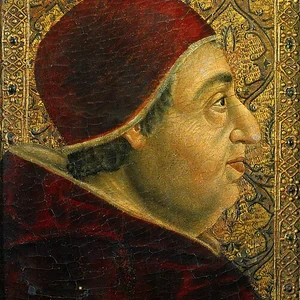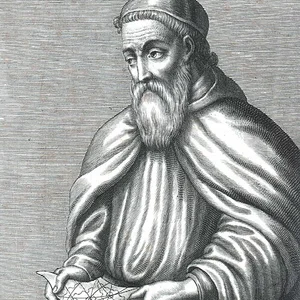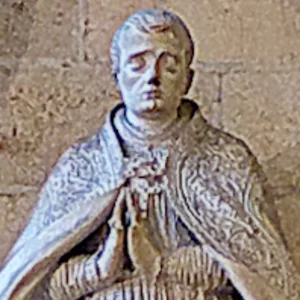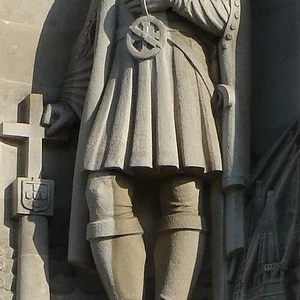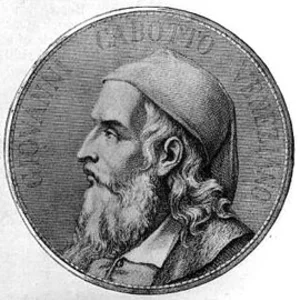

A Venetian navigator sailing in the service of England, John Cabot completed in 1497 the first crossing of the North Atlantic since Antiquity and reached the shores of North America. His voyage laid the groundwork for future English claims on the American continent.
John Cabot(1450 — 1498)
John Cabot
république de Venise
9 min read
Frequently asked questions
Key Facts
- Born around 1450 in Genoa or Venice, naturalized as a Venetian citizen
- In 1497, he set sail from Bristol aboard the Matthew and reached the shores of North America (probably Newfoundland or Labrador)
- His voyage was commissioned by King Henry VII of England, who granted him letters patent
- He is the first known European to reach the North American mainland since the Vikings
- His son Sebastian Cabot would carry on his father's work of exploration
Works & Achievements
Crossing of the North Atlantic from Bristol to the shores of North America in approximately 35 days. The first attested European expedition to reach the North American continent since the Viking explorations of the 11th century.
By planting the cross and the royal banner of England on American soil, Cabot laid the legal groundwork for future English claims to North America — the colonial foundation of what would become English-speaking Canada.
On his return voyage, Cabot reported to his Bristol backers the existence of extraordinarily fish-rich waters off Newfoundland. This discovery of the Grand Banks gave rise to the great Atlantic cod fishery that would feed Europe for centuries.
Comprising five ships and around 300 men, this more ambitious expedition aimed to establish trade contacts with what was believed to be Asia. John Cabot vanished during the voyage, from which only one damaged ship returned to Ireland.
Anecdotes
Born Giovanni Caboto in Genoa around 1450, John Cabot obtained Venetian citizenship in 1476 after fifteen years of residence in the Serenissima — a prerequisite for trading under the Venetian flag. It was by watching spice and silk caravans arriving overland from the East that he developed the idea of a direct sea route to Asia by sailing west.
In 1496, Henry VII of England granted him royal letters patent authorizing him to sail west in search of a route to Asia — on the condition that he return only through England and hand over one fifth of the profits to the Crown. Cabot had to finance the expedition himself, and a group of Bristol merchants agreed to back him in exchange for a share of future trading profits.
On 24 June 1497, the feast of St John the Baptist, John Cabot reached the shores of North America aboard the Matthew, a vessel of barely 50 tons crewed by around twenty men. He planted a cross and the flags of England and Venice, claiming the land in the king's name — but like Columbus, he was convinced he had reached the shores of eastern Asia.
On his return to Bristol in August 1497, Cabot was celebrated as a hero throughout the kingdom: Henry VII awarded him a reward of just ten pounds sterling — the equivalent of a few weeks' wages for a skilled craftsman — and then an annual pension of twenty pounds. This modest royal reward stands in stark contrast to the historical magnitude of his discovery.
In 1498, Cabot set out again with five ships and around 300 men on a second expedition intended to establish trading posts in Asia. He never returned, and to this day no one knows what became of him or most of his crew: only a single damaged ship made it back to Ireland. His disappearance remains one of the great mysteries of Atlantic exploration.
Primary Sources
We give and grant our licence to John Cabot, citizen of Venice, and to his sons Lewis, Sebastian and Sancio, to sail under our banners and colours unto all parts, regions and coasts of the eastern, western and northern sea, to seek out, discover and find whatsoever isles, countries, regions or provinces of heathens and infidels, which before this time were unknown to all Christians.
Your Most Illustrious Lordship knows that for a long time His Majesty the King of England has been sending to find new lands. This Master John has the faculty of making Englishmen such great lords that they will have no more need either of Portugal or of Spain. He has discovered on the coast of eastern Asia two very great islands, having planted on them the royal banner of England.
It is certain that the cape first discovered, when they went on the first voyage, is in the land called Brasil… They went ashore and saw trees cut after the fashion of a razor, a stick painted red, and they also saw grass that had been trodden down; they believed there were inhabitants and returned to the ship, afraid to go any further.
I believe your Highness will already have had news of the fact that the King of England has sent men to find new lands. I can say that seven ships were fitted out and set sail nine months ago. They have discovered lands upon which they have planted crosses and banners of England.
Key Places
Probable birthplace of John Cabot, around 1450. Like Christopher Columbus, he grew up in this Ligurian maritime city before seeking his fortune in Venice and then in England.
The city where Cabot obtained citizenship in 1476 after fifteen years of residence. It was in Venice that he honed his skills as a navigator and merchant, and where he first conceived the idea of a westward route to the Orient.
The port from which John Cabot set sail aboard the *Matthew* in May 1497. England's second largest port at the time, Bristol was a thriving centre of Atlantic navigation, and its merchants financed both of Cabot's expeditions.
Seat of the court of Henry VII, where Cabot was granted his letters patent in 1496 and received a royal reward of ten pounds upon his triumphant return in 1497.
The North American coastline reached by Cabot on 24 June 1497 — the exact location remains debated among historians, but it was most likely on the island of Newfoundland or Cape Breton. This is the first attested European landfall in North America since the Vikings.
Typical Objects

An instrument for measuring the altitude of celestial bodies above the horizon, used to calculate latitude at sea. Cabot and his crew relied on it to navigate the North Atlantic without losing their way despite having no coastline in sight.

A sea chart depicting known coastlines with rhumb lines radiating from compass roses. Cabot used one to plan his westward route and hoped to add the newly discovered shores of North America to it.

An indispensable tool for open-sea navigation, allowing sailors to hold a steady course even in bad weather or when no stars were visible. One was permanently mounted on the deck of the *Matthew* to guide the helmsman.

An official document signed by Henry VII in 1496 authorizing Cabot to sail and claim lands on behalf of England. It served both as legal protection and as a commercial guarantee for the merchant investors backing the voyage.

Used to measure time on board and calculate the ship's speed alongside the log line. Each crew watch was marked by the turning of the hourglass, with sailors taking turns to ensure the count of hours was never lost.

A rope weighted with a lead plumb used to measure the depth of coastal waters. Essential when approaching the unknown shores of North America, it helped avoid rocks and locate dangerous shallows.

Cabot planted Henry VII's banner on American soil when he landed in June 1497 — a symbolic act of possession in the name of the Crown that laid the foundation for Britain's later claims over North America.
School Curriculum
Vocabulary & Tags
Key Vocabulary
Daily Life
Morning
Aboard the Matthew, the day began before dawn: the captain consulted the compass, checked the wind direction, and inspected the sails. John Cabot personally took astronomical measurements with the astrolabe to determine the ship's latitude — a crucial task on the North Atlantic, where fog and storms were a constant presence.
Afternoon
The afternoon was devoted to managing the ship: Cabot supervised the sail manoeuvres, settled disputes among the sailors, and kept his logbook with the estimated distance covered. The four-hour watch rotation structured the time for the twenty crew members crammed aboard the small 50-ton vessel.
Evening
Come evening, Cabot and his officers deliberated over the next day's course, comparing the visible stars against their portolan charts. Back in Bristol, at his house in the merchant quarter near the harbour, he would receive his backers to report on his plans and secure funding for his expeditions.
Food
On board, the diet consisted mainly of ship's biscuit (very hard, dry bread), salted or dried meat, cheese, dried legumes, and ale rather than fresh water, which spoils quickly. Fish caught along the way — especially the plentiful cod in the waters off Newfoundland — supplemented their stores and helped the men endure the crossing.
Clothing
Cabot wore the typical dress of a prosperous merchant navigator of the late 15th century: a thick wool doublet, hose, a padded jerkin, and a fulled-wool waterproof cloak to withstand the spray of the North Atlantic. Sturdy leather boots and a wool cap completed his attire at sea.
Housing
In Bristol, John Cabot lived in a house in the commercial quarter near the harbour, in the manner of prosperous merchants of the time, with rooms furnished with chests, tables, and benches. Aboard the Matthew, the captain had a separate space at the stern of the ship — tiny, but set apart from the rest of the crew, who slept on the bare planks of the deck.
Historical Timeline
Period Vocabulary
Liens externes & ressources
Références
Œuvres
Premier voyage atlantique — expédition du Matthew
1497
Revendication anglaise sur l'Amérique du Nord
24 juin 1497
Découverte des Grands Bancs de Terre-Neuve
1497
Deuxième expédition vers l'Amérique du Nord
1498