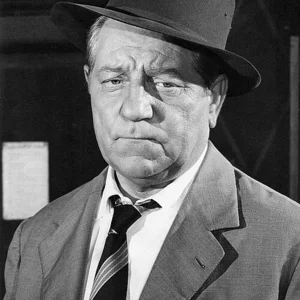

Jean Gabin (1904–1976) is one of the greatest French actors of the 20th century. He rose to fame in the 1930s with films such as La Bête humaine and La Grande Illusion, embodying the myth of the working-class man — tough yet sensitive.
Jean Gabin(1904 — 1976)
Jean Gabin
France
8 min read
Frequently asked questions
Famous Quotes
« I don't act, I live my roles.»
« An actor is someone who needs others in order to exist.»
Key Facts
- 1904: Born in Paris under the name Jean-Alexis Moncorgé
- 1934–1939: Poetic realism period with Pépé le Moko, La Bête humaine, and La Grande Illusion
- 1940–1945: Exile in the United States during World War II; enlisted in the Free French Forces
- 1954: Comeback with Touchez pas au grisbi, which relaunched his career
- 1976: Died in Neuilly-sur-Seine, leaving behind a body of work spanning more than 95 films
Works & Achievements
Jean Renoir's film about French prisoners of war during 1914–1918. A masterpiece of pacifism and humanism, it was the first non-English-language film nominated for the Academy Award for Best Picture, and was banned by the Nazis.
Marcel Carné's film representing poetic realism at its peak: Gabin plays a army deserter in a misty port town. Joseph Goebbels called it "French poison."
Jean Renoir's adaptation of Zola's novel, in which Gabin plays a locomotive engineer haunted by murderous impulses. Gabin actually learned to drive a locomotive himself for the role.
Jacques Becker's film marking Gabin's triumphant comeback after a decade in the wilderness. He invented a new type of aging gangster — dignified and weary — that redefined the French crime thriller.
Gabin plays an authoritarian yet principled politician in this Henri Verneuil film. It cemented his new image as a commanding patriarch who dominated popular French cinema throughout the 1960s.
Opposite Simone Signoret, Gabin plays an old man trapped in a crumbling marriage. This intimate and deeply moving film won recognition at Berlin and is considered one of the highlights of his late career.
Gabin portrays Gaston Dominici, a farmer accused of a triple murder, in a dramatization of the famous trial of the 1950s. His performance was acclaimed as one of the most powerful of his entire career.
Anecdotes
During World War II, Jean Gabin refused to collaborate with the Nazi occupiers and left for the United States in 1941. Unsatisfied with his comfortable exile, he enlisted in the Free French Forces in 1943 and took part in the Provence landings in 1944 as a gunner on a tank. He was awarded the Military Medal and the Croix de Guerre for his service in combat.
In 1936, during the filming of Julien Duvivier's La Belle Équipe, two alternative endings were shot: one happy, one tragic. Audiences were given the choice through a vote at preview screenings. The darker ending was ultimately selected for the final release, embodying the brooding quality characteristic of poetic realism.
After the war, Gabin went through a long dry spell: his American films were failures, and French audiences seemed to have forgotten him. It was his role in Jacques Becker's Touchez pas au grisbi (1954) that spectacularly relaunched his career, this time establishing a new persona — the aging but commanding patriarch — that would define his entire second career.
Jean Gabin had a passion for farming and owned a stud farm in Normandy where he raised racehorses and cattle. Far from Hollywood's glamorous image, he would rise at dawn to tend to his animals and often said that working the land restored him far better than any film set ever could.
On the set of La Grande Illusion (1937), Jean Renoir and Gabin developed a relationship of total trust. Gabin would improvise certain lines that Renoir kept in the final edit, believing the actor conveyed a human truth that the script alone could not capture. The film was nominated for the Academy Award for Best Picture, making it the first non-English-language film ever to receive that honor.
Primary Sources
I want to fight for France. I cannot stay here making films while my comrades are suffering.
Gabin doesn't need to act. He simply is. That is the difference between an actor and a man who carries within him the whole truth of a people.
I don't play down-and-out men because it's fashionable. I play them because I know them, because I am one of them.
Jean Gabin built a body of work that is the mirror of a century, a people, and a language.
My cows don't ask me to be famous. They just need me to be there, that's all. It's restful.
Key Places
Jean Gabin's birthplace, where he was born on May 17, 1904. This village in the Paris suburbs, where his family of performers had settled, reflects the working-class roots that would shape all of his roles.
It was at this famous Montmartre cabaret that Gabin took his first steps on stage in the 1920s, following his family's tradition in live performance.
Gabin filmed many movies here during the 1930s, the golden age of French poetic realism. These studios were the heart of the French film industry before the war.
Gabin's farm estate in Normandy, where he raised racehorses and cattle. He spent as much time there as possible, away from the world of cinema that he loved but that wore him out.
The town where Jean Gabin spent his final years and died on November 15, 1976. His funeral drew enormous crowds, a testament to the public's deep affection for the actor.
Typical Objects

Gabin wore the uniform of the Free French Forces during the Provence landings in 1944. This cap symbolizes his concrete patriotic commitment, far from the film sets.

Gabin smoked heavily both on screen and in real life, with a cigarette dangling from his lips being one of his most recognizable visual trademarks in his films from the 1930s to 1950s.

In his roles as a gang boss or aging patriarch from the 1950s to 1970s, Gabin invariably wore a sharp suit that embodied quiet authority and hard-earned respectability.

Gabin read and meticulously annotated his scripts, refusing any role he felt lacked human credibility. He was known for sending entire scripts back, dismissing them as false.

As a gunner serving in the 2nd Armored Division, Gabin fought aboard Sherman tanks during the liberation of France. This war machine represents his complete break from his Hollywood career.

Gabin kept detailed records of his horse and cattle breeding on his farm in Normandy, an agricultural passion that stood in sharp contrast to his cinematic image.
School Curriculum
Vocabulary & Tags
Key Vocabulary
Daily Life
Morning
Gabin got up very early, around five or six in the morning — a habit picked up from his time on the Norman farm. He would start his day with an inspection of his stables and fields, boots on and cap firmly planted on his head, far removed from any image of a Hollywood star.
Afternoon
On filming days, he arrived on set at exactly the right time, lines perfectly memorized, demanding the same rigor from his fellow actors. Outside of shoots, Norman afternoons were devoted to farm work and overseeing his cattle breeding operations.
Evening
Gabin enjoyed simple dinners with family or close friends, accompanied by good Burgundy wine. He went to bed early, having little patience for the social gatherings of the Parisian film world, which he found phony and exhausting.
Food
Classic French bourgeois cuisine: pot-au-feu, rib of beef, Norman cheeses. Gabin ate well and simply, attached to the produce from his farm. He drank red wine in moderation and smoked Gauloises heavily throughout his life.
Clothing
In everyday life, Gabin wore sturdy, practical clothing: corduroy trousers, a thick jumper, a hunting jacket for the farm. On screen during his golden years in the 1930s, he sported the suit and tie of a working man dressed in his Sunday best; later, the three-piece suit of an imposing boss.
Housing
Gabin divided his life between a modest Parisian apartment in Neuilly and his Norman stud farm, his true home. The farm — with its stables, barns, and pastures — represented for him the stability and authenticity that the world of show business could never provide.
Historical Timeline
Period Vocabulary
Visual Style
L'univers visuel de Gabin oscille entre le noir et blanc expressionniste du réalisme poétique des années 30 et les tons chauds et crépusculaires du cinéma populaire français des années 50-70.
Sound Ambience
Les sons de l'univers de Gabin mêlent le Paris populaire des années 1930 — bistrots, ateliers, quais de Seine — aux plateaux de cinéma et au grondement des chars de la Libération.
Liens externes & ressources
Références
Œuvres
La Bête humaine
1938
L'Affaire Dominici
1973