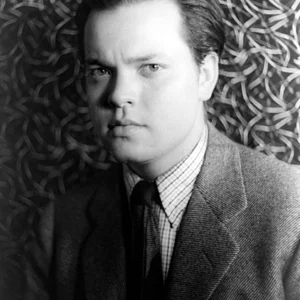

American director, actor, and screenwriter (1915–1985), Orson Welles revolutionized cinema with Citizen Kane (1941), widely regarded as one of the greatest films ever made. A towering figure in filmmaking, he also left a lasting mark on radio and theater.
Orson Welles(1915 — 1985)
Orson Welles
États-Unis
9 min read
Frequently asked questions
Famous Quotes
« A film is never really good unless the camera is an eye in the head of a poet.»
« I started at the top and worked my way down.»
« An artist must be his own rule.»
Key Facts
- 1938: Radio broadcast of The War of the Worlds, triggering widespread panic across the United States
- 1941: Direction of Citizen Kane, a landmark in cinematic narrative and technique
- 1942: Direction of The Magnificent Ambersons, another masterpiece of American cinema
- 1948: Direction of Macbeth, a widely acclaimed Shakespearean adaptation
- 1952: Palme d'Or at Cannes for Othello
Works & Achievements
Welles's debut feature film, regularly ranked number one among the greatest films in cinema history. Revolutionary for its non-linear storytelling, cinematography, and camera angles, it remains an absolute reference in film schools around the world.
A radio adaptation of H.G. Wells's novel, broadcast on CBS in the form of fake news bulletins. A landmark media event that illustrates the power and dangers of mass media manipulation.
Welles's second film, considered by some critics to be superior to Citizen Kane despite being re-edited by the studio. A melancholy chronicle of the decline of an aristocratic American family in the face of industrialization.
An adaptation of Shakespeare's tragedy, filmed intermittently over ten years due to lack of funding. Its Palme d'Or at Cannes recognized a film of stunning visual beauty, built against all odds.
A noir thriller set on the Mexican-American border, celebrated for its unbroken three-minute opening tracking shot. Considered a masterpiece of film noir and the last major film Welles directed in the United States.
An adaptation of Shakespeare's play shot in 23 days on a minimal budget. Despite its constraints, the film delivers a dark and original expressionist vision of the Shakespearean world.
An experimental documentary about art forger Elmyr de Hory and fraudulent biographer Clifford Irving. A fascinating meditation on art, deception, and the nature of truth, considered a forerunner of the contemporary essay film.
Anecdotes
On October 30, 1938, Orson Welles broadcast on CBS a radio adaptation of H.G. Wells's The War of the Worlds, presented as a live news bulletin announcing a Martian invasion. While the widespread panic is partly a myth amplified by the press, the broadcast genuinely frightened many listeners and instantly made the 23-year-old famous.
When RKO handed Welles the direction of Citizen Kane in 1941, he secured a contract unique in Hollywood history: complete artistic control over the film, with no studio oversight. At just 25, he crafted a technically revolutionary masterpiece, inventing narrative and visual techniques that would influence world cinema for decades.
Citizen Kane was a commercial failure upon release, largely because press magnate William Randolph Hearst — who recognized himself in the main character — pressured media outlets to boycott the film. Welles never regained that level of creative freedom in Hollywood and had to self-finance most of his subsequent films.
To fund Othello (1952), Welles had to halt production several times due to lack of money, sometimes for months at a stretch. The murder scene in the bathhouse was improvised using towels because the costumes had not yet been delivered. The film nonetheless won the Palme d'Or at Cannes.
Welles began his theatrical career at just 16 by lying about his age to join the Gate Theatre in Dublin. At 20, he co-founded the Mercury Theatre in New York with John Houseman, staging provocative productions including a Julius Caesar set in fascist uniforms that both scandalized and captivated critics.
Primary Sources
"I am fundamentally a man of the theatre. Cinema interests me because it is an art of light and shadow, and because it allows you to reach an audience that theatre can never touch."
Orson Welles was granted the right to produce, direct, write, and star in two films with complete artistic control — an unprecedented clause in the Hollywood industry of the time.
"We wanted to pay tribute to the tradition of Halloween storytelling — ghost stories, supernatural invasions — by transposing this classic into a contemporary radio format. We never imagined that anyone might believe these events were real."
"Film is the greatest opportunity ever given to an artist to reach millions of people — but also the best way to bore them profoundly if you have nothing to say."
"Citizen Kane is not my best film. It may be the one in which I had the most raw talent, but talent and mastery are two different things."
Key Places
Orson Welles's hometown, where he was born in 1915 into a wealthy family. His father was an inventor and his mother a concert pianist; this culturally rich upbringing shaped his early artistic sensibility.
A theater founded by Welles and John Houseman in 1937 in the heart of Manhattan, where he staged groundbreaking productions and developed the Mercury Theatre on the Air, the radio program that would make him famous across America.
It was at these legendary studios that Orson Welles filmed Citizen Kane in 1940–1941, enjoying complete artistic freedom that Hollywood would never grant him again. He famously described the studio as "the greatest electric train set a boy ever had."
A Moroccan city (now known as Essaouira) where Welles filmed part of Othello in the late 1940s and early 1950s, making use of the light and architecture to work around budget constraints. These limitations pushed him toward highly inventive visual solutions.
Welles spent much of his European exile in Italy, shooting several films including Othello and appearing in Italian productions. He found in Europe the artistic freedom and respect that the Hollywood industry denied him.
Typical Objects

Welles used this professional camera to shoot Citizen Kane, experimenting with radical low-angle shots and depths of field never before seen in cinema. His cinematographer Gregg Toland taught him the secrets of the camera in just a few weeks.

The CBS studio microphone was the instrument of Welles's fame: it was before this mic that he perfected the art of radio narration and broadcast The War of the Worlds. His deep bass voice was ideally suited to the radio medium of the 1930s and 40s.

Welles had a fondness for sweeping capes and dark overcoats, which emphasized his imposing stature and reinforced his image as a theatrical figure. This distinctive silhouette is visible in numerous photographs and public appearances.

A great lover of Cuban cigars, Welles made them a near-permanent accessory. This habit contributed to his image as a powerful, larger-than-life personality, whether in real life or in his on-screen roles.

Welles spent thousands of hours at the Moviola editing his films, often under precarious conditions and with limited budgets. Editing was for him a fundamental creative act, on a par with writing or directing.

A fictional yet iconic object from Citizen Kane, the main character's childhood sled has become one of the most famous symbols in world cinema, representing nostalgia and lost innocence.
School Curriculum
Vocabulary & Tags
Key Vocabulary
Tags
Daily Life
Morning
Welles woke late, often after 10 a.m., having worked until dawn on his scripts or editing. He ate a hearty breakfast — he struggled with his weight his entire life — and began the day reading newspapers and professional correspondence, usually alongside his first cigar.
Afternoon
Afternoons were devoted to rehearsals, shooting, or production meetings. Welles was known for his intense, improvisational working methods on set, rewriting the script mid-day and experimenting with unexpected technical solutions alongside his crew. He could spend hours debating a frame composition or a lighting angle.
Evening
Evenings were often social affairs — dinners at restaurants, gatherings with actors, writers, or politicians in the bohemian circles of New York or Hollywood. Welles was a remarkable dinner companion, a brilliant orator and an inexhaustible storyteller. He would then frequently work deep into the night on his projects.
Food
A hearty eater and food enthusiast, Welles battled chronic weight gain that worsened from the 1950s onward. He had a particular fondness for Italian cuisine, fine wines, and Cuban cigars. His dietary excesses — which he often acknowledged with self-deprecating humor — stood in sharp contrast to the strict discipline he demanded from his film crews.
Clothing
Welles favored imposing outfits that emphasized his stature: long black coats, theatrical capes, dark well-tailored suits. He wielded his physical presence as a dramatic instrument, both in life and on screen. In his later years, he often wore a beard and loose-fitting clothes that gave him the air of a Shakespearean patriarch.
Housing
Welles led a nomadic life, moving between New York and Hollywood before embarking on a long European exile — Italy, Spain, France, Morocco — beginning in the 1940s. He stayed in luxury hotels when his finances allowed, and in modest apartments or with friends during harder times. He ended his life in a house in Los Angeles, surrounded by unfinished screenplays.
Historical Timeline
Period Vocabulary
Visual Style
Le style visuel de Welles est dominé par un noir et blanc expressionniste, des contre-plongées vertigineuses, un éclairage chiaroscuro dramatique et une profondeur de champ révolutionnaire qui transforment chaque cadre en composition picturale sur le pouvoir et la décadence.
Sound Ambience
L'univers sonore d'Orson Welles mêle le bourdonnement des plateaux de cinéma hollywoodiens des années 1940, l'atmosphère crépitante des studios de radio d'avant-guerre et le brouhaha vivant des théâtres new-yorkais des années 1930.
Liens externes & ressources
Références
Œuvres
La Guerre des mondes (émission radiophonique)
1938