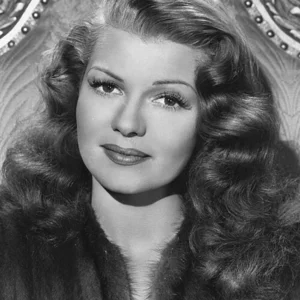

Rita Hayworth (1918-1987) was an American actress and dancer, considered one of the greatest Hollywood stars of the 1940s. A glamour icon, she is best known for her role in Gilda (1946).
Rita Hayworth(1918 — 1987)
Rita Hayworth
États-Unis
8 min read
Frequently asked questions
Key Facts
- Born Margarita Carmen Cansino on October 17, 1918, in Brooklyn, New York
- Signed a contract with Columbia Pictures in 1937 and became one of the highest-paid actresses in Hollywood
- Her role in Gilda (1946) made her a global icon of glamour and allure
- Her pin-up photo was attached to the atomic bomb dropped on Bikini Atoll in 1946, a symbol of the pop culture of the era
- Diagnosed with Alzheimer's disease in the 1980s, she helped raise public awareness of the illness
Works & Achievements
Film noir directed by Charles Vidor, considered Rita Hayworth's masterpiece. The glove striptease scene became legendary in cinema history and defined the image of the Hollywood femme fatale.
Psychological thriller directed by her husband Orson Welles, in which Rita Hayworth appears with short blonde hair, breaking away from her usual image. A cult classic of American film noir.
Musical comedy in which Rita Hayworth dances alongside Gene Kelly. The film showcased the full range of her talents as a dancer and cemented her status as a top-tier Hollywood star.
Spy film in which Rita Hayworth attempted to recapture the success of Gilda. Though less critically acclaimed, it remains emblematic of the second half of her career.
Musical comedy alongside Frank Sinatra and Kim Novak. One of her last major commercial successes, it shows an artist seeking to transition toward more mature roles.
Anecdotes
Rita Hayworth was born Margarita Carmen Cansino, the daughter of a Spanish flamenco dancer. To meet Hollywood's demands — which deemed her "too Hispanic" — the studios subjected her to painful electrolysis to raise her hairline and dyed her hair red, effectively erasing part of her heritage.
During World War II, Rita Hayworth was the favorite pin-up of American soldiers. A photo of her in a negligee, published in Life Magazine in 1941, was taped onto the atomic bomb dropped on Bikini Atoll in 1946 during nuclear testing — a gesture that deeply shocked her.
Her role in Gilda (1946) remains one of the most iconic in American cinema. The scene in which she slowly removes her glove while singing 'Put the Blame on Mame' is considered one of the most sensual moments in Hollywood history, while still staying within the limits imposed by the Hays Code.
Rita Hayworth was married five times, most notably to Orson Welles (1943–1947) and Prince Aly Khan (1949–1951), who made her a princess. Her union with the Ismaili royal family made front pages around the world and came to symbolize the American dream at its peak.
Late in life, Rita Hayworth became one of the first celebrities to publicly suffer from Alzheimer's disease, diagnosed in 1980. Her daughter Yasmin Khan campaigned tirelessly to raise awareness of the then little-known illness, helping to break a major medical and social taboo.
Primary Sources
The photograph of Rita Hayworth in a satin negligee, published in August 1941, instantly became the most reproduced image of the war, distributed by the millions to American soldiers on every front.
Rita Hayworth publicly expressed her outrage when she learned that her photograph had been affixed to the atomic bomb used in the Bikini tests: 'I was not consulted and I am horrified.'
In this interview, Rita Hayworth confided: 'Men go to sleep with Gilda and wake up with me. It's not me they love — it's a character I played.'
Rita Hayworth's daughter testified before the U.S. Senate to secure funding for Alzheimer's disease research, describing her mother's final years as a silent struggle against an illness still poorly understood by the general public.
Key Places
Birthplace of Margarita Carmen Cansino on October 17, 1918. It was in this working-class New York neighborhood that the future star grew up, immersed in the artistic world of her family.
The studio that signed Rita Hayworth in 1937 and turned her into an international star. It was here that Gilda and The Lady from Shanghai were filmed, under the controversial leadership of studio boss Harry Cohn.
Site of the 1946 American nuclear tests, where a bomb nicknamed 'Gilda' bore a photo of Rita Hayworth. This event symbolizes the unsettling connection between American popular culture and the atomic age.
The French Riviera resort town where Rita Hayworth frequently stayed during the 1940s and 1950s, particularly during her affair and subsequent marriage to Prince Aly Khan.
Rita Hayworth spent her final years in Manhattan, where she died on May 14, 1987. The city bore witness to her gradual public decline due to Alzheimer's disease.
Typical Objects

Long gloves were an essential part of the glamorous costumes worn by Hollywood stars of the 1940s. The glove that Rita slowly removes in Gilda has become one of the most iconic props in cinema history.

Rita Hayworth was photographed hundreds of times in the studios of Columbia Pictures. Carefully orchestrated photo sessions by the studios' official photographers shaped the public image of their stars — a powerful marketing tool.

The daughter of a Spanish dancer, Rita Hayworth wore flamenco dresses from childhood and continued dancing throughout her career. These outfits recall her Hispanic heritage, which Hollywood had tried to erase.

A symbol of major radio broadcasts and USO tours, the ribbon microphone was the essential tool of wartime entertainment. Rita Hayworth performed for American soldiers to boost troop morale.

Large-format lithographed Technicolor posters were the primary communication tool of Hollywood studios. Rita Hayworth's face was displayed on the facades of movie theaters around the world.

An indispensable technical object on any film set, the clapperboard symbolizes the day-to-day work on the Columbia Pictures lots where Rita Hayworth shot her most celebrated films.
School Curriculum
Vocabulary & Tags
Key Vocabulary
Tags
Daily Life
Morning
Rita Hayworth rose early to meet her contractual obligations with Columbia Pictures. Mornings were devoted to hair and makeup sessions, which could last several hours to transform Margarita Cansino into Rita Hayworth. She often started her day with a dance workout to stay in shape.
Afternoon
Afternoons were spent on set, under the studio lights of Hollywood. Rita Hayworth was known for her professionalism and discipline: she learned her lines and rehearsed her dance numbers with the rigor she had developed through years of training as a vaudeville performer. Between takes, she remained approachable with the crew.
Evening
At the height of her career, her evenings were divided between Hollywood film premieres, glamorous dinners at upscale Beverly Hills restaurants, and nights out at Los Angeles jazz clubs. These public appearances were part of the obligations studios imposed to maintain their stars' image.
Food
Like most stars under Hollywood contract, Rita Hayworth followed a strict diet dictated by the studios. She ate light meals centered on fruits, vegetables, and lean proteins to maintain the figure Columbia Pictures required. On-set meals were standardized and monitored by studio management.
Clothing
On set, Rita Hayworth wore elaborate costumes created by Hollywood's top studio designers, such as Jean Louis, who designed her iconic black gown in Gilda. In everyday life, she favored elegant suits, fitted dresses, and sophisticated outfits in keeping with her image as an international star.
Housing
At the height of her career, Rita Hayworth lived in lavish Beverly Hills villas, the residential neighborhood of Hollywood's elite. She also resided in grand European hotels during her marriage to Prince Aly Khan. Her homes reflected the luxury that the studio system cultivated to maintain the glamorous image of its contracted stars.
Historical Timeline
Period Vocabulary
Visual Style
Le style visuel de Rita Hayworth est celui du glamour hollywoodien classique des années 1940 : noir et blanc contrasté du film noir, robes en satin, éclairages de studio dramatiques et sophistication Art Déco.
Sound Ambience
L'univers sonore de Rita Hayworth mêle le jazz swing des grands orchestres de l'âge d'or d'Hollywood aux bruits des plateaux de cinéma et à l'atmosphère des boîtes de nuit californiennes des années 1940.
Liens externes & ressources
Références
Œuvres
Pal Joey
1957