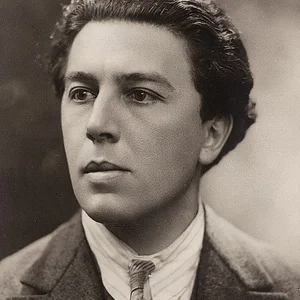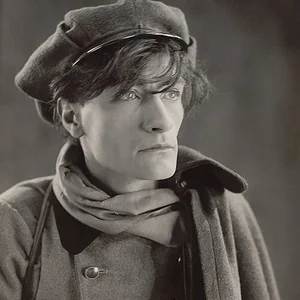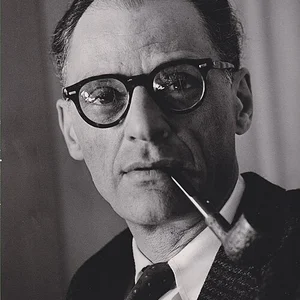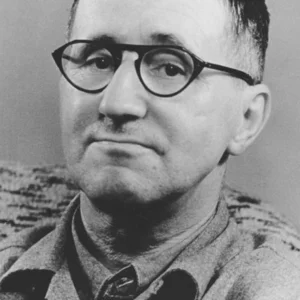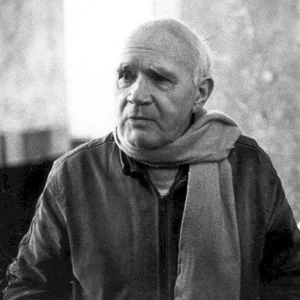

French writer, poet, and playwright of the 20th century. Shaped by a childhood as an orphan, a thief, and a prisoner, he transformed marginality into provocative literary and theatrical work, celebrated by Sartre and Cocteau.
Jean Genet(1910 — 1986)
Jean Genet
France
7 min read
Frequently asked questions
Famous Quotes
« To win goodness, I had to be beautiful and strong.»
Key Facts
- Born in Paris in 1910, abandoned and placed in the care of public welfare
- Publishes his first novel, Our Lady of the Flowers, in 1943-1944, written partly in prison
- Creates the play The Maids in 1947, inspired by a real news story
- Stages The Balcony (1956) and The Blacks (1959), major works of contemporary theater
- Becomes politically active in the 1970s alongside the Black Panthers and the Palestinians, dies in 1986
Works & Achievements
First novel, written in prison, plunging into the world of Parisian outcasts and immediately establishing Genet's sumptuous, provocative style.
Novel inspired by the Mettray penal colony and prison, where delinquency and captivity are transfigured into an almost mystical experience.
A major play of 20th-century theatre: two servants reenact the murder of their mistress, exposing the dynamics of domination and desire.
A reinvented autobiographical account in which Genet recounts his wanderings as a thief and vagabond across Europe, and lays claim to the beauty of evil.
A play set in a brothel where clients act out roles of power, a grating mirror of authority and revolution.
A play about racism and colonial domination, performed at the height of the decolonization movement, which reverses the roles between white and black people.
A sweeping theatrical fresco about the Algerian War; its 1966 premiere at the Odéon sparked a resounding political scandal.
A testamentary work published upon his death, blending memories and reflections on the years he spent with the Black Panthers and the Palestinians.
Anecdotes
Abandoned by his mother at birth in 1910, Jean Genet was placed in the care of public welfare and raised by a family of peasants in the Morvan, in Alligny. A model pupil at school, he nonetheless began stealing at a very young age — an act he would later claim as the foundation of his entire body of work.
As a teenager, he was confined to the Mettray penal colony, near Tours, a brutal reformatory for minors. He would transform this humiliating experience into poetic material in *Miracle of the Rose*, turning the young inmates into almost sacred figures.
In 1943, tried for stealing books, Genet faced life-long deportation as a repeat offender. Jean Cocteau sent the court a letter declaring him “the greatest writer of the modern era”: his sentence was reduced, and the writer began to enjoy the protection of intellectuals.
In 1948, when a new conviction could have sent him to a penal colony for life, a petition of artists led by Cocteau and Sartre secured him a presidential pardon. The thief officially became a recognized writer, without ever disowning his past.
In the final years of his life, Genet all but abandoned literature to become an activist: he lived with the Black Panthers in the United States and then with Palestinian fighters, and after the Sabra and Shatila massacre in 1982 he wrote a deeply moving text, *Four Hours in Shatila*.
Primary Sources
The convicts' garb is striped pink and white.
The greatest writer of the modern era.
A study in which Sartre makes Genet's trajectory — the abandoned child who became a thief and then a writer — the model of a freedom that embraces its condition as an outcast to the very end.
A play inspired by a real news story, in which two servants reenact the murder of their mistress every evening, mirroring the hatred and fascination the dominated feel toward those who dominate them.
Key Places
City where Genet was born in 1910 and died in 1986. It was also the stage for his thefts, his arrests, and his rise to literary fame.
Village in the Morvan region where the public welfare service placed the child with a peasant family. There he received a rural upbringing and began to steal.
A reformatory for minors near Tours where Genet was confined as a teenager. This experience inspired 'Miracle of the Rose'.
It was while imprisoned at Fresnes, in the years 1942-1944, that Genet wrote his first major texts. The prison became his writer's workshop.
From 1970 onward, Genet lived with Palestinian fighters in Jordan and Lebanon. The Shatila massacre, in Beirut, inspired one of his last great texts.
A small coastal town in Morocco where Genet was buried, in an old Spanish cemetery facing the ocean, according to his wishes.
Typical Objects

The striped uniform of convicts and penal colonies, which Genet describes in the very first sentence of 'The Thief's Journal'. He turns it into a symbol of shame transformed into pride.

It was on the coarse paper meant for making bags that Genet wrote his first novel in his cell. The manuscript was reportedly even confiscated and burned the first time around.

Genet's plays such as 'The Maids' or 'The Balcony' first circulated as typescripts handed to directors. They profoundly renewed twentieth-century theatre.

Genet was convicted several times for stealing books from Parisian bookshops. The object of the crime was also the instrument of his intellectual emancipation.

First an enlistee and then a deserter, Genet wore the uniform of the French Foreign Legion for a time. His wanderings as an undisciplined soldier fed the myth he built around himself.

In his final years as an activist, Genet shared the life of the fedayeen and adopted the symbols of their cause. The keffiyeh became the emblem of his commitment alongside the Palestinians.
School Curriculum
Vocabulary & Tags
Key Vocabulary
Daily Life
Morning
During his years of wandering, Genet often woke up in seedy hotel rooms, in prisons, or under the open sky. Later, as a recognized writer, he kept his habit of living lightly, with no fixed home tied to possessions.
Afternoon
For a long time his afternoons were taken up by getting by: petty theft, haggling over books, encounters in the underworld of European cities. Once he became an author, he devoted this time to writing and to exchanges with directors and publishers.
Evening
In the evening, Genet frequented the marginal circles he described in his books, or else the gatherings of artists and intellectuals who had taken him in. It was also the time when, in prison, he wrote by the faint light of his cell.
Food
In his youth as a vagrant and prisoner, Genet ate whatever he could find: the meager rations of the penal colony, meals scrounged or stolen. As an adult, he kept a sober and indifferent relationship with food, preferring coffee and tobacco.
Clothing
Genet wore, in turn, the striped uniform of the penal colony, the garb of the Foreign Legion, and the worn-out clothes of the vagrant. Once he became famous, he dressed with an almost monastic simplicity, far from any bourgeois elegance.
Housing
He lived most of his life without a true home: penal colonies, prisons, hotel rooms, and militant camps in the Middle East. This deliberate nomadism was part of his identity as a writer resistant to ever settling down.
Historical Timeline
Period Vocabulary
Liens externes & ressources
Références
Œuvres
Notre-Dame-des-Fleurs
1944
Miracle de la rose
1946
Les Bonnes
1947
Journal du voleur
1949
Le Balcon
1956
Les Nègres
1959
Les Paravents
1961