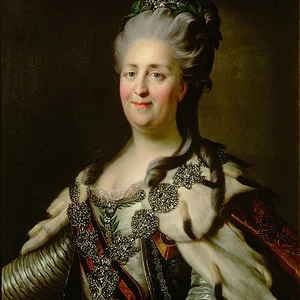

Catherine II, known as Catherine the Great, was Empress of Russia from 1762 to 1796. Of German origin, she overthrew her husband Peter III and modernized the Russian Empire by drawing on the ideas of Enlightenment philosophers, while strengthening autocratic power.
Catherine II of Russia(1729 — 1796)
Catherine II of Russia
royaume de Prusse, Empire russe
7 min read
Frequently asked questions
Famous Quotes
« The more I read, the more I am convinced that men need to be governed.»
« I shall be an autocrat: that's my trade. And the good Lord will forgive me: that's his.»
Key Facts
- 1762: overthrow of Peter III and accession to the Russian throne
- 1767: drafting of the Instruction (Nakaz), inspired by Enlightenment philosophers, to reform Russian laws
- 1773–1775: suppression of the Pugachev Revolt, a major peasant uprising
- 1772–1795: participation in the three partitions of Poland with Prussia and Austria
- 1796: death after 34 years of reign; Russia had become a major European power
Works & Achievements
A text of 526 articles inspired by Montesquieu and Beccaria, intended to reform Russian law. It proclaimed principles of tolerance and humanity, although the reforms did not come to fruition.
Catherine creates one of the world's greatest museums by accumulating more than 3,000 paintings, sculptures, and works of art. The Hermitage is today the second most visited museum in the world.
A legislative text guaranteeing the privileges of the Russian nobility (exemption from compulsory service, rights over their estates). It reinforced the manorial system and serfdom.
A reform granting Russian cities a municipal organization and rights to the bourgeoisie. Inspired by Western models, it aimed to modernize urban administration.
Catherine founds the Russian Academy to standardize and enrich the Russian language. She entrusted its presidency to Princess Vorontsova-Dashkova, the first woman to lead a scientific academy.
Through two victorious Russo-Turkish wars, Catherine considerably expanded the Russian Empire southward, gaining access to the Black Sea and annexing Crimea.
Anecdotes
Catherine II was not Russian by birth: she was born Sophie of Anhalt-Zerbst, in a small German principality. At 15, she was chosen by Empress Elizabeth I to marry the future tsar Peter III. She learned Russian with such fervor that she would get up at night in her nightgown to review her lessons, thereby contracting pneumonia.
In 1762, Catherine overthrew her own husband, Tsar Peter III, in an almost bloodless coup. She presented herself to the Imperial Guard regiments dressed in a green military uniform, on horseback, and the soldiers acclaimed her as empress. Peter III abdicated a few days later and died under obscure circumstances.
A great admirer of the Enlightenment philosophers, Catherine maintained a long correspondence with Voltaire, Diderot, and d'Alembert. She invited Diderot to Saint Petersburg in 1773, bought his personal library to relieve him financially, while allowing him the use of the books until his death.
Catherine founded the Hermitage in 1764 by purchasing 225 Flemish and Dutch paintings from a Berlin merchant. Her collection became one of the most important in Europe: at her death, it comprised more than 3,000 paintings, including works by Rembrandt, Raphael, and Titian, now preserved at the Hermitage Museum in Saint Petersburg.
During the smallpox epidemic ravaging Russia, Catherine decided in 1768 to be publicly inoculated by the English physician Thomas Dimsdale, in order to encourage her subjects to follow her example. Her son Paul was inoculated the following day. This political and sanitary gesture made her a model of the Enlightenment across Europe.
Primary Sources
I have made it a rule to neglect nothing that could win me the affection of the Russian people... I have worked to make myself worthy of the crown I wore.
Russia is a European state... The sovereign is the source of all political and civil power. Liberty is the right to do everything that the laws permit.
You have shaped my mind and my way of thinking since my early years. I am your most devoted pupil.
We, Catherine II, by the grace of God, Empress and Autocrat of All the Russias... The danger of the dismemberment of the Empire has obliged us to take the government into our hands.
Your zeal for the arts and letters, and your friendship for me, are equally precious to me. Come then to Saint Petersburg, you will be received there as you deserve.
Key Places
Official residence of the Russian tsars, where Catherine exercised her power for 34 years. She arranged the adjoining Hermitage to house her fabulous art collection.
Imperial summer residence where Catherine had the Alexander Palace built and the Catherine Palace expanded. She spent every summer there and received European philosophers and diplomats.
Birthplace of Sophie of Anhalt-Zerbst in 1729, in what was then Prussia. Catherine never returned to her hometown after leaving for Russia.
Peninsula annexed by Russia in 1783 through Catherine's expansionist policy. She made a triumphal journey to Crimea in 1787 to inspect her new conquests.
Site of Catherine II's coronation in September 1762. Although she preferred Saint Petersburg, Moscow remained the symbolic and religious heart of Russia.
Typical Objects

Emblem of Russian autocratic power, the sceptre topped with the Orlov diamond was given to Catherine by her favourite Grigori Orlov. It symbolised her legitimacy to rule an empire she had seized through a coup d'état.

Catherine II was a prolific letter-writer and author, composing more than 6,000 letters to European correspondents including Voltaire and Diderot. She also wrote plays, memoirs, and legislative texts.

During the harsh winters of Saint Petersburg, Catherine travelled in gilded, heated sleighs, sometimes racing at full speed across the frozen Neva. These lavish conveyances were a much-admired spectacle at court.

Catherine owned a copy of the Encyclopédie and funded its distribution. This work symbolised her adherence to Enlightenment ideals and her ambition to modernise Russia through reason and knowledge.

Catherine personally managed a large part of her diplomacy, dictating or drafting her own instructions to ambassadors. Her diplomatic archives bear witness to an ambitious and calculated foreign policy.

Numerous official portraits of Catherine, commissioned from painters such as Vigilius Eriksen and Johann Baptist Lampi, depict her in armour or court dress, emphasising both her femininity and her military authority.
School Curriculum
Vocabulary & Tags
Key Vocabulary
Daily Life
Morning
Catherine rose every morning around 6 o'clock, including in winter, and prepared her own very strong coffee. She devoted the early hours of the day to reading and correspondence, writing up to twenty letters before the court awoke.
Afternoon
Afternoons were occupied by audiences, Councils of State, and diplomatic receptions. Catherine also held working sessions with her ministers, personally directing foreign policy and major administrative reforms.
Evening
Evenings at court alternated between opera or theatre performances at the Hermitage Theatre, chamber concerts, and intimate suppers with her favourites and the brilliant minds she invited. Catherine also played cards and rarely went to bed after 10 p.m.
Food
Catherine had simple tastes for an empress: she enjoyed boiled beef, boiled vegetables, and fruit. She drank mainly very strong coffee and water, and ate moderately compared to the usual splendour of the Russian court.
Clothing
In public, Catherine wore sumptuous court gowns of silk embroidered with gold and diamonds, along with the imperial insignia. In private, she preferred simpler and more comfortable dresses. For her equestrian outings — a genuine passion — she wore a green military uniform of the Imperial Guard.
Housing
Catherine resided primarily at the Winter Palace, a baroque edifice of several hundred rooms with turquoise and gilded facades. She had arranged more intimate apartments alongside the state rooms, and had the neighbouring Hermitage built as a private space for contemplation and her collections.
Historical Timeline
Period Vocabulary
Visual Style
L'esthétique de Catherine II fusionne le baroque russe fastueux du Palais d'Hiver et le néoclassicisme rationnel des Lumières, dans une palette impériale de bleu profond, d'or et de vert militaire.
Sound Ambience
L'univers sonore de Catherine II mêle le raffinement d'une cour européenne francophone — musique de chambre, conversations des philosophes — aux sonorités profondes de la Russie orthodoxe et de ses hivers impitoyables.
Liens externes & ressources
Références
Œuvres
Nakaz (Instruction à la Commission législative)
1767
Fondation de l'Ermitage
1764
Charte de la noblesse
1785
Charte des villes
1785
Fondation de l'Académie russe des sciences et des lettres
1783
Expansion territoriale vers la mer Noire
1768-1792