
explorer and botanist (1740-1807)
Jeanne Barret(1740 — 1807)
Jeanne Barret
France
8 min read
Frequently asked questions
Key Facts
- Née en 1740 en Bourgogne, Jeanne Barret est la première femme à avoir accompli le tour du monde (1766-1769).
- Elle embarque déguisée en homme sur la frégate La Boudeuse sous les ordres de Bougainville, car les femmes étaient interdites à bord des navires de guerre français.
- Elle assiste le botaniste Philibert Commerson tout au long de l'expédition et contribue à la collecte de milliers de spécimens végétaux, dont le bougainvillier.
- Sa véritable identité est découverte à Tahiti en 1768 ; elle termine le tour du monde depuis l'île Maurice après la séparation de l'équipage.
- En 1785, elle est reconnue par le roi Louis XVI et reçoit une pension pour ses services rendus à la botanique et à la navigation.
Works & Achievements
By boarding Bougainville's expedition disguised as a man, Jeanne Barret became the first woman to circumnavigate the globe. This feat, accomplished under extreme conditions of concealment, remains her most iconic achievement.
Jeanne Barret contributed to the collection and preparation of more than 6,000 previously unknown plant specimens from four continents. This collection, held at the Muséum national d'Histoire naturelle in Paris, represents a major milestone in 18th-century botany.
During the stopover in Brazil, Jeanne Barret was one of the first Europeans to collect the bougainvillea (Bougainvillea spectabilis). Some historians even credit her with the initial discovery, before it was officially attributed to Commerson.
After the expedition's departure, Jeanne Barret continued to work with Commerson on plants from the Indian Ocean, enriching the herbaria with previously unknown local species that were transmitted to French scientific institutions.
Anecdotes
To board the Boudeuse and the Étoile in 1766, Jeanne Barret disguised herself as a man under the name 'Jean Barret', presenting herself as the valet of botanist Philibert Commerson. She bound her chest, cut her hair, and deceived the entire crew for months, as well as Bougainville himself, who noticed nothing unusual.
It was in Tahiti, in April 1768, that her secret was revealed. The Polynesian inhabitants, accustomed to varied body types, immediately identified her as a woman. Bougainville, surprised but full of admiration, noted in his journal that she had endured all the hardships of the crossing with as much vigour as any sailor.
Jeanne Barret was an accomplished botanist: she actively contributed to the collection of more than 6,000 plant specimens with Commerson, including the famous bougainvillea, a climbing vine with vivid flowers brought back from Brazil and named in Bougainville's honour. It is nonetheless Jeanne who, according to some historians, may have been the first to collect the plant.
After the death of Philibert Commerson on the Île de France (present-day Mauritius) in 1773, Jeanne Barret found herself alone on the other side of the world. She ran a tavern in Port Louis, saved enough money to make her way home, and returned to France around 1775 — thereby completing the circumnavigation she had begun disguised as a man.
In 1785, King Louis XVI granted her a pension of 200 livres per year in recognition of her circumnavigation, an exceptional gesture for the time. The official decree described her as a deserving explorer, making her the first woman officially recognised by the French state for an achievement in navigation and scientific exploration.
Primary Sources
Barret [...] had endured, without being recognized, all the hardships of this campaign. She had assisted Commerson in his botanical research with great zeal and intelligence.
His Majesty, wishing to reward the services rendered by citizeness Barret, who circumnavigated the globe disguised as a man, grants her an annual pension of two hundred livres.
My servant Barret, whose faithfulness and zeal for the natural sciences never wavered, was of invaluable assistance to me in the collection and classification of plants.
Jeanne Barret, a native of La Comelle in Burgundy, aged about thirty-five years, married Jean Dubernat in the church of Saint-Aulaye.
Key Places
Jeanne Barret's birthplace, where she grew up in a peasant family. This place anchors her humble origins, far removed from the world of navigation and scholarly botany.
Major French military port from which Bougainville's expedition set sail in November 1766. It is here that Jeanne Barret secretly boarded the Étoile.
Island where her female identity was revealed by the local inhabitants in April 1768. Bougainville describes the scene in his journal, making Jeanne famous despite herself.
Island where Jeanne Barret and Commerson were disembarked after the revelation. She lived there for several years, continuing botanical research and running a tavern after Commerson's death.
Town where Jeanne Barret married Jean Dubernat and spent her final years. She died there in 1807, without ever receiving the recognition she deserved.
Typical Objects

Cylindrical metal box used by field botanists to preserve fresh specimens. Jeanne Barret carried one during each stopover to bring plants and flowers back to Commerson.

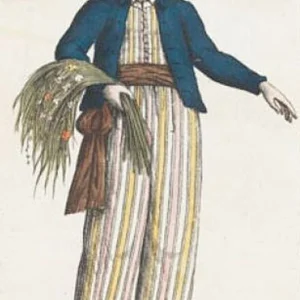
Men's shirt, breeches, jacket and hat, accompanied by bandages to flatten the chest. This costume allowed Jeanne to illegally board a French royal vessel for more than a year.

Tool consisting of two wooden boards and absorbent sheets used to dry and flatten collected plants. Jeanne used it daily to prepare the 6,000 specimens brought back from the expedition.

Small brass and glass hand lens used to observe details of plants and insects. An essential instrument in the daily work of a botanical assistant in the 18th century.

Chart engraved on vellum depicting known coastlines and maritime routes. Aboard the Étoile, these charts were constantly consulted to locate stopovers and collection areas.

Small thick-papered notebook in which Jeanne Barret recorded plant descriptions, their habitat and local uses. These notes fed into Commerson's scientific work.
School Curriculum
Vocabulary & Tags
Key Vocabulary
Daily Life
Morning
Aboard the Étoile, Jeanne Barret rose before dawn to prepare the botanical collection equipment before port calls. She checked the herbarium presses, filled the vasculums, and transcribed the previous day's notes onto the dried specimens. Her male attire — a coarse shirt, jacket, and hat — had to be adjusted and the binding tightened each morning to maintain her disguise.
Afternoon
Shore-stop afternoons were devoted to botanical exploration: Jeanne roamed forests and coastlines with Commerson, identifying, collecting, and labelling plant specimens unknown to Europeans. On board, she helped press the plants, sorted the samples, and wrote up morphological descriptions under the botanist's dictation.
Evening
In the evenings aboard ship, Jeanne quietly joined the lower-ranking crew members for meals so as not to arouse suspicion. She used the lamplight to finish labelling the herbarium sheets and copy field notes into Commerson's notebooks, often working late into the night in the naturalist's cramped cabin.
Food
On board, the diet consisted mainly of ship's biscuits, salt meat, dried pulses, and rationed water, supplemented during port calls by tropical fruits, fresh fish, and local vegetables. During stays on Île de France, Jeanne enjoyed more varied fare: rice, exotic fruits, vegetables from the colonial garden, local meats, and tea.
Clothing
Throughout the voyage, Jeanne Barret wore men's clothing at all times: a heavy linen shirt, cloth breeches, a short jacket, and a broad-brimmed hat. She concealed her feminine figure using strips of fabric bound tightly around her chest. This disguise required constant vigilance to maintain convincing gestures and a convincing voice in front of the sailors.
Housing
Aboard the Étoile, Jeanne occupied the cramped quarters assigned to Commerson and his valet — barely larger than a cupboard, cluttered with crates of specimens and botanical instruments. On Île de France, she lived in the house Commerson occupied near the Pamplemousses botanical garden, and later in modest lodgings above the tavern she ran on her own after his death.
Historical Timeline
Period Vocabulary
Visual Style
Esthétique maritime et naturaliste du XVIIIe siècle, entre cabine de navire éclairée à la chandelle et escales tropicales luxuriantes, avec une direction artistique inspirée des illustrations botaniques de l'époque.
Sound Ambience
Ambiance des grandes traversées marines du XVIIIe siècle, entre pont de navire venteux et cabine de naturaliste, ponctuée par les sons des îles tropicales découvertes lors des escales.
Liens externes & ressources
Références
Œuvres
Tour du monde — première circumnavigation féminine
1766-1775
Collection botanique de l'expédition Bougainville
1766-1769
Identification et collecte du bougainvillier
1767
Herbiers botaniques de l'île de France (Maurice)
1769-1773