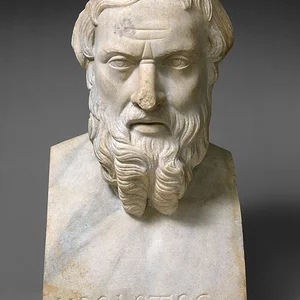

Greek historian and geographer born around 484 BC in Halicarnassus, considered the "Father of History". He is the author of the Histories, a vast inquiry into the Greco-Persian Wars and the peoples of the ancient world.
Herodotus(483 av. J.-C. — 424 av. J.-C.)
Herodotus
Halicarnasse
8 min read
Frequently asked questions
Famous Quotes
« Great deeds are usually wrought at great risks.»
« Call no man happy until he is dead.»
Key Facts
- Born around 484 BC in Halicarnassus (present-day Turkey)
- Wrote the Histories, the first major historical work of the Western world
- Traveled to Egypt, Persia, Babylon, and Scythia to gather testimonies and accounts
- Cicero credited him with the title of "Father of History" (pater historiae)
- Died around 425 BC, probably in Thurii (Magna Graecia)
Works & Achievements
The first book of the Histories, devoted to the origins of the Greco-Persian conflict, the kingdom of Lydia, Croesus, and the rise of the Persian Empire under Cyrus the Great.
An extensive account of Egypt: the geography of the Nile, the history of the pharaohs, and the customs and beliefs of the Egyptians. This book is considered one of the earliest ethnographic texts in history.
These books cover the Persian expansion under Cambyses and Darius, the Ionian revolts, and the geography of the Scythian, Libyan, and Thracian peoples. Herodotus develops his comparative method for studying civilizations throughout.
The narrative heart of the work: the Persian Wars from Marathon (490) to Plataea and Mycale (479), featuring accounts of Themistocles, Leonidas, Xerxes, and the ultimate victory of the Greek city-states.
Anecdotes
Herodotus reportedly traveled for several years across Egypt, Persia, Babylonia, and the shores of the Black Sea to collect firsthand accounts. He interviewed priests, merchants, and soldiers, carefully noting what he saw and heard. This method of direct inquiry was completely groundbreaking for the time.
While visiting Egypt, Herodotus was fascinated by the pyramids of Giza. In his Histories, he reports that the Great Pyramid of Khufu required 100,000 workers over twenty years to build — an estimate that, even if debated, reflects his determination to understand the technical achievements of foreign civilizations.
Herodotus tells the story of the Lydian king Croesus, renowned for his immense wealth, who asked the Oracle at Delphi whether he should attack Persia. The oracle told him he would destroy a great empire — but it was his own he destroyed when he was defeated by Cyrus the Great. This anecdote illustrates how Herodotus weaves historical narrative together with moral reflection.
At the Battle of Thermopylae in 480 BC, Herodotus recounts that the Spartan king Leonidas, upon learning that Persian arrows would blot out the sun, replied proudly: "Then we shall fight in the shade." Even if this remark may be legendary, it captures Herodotus's method: he gathered both facts and memorable words to bring History to life.
Cicero called Herodotus the "Father of History" (pater historiae) because he was the first to write a systematic inquiry into past events while seeking to explain their causes. Before him, accounts of the past were largely poetic epics or myths. Herodotus established a new way of describing the world, grounded in observation and testimony.
Primary Sources
"I will set forth here the results of my inquiry, so that the memory of the past may not be blotted out from among men by time, and that great and marvellous deeds done by Greeks and foreigners may not lack renown."
"Egypt is the gift of the Nile." Herodotus meticulously describes the river's floods, Egyptian customs, their funerary rites, and the construction of the pyramids.
"Xerxes, having seen his whole army assembled at Abydos, wished to review his troops by land and sea. He gazed upon them from the top of a white promontoire... then he wept."
Herodotus describes the naval battle of Salamis (480 BC) as the decisive turning point of the Greco-Persian Wars, in which the Greek fleet led by Themistocles destroyed the Persian fleet of Xerxes.
Key Places
Herodotus's birthplace in Asia Minor, then under Persian rule. This cosmopolitan city, at the crossroads of Greek and Eastern cultures, nurtured his curiosity about foreign peoples from an early age.
Herodotus spent several years in Athens during the age of Pericles, moving in intellectual circles and reportedly giving public readings of excerpts from his Histories. The city was then at the height of its cultural power.
A Panhellenic colony founded in 443 BC where Herodotus settled and most likely spent the rest of his life. He completed the final version of his Histories there and died around 424 BC.
The ancient capital of Egypt, which Herodotus visited during his journey along the Nile. There he questioned Egyptian priests and gathered information about the history of the pharaohs and the construction of the pyramids.
Herodotus visited the great Mesopotamian city and describes its massive walls, hanging gardens, and local customs in his Histories, providing a unique account of that civilization.
The oracular sanctuary of Apollo at the heart of the Greek world. Herodotus gives the Oracle of Delphi a central role in his narratives, most notably the consultations by Croesus and the Greek city-states before the Persian Wars.
Typical Objects

Writing material used by Greek and Egyptian scholars. Herodotus recorded his inquiries and testimonies on scrolls, which he assembled into his Histories, organized into nine books.

Used for quickly jotting down information while traveling. Herodotus likely used them to record oral accounts before transcribing them onto papyrus.

A schematic representation of the oikoumene (the inhabited world) as known to the Greeks. Herodotus mentions and critiques the maps of his time, notably that of Hecataeus of Miletus, while proposing his own geographical vision of the world.

Light leather shoes worn by Greek travelers. Herodotus covered thousands of kilometers on foot, by boat, and on the backs of animals to conduct his inquiries throughout the Mediterranean world and the Near East.

An essential light source for working and writing at night. Herodotus spent long hours organizing and writing up the information he had gathered during his travels.

The first minted coin in history, invented by the Lydians in the 7th century BC. Herodotus describes its origins in his Histories and used such currency during his commercial travels in Asia Minor.
School Curriculum
Vocabulary & Tags
Key Vocabulary
Tags
Daily Life
Morning
Herodotus rose early at sunrise. In the cities he visited, he would head to the local market or sanctuary to question residents, priests, or officials. He took notes on wax tablets or carefully memorized the accounts he heard.
Afternoon
Afternoons were devoted to visiting remarkable sites: temples, tombs, monuments, and waterways. Herodotus observed, measured the dimensions of structures, noted ritual practices, and questioned local guides or priests about the traditions and history of each place.
Evening
In the evenings, at banquets or symposia hosted by wealthy patrons, Herodotus shared his discoveries and listened to the accounts of travelers and merchants. Back at his lodgings, he organized his collected information in writing, taking care to distinguish what he had witnessed himself from what he had merely heard reported.
Food
Like any Greek of his social standing, Herodotus ate mainly barley or wheat bread, olive oil, olives, dried legumes (lentils, chickpeas), goat's or sheep's milk cheese, and dried fish. On his travels, he adapted to local cuisines — wheat flatbreads and barley beer in Egypt, dates and mutton in Persia.
Clothing
Herodotus wore the classic Greek outfit: a chiton (a linen or wool tunic) fastened at the shoulders with pins, draped with a himation (cloak) when traveling or in cold weather. On the road, he wore sturdy leather sandals and a broad-brimmed hat (petasus) to shield himself from the Mediterranean sun.
Housing
In Halicarnassus or Thurii, Herodotus likely lived in a Greek courtyard house (oikos), with rooms arranged around a peristyle. A quiet room served as a scriptorium where his precious papyrus scrolls were kept. While traveling, he stayed with hosts (following the custom of hospitality, or xenia), in harbor inns, or near sanctuaries.
Historical Timeline
Period Vocabulary
Visual Style
Esthétique inspirée de la céramique grecque à figures rouges et des manuscrits antiques, avec des tons ocre, terracotta et bleu méditerranéen évoquant le monde grec du Ve siècle av. J.-C.
Sound Ambience
Ambiance sonore d'un port grec antique mêlant bruits de marché, chants de marins et murmures de l'agora, évoquant le monde cosmopolite dans lequel Hérodote collectait ses témoignages.
Liens externes & ressources
Références
Œuvres
Histoires (Ἱστορίαι) — Livre I : Clio
vers 440 av. J.-C.
Histoires — Livre II : Euterpe
vers 440 av. J.-C.
Histoires — Livres III à V
vers 440 av. J.-C.
Histoires — Livres VI à IX
vers 440-425 av. J.-C.
See also
Related Characters
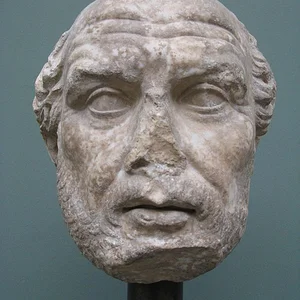
Phidias
499 av. J.-C. — 429 av. J.-C.
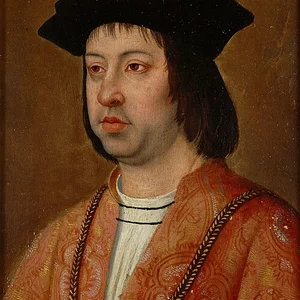
Ferdinand II of Aragon
1452 — 1516
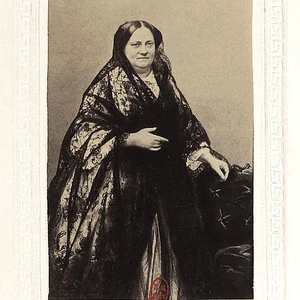
Ferdinand II of Spain
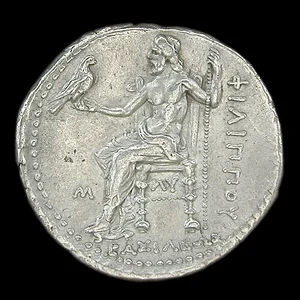
Alexander II of Macedon
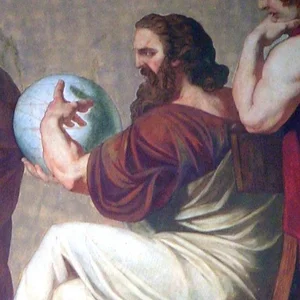
Anaxagoras of Clazomenae
499 av. J.-C. — 427 av. J.-C.
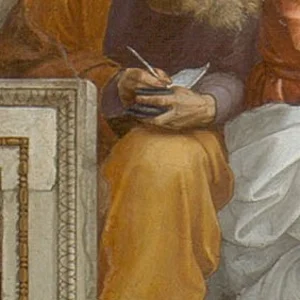
Anaximander
609 av. J.-C. — 545 av. J.-C.