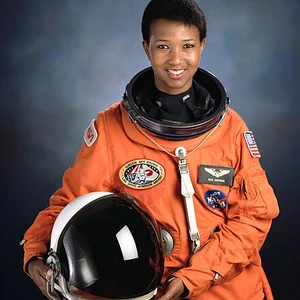

American physician and astronaut
Mae Jemison(1956 — )
Mae C. Jemison
États-Unis
7 min read
Frequently asked questions
Key Facts
- Mae C. Jemison naît le 17 octobre 1956 à Decatur, en Alabama
- Elle obtient son doctorat en médecine à l'université Cornell en 1981 et travaille comme médecin en Afrique de l'Ouest dans le Corps de la Paix (1983-1985)
- Sélectionnée par la NASA en 1987, elle devient la première femme afro-américaine astronaute
- Le 12 septembre 1992, elle part dans l'espace à bord de la navette Endeavour (mission STS-47), réalisant des expériences scientifiques en apesanteur
- Après la NASA, elle fonde en 1993 la Jemison Group, une entreprise de recherche technologique, et milite pour promouvoir les sciences auprès des jeunes
Works & Achievements
The first African-American woman in space, Jemison completed 127 orbits around the Earth in 8 days. She conducted biomedical experiments on microgravity and the skeletal system.
An international summer educational program for teenagers aged 12 to 16, designed to solve real global scientific problems. It aims to democratize access to science and critical thinking.
An autobiographical account aimed at young readers, recounting her childhood, education, medical career, and journey to space. A reference book to inspire scientific vocations in young girls.
An ambitious initiative supported by the American defense agency DARPA, aimed at making crewed interstellar travel technically feasible before 2112. Jemison took the lead to envision the future of human exploration beyond the solar system.
A plea for an education that reconciles arts and sciences, two fields Jemison has always cultivated together. This talk influenced the debate on STEAM teaching methods.
The first real astronaut to appear in a science fiction series, Jemison played Ensign Palmer in the episode 'Second Chances'. This nod to the show that had inspired her as a child brought the story full circle.
Anecdotes
At 16, Mae Jemison entered Stanford University on a scholarship, where she simultaneously studied chemical engineering and African-American studies. Her professors sometimes advised her to drop one of her two programs, but she refused and earned both degrees in 1977.
Before becoming an astronaut, Mae Jemison worked as a doctor with the U.S. Peace Corps in Sierra Leone and Liberia from 1983 to 1985. She managed medical care on her own for hundreds of volunteers under often precarious conditions — an experience that forged her determination.
On September 12, 1992, aboard the Space Shuttle Endeavour, Mae Jemison became the first African-American woman to travel to space. Among her personal items, she brought a flag from the Organization of African Unity and objects symbolizing the African diaspora, affirming that space belongs to all of humanity.
A great admirer of Star Trek, Mae Jemison had been inspired as a child by the character of Ensign Uhura, a Black female officer in space. Years later, she made a guest appearance in an episode of Star Trek: The Next Generation in 1993, becoming the first real astronaut to appear in the series.
After leaving NASA, Jemison founded the 100 Year Starship project in 1999, backed by DARPA, aimed at making crewed interstellar travel possible by 2112. She frequently emphasizes that science must be accessible to everyone, especially young girls and minorities who are too often excluded from scientific careers.
Primary Sources
"The arts and sciences are not separate. They are both expressions of human creativity. When we separate them, we lose something essential about what it means to be human."
"I always knew I'd go to space. Not because it was easy, but because I refused to let anyone else define what was possible for me. Every time someone said 'you can't', I heard 'you must'."
"I wanted to be a scientist, a dancer, an astronaut. People told me to choose. I chose all of them. My life is proof that you do not have to fit into a single box."
"Conducting experiments on bone cell research and motion sickness in microgravity confirmed what I believed: space is a laboratory that belongs to all of humanity, not to a privileged few."
Key Places
Mae Jemison's birthplace in 1956, in an American South still marked by segregation. Growing up in this context forged her determination to break down racial and gender barriers.
Jemison earned her degrees in chemical engineering and African-American studies here in 1977. It was here that she refined her vision of a science open to all cultures and identities.
Launch site of the Space Shuttle Endeavour on September 12, 1992, the historic date when Mae Jemison became the first African-American woman to leave Earth's atmosphere.
The capital where Jemison served as a Peace Corps physician from 1983 to 1985, single-handedly managing the healthcare of hundreds of American volunteers in West Africa.
NASA headquarters where Jemison was selected and trained as an astronaut starting in 1987. She spent five years there preparing for mission STS-47 before her historic flight.
Liens externes & ressources
Références
Œuvres
Mission STS-47 à bord d'Endeavour
12-20 septembre 1992
Fondation du Earth We Share Science Camp
1994
Autobiographie : 'Find Where the Wind Goes'
2001
Projet 100 Year Starship (DARPA)
2012
Conférence TED — 'Teach arts and sciences together'
2002
Apparition dans Star Trek : La Nouvelle Génération
1993