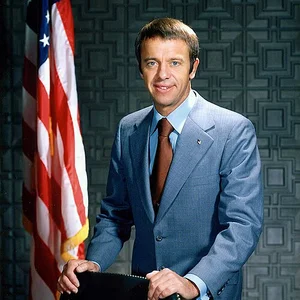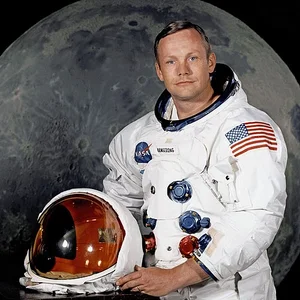

American astronaut (1930-2012), Neil Armstrong was the first person to walk on the Moon on July 20, 1969. Commander of the Apollo 11 mission, he marked a major turning point in space exploration and the Cold War.
Neil Armstrong(1930 — 2012)
Neil Armstrong
États-Unis
7 min read
Frequently asked questions
Famous Quotes
« That's one small step for man, one giant leap for mankind»
« It was a privilege to serve for NASA»
Key Facts
- July 20, 1969: First person to walk on the Moon during the Apollo 11 mission
- July 21, 1969: Planting of the American flag on the Moon and collection of lunar samples
- 1962-1966: Pilot in the Gemini program, performing orbital rendezvous maneuvers
- 1930: Born in Ohio; trained as an aviator and aeronautical engineer
- 2012: Died on August 25; recognized worldwide as a hero of space exploration
Works & Achievements
Armstrong commanded the first mission to achieve a docking between two spacecraft in orbit, a fundamental technical feat in preparation for future lunar missions.
As commander of the historic mission, Armstrong manually piloted the Eagle module and became the first human being to walk on the Moon, fulfilling the objective set by Kennedy in 1961.
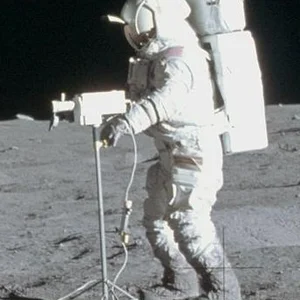
Armstrong spent 2h31 on the lunar surface, collecting samples, taking scientific photographs and planting the American flag, constituting the first extraterrestrial EVA in history.
The only official biography authorized by Armstrong, the result of lengthy exclusive interviews; it reveals the complexity of a man who always refused to consider himself a solitary hero.
Armstrong publicly spoke out against the reorientation of the space program decided by the Obama administration, stating that abandoning crewed flights would weaken American space leadership.
Anecdotes
Before becoming an astronaut, Neil Armstrong nearly never reached the Moon. During the Gemini 8 mission in 1966, his spacecraft entered an uncontrolled spin at an altitude of 400 km. Armstrong took manual control and stabilized the craft within seconds, averting a catastrophe and demonstrating his exceptional composure under pressure.
On July 20, 1969, as Armstrong manually guided the Eagle lunar module to avoid a rocky crater, only 17 seconds of fuel remained at the moment of landing. Mission Control in Houston held its breath; Armstrong, for his part, kept his eyes fixed on the lunar surface without showing the slightest emotion.
The historic phrase spoken by Armstrong on the Moon — 'That's one small step for [a] man, one giant leap for mankind' — was partially lost due to radio static. Armstrong always maintained that he said 'a man', but the word 'a' was never clearly heard in the recordings, fueling an enduring historical debate.
After the Apollo 11 mission, Armstrong became a global symbol but consistently refused celebrity. He left NASA in 1971 to teach aerospace engineering at the University of Cincinnati, living quietly on a farm in Ohio. He granted interviews very rarely and signed autographs even more rarely.
Armstrong carried with him, during the Apollo 11 mission, fragments of wood and fabric from the Wright Brothers' airplane — the Flyer I, which had made the first powered flight in 1903. It was a symbolic tribute connecting 66 years of aviation, from the first flight to the walk on the Moon.
Primary Sources
Houston, Tranquility Base here. The Eagle has landed. [...] That's one small step for man, one giant leap for mankind.
We were very privileged to have the opportunity to leave on the Moon a plaque that we hope will be a symbol of the feelings of the people of our nation.
We came in peace for all mankind. It was a small step but it reflected the efforts of thousands of men and women who worked to make it possible.
I was elated, ecstatic and extremely surprised that we were successful. The Moon was essentially a grey place. Very white, chalky grey.
Here men from the planet Earth first set foot upon the Moon. July 1969, A.D. We came in peace for all mankind.
Key Places
It was from Launch Pad 39A that the Saturn V rocket carrying Armstrong and the Apollo 11 crew lifted off on July 16, 1969, before the eyes of one million spectators.
The landing site of Apollo 11 on July 20, 1969, it is here that Armstrong spoke his historic words as he set foot on the lunar surface at 2:56 UTC.
Headquarters for NASA's crewed mission control, this is where engineers followed every step of the Apollo 11 mission in real time and heard 'Houston, the Eagle has landed'.
Neil Armstrong's hometown, where he was born on August 5, 1930; it is now home to the Armstrong Air & Space Museum, dedicated to his memory and the history of space exploration.
After leaving NASA, Armstrong taught aerospace engineering there from 1971 to 1979, deliberately choosing academic discretion over public fame.
Typical Objects

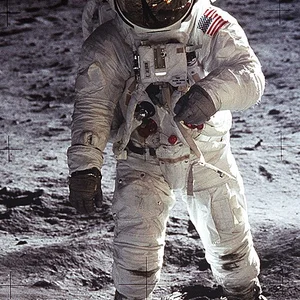
Pressurized suit worn by Armstrong during the Apollo 11 mission, it protected him from the vacuum of space, radiation, and extreme temperatures (-170°C to +120°C) on the lunar surface.

Spacecraft designed solely to fly in a vacuum, it carried Armstrong and Aldrin from lunar orbit to the Sea of Tranquility, becoming the first crewed vehicle to land on the Moon.

Mounted on the lunar module, it broadcast live footage of Armstrong descending the ladder and setting foot on the Moon, allowing 600 million viewers to witness the event in real time.

Armstrong and Aldrin planted this flag on the Moon; fitted with a horizontal rod to keep it unfurled in the vacuum, it became one of the most powerful symbols of American space exploration.

Armstrong collected 21.5 kg of lunar rocks and dust using special airtight boxes; these samples are still being analyzed today by scientists around the world.

NASA's official watch worn by Armstrong during the Apollo 11 mission; the only wrist-worn timekeeping instrument on the Moon, it became an icon of the space age.
School Curriculum
Vocabulary & Tags
Key Vocabulary
Tags
Daily Life
Morning
During his NASA training (1962-1969), Armstrong rose early for simulation sessions in cockpits faithfully reproducing the Gemini and then Apollo spacecraft. He studied technical manuals, attended mission briefings, and flew jet aircraft to keep his pilot reflexes sharp.
Afternoon
Afternoons were devoted to centrifuge simulations, weightlessness training aboard the KC-135 (nicknamed the 'vomit comet'), briefings with NASA engineers, and coordination meetings with the Houston teams. Armstrong also took part in equipment and spacesuit testing.
Evening
In the evenings, Armstrong returned to his family home near Houston, where he lived with his wife Janet and their children. A private man, he spent his evenings with family, reading technical reports or listening to classical music. Even at the height of his fame, he shunned social events and formal receptions.
Food
Armstrong followed a simple, functional diet typical of an engineer-pilot of the 1960s. Aboard Apollo 11, meals consisted of freeze-dried or semi-liquid food consumed from pouches: chicken, mashed potatoes, and fruit cocktail. He never showed any particular interest in fine dining.
Clothing
In his day-to-day life as an astronaut, Armstrong wore the standard NASA blue flight suit during training, and plain civilian attire (suit, white shirt) for official meetings. On the Moon, he wore the white A7L pressurized suit, which weighed 81 kg on Earth but allowed relative mobility in lunar gravity (1/6th of Earth's).
Housing
Armstrong and his family lived in an ordinary suburban house in El Lago, Texas, close to the Johnson Space Center. After retiring from NASA in 1971, he moved to a farm in Lebanon, Ohio, far from the spotlight, embracing his preference for a quiet, rural life.
Historical Timeline
Period Vocabulary
Visual Style
Sound Ambience
L'environnement sonore d'Armstrong est dominé par les communications radio crépitantes entre Houston et le vaisseau Apollo, le vrombissement des ordinateurs de la NASA et le grondement historique du Saturn V au décollage.
Liens externes & ressources
Références
Œuvres
Mission Gemini 8 — premier amarrage orbital habité
16 mars 1966
Mission Apollo 11 — premier alunissage habité
16-24 juillet 1969
Activité extra-véhiculaire (EVA) sur la Lune
20-21 juillet 1969
Autobiographie 'First Man: The Life of Neil A. Armstrong' (par James R. Hansen)
2005
Témoignage devant le Congrès américain pour la défense de la NASA
2010