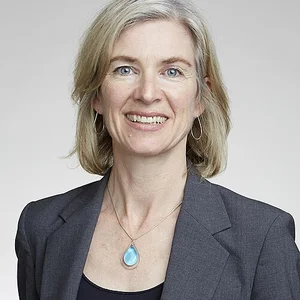

American biochemist and pioneer of CRISPR-Cas9 technology. Her work revolutionized genome editing, opening up enormous possibilities in medicine and biotechnology. She received the Nobel Prize in Chemistry in 2020 alongside Emmanuelle Charpentier.
Jennifer Doudna(1964 — ?)
Jennifer Doudna
États-Unis
7 min read
Frequently asked questions
Key Facts
- Born in 1964 in Washington D.C.
- Published the landmark paper on CRISPR-Cas9 as a genome editing tool in 2012, alongside Emmanuelle Charpentier
- Professor at the University of California, Berkeley
- Nobel Prize in Chemistry 2020, shared with Emmanuelle Charpentier
- Co-founder of several biotechnology companies based on CRISPR
Works & Achievements
Landmark article co-written with Charpentier demonstrating that CRISPR-Cas9 can be reprogrammed to cut any DNA sequence. Considered one of the most influential publications of the 21st century.
Publication revealing the atomic three-dimensional structure of the CRISPR-Cas9 complex in action, explaining its cutting mechanism at the molecular level and enabling optimization of its performance.
Book in which Doudna recounts the discovery of CRISPR and its far-reaching ethical implications. Translated into around twenty languages, it raises public awareness of the stakes of genome editing.
Institute co-founded at Berkeley to accelerate medical applications of CRISPR while providing an ethical framework for their development — a model of responsible research recognized worldwide.
The first time two women have shared this prize on their own, awarded for the development of CRISPR-Cas9: a powerful symbol for diversity in science and the recognition of international collaborative work.
Anecdotes
At the age of twelve, Jennifer Doudna finds 'The Double Helix' by James Watson on her desk, left there by her father. She realizes that science can read like an adventure novel. This book ignites in her a passion that will never fade and will guide her entire career.
At school in Hawaii, a teacher tells her that a scientific career 'isn't for girls'. Far from discouraging her, this remark strengthens her determination. Jennifer Doudna will go on to become one of the most cited scientists in the world and an icon for women in science.
In 2011, at a conference in Puerto Rico, Jennifer Doudna runs into Emmanuelle Charpentier in a hallway and an impromptu conversation springs up between them. The two researchers decide to collaborate. Less than a year later, they publish one of the most important discoveries of the twenty-first century.
After becoming aware of CRISPR's potential, Jennifer Doudna has a haunting nightmare: Adolf Hitler asks her to explain the technology so he can use it for eugenic purposes. This disturbing dream leads her to actively engage in global ethical debates about gene editing.
When Chinese researcher He Jiankui announces in 2018 the birth of genetically modified babies via CRISPR, Doudna is appalled. She immediately helps mobilize an international committee of experts to oversee the medical use of the technology, tirelessly repeating: 'With great power comes great responsibility.'
Primary Sources
We show that Cas9 can be programmed with guide RNA to cleave specific DNA sequences, establishing a versatile and precise platform for genome editing applicable to any organism.
The CRISPR-Cas9 system has rapidly emerged as a versatile genome-editing tool with broad implications for biology and medicine, enabling precise modifications in virtually any cell type.
I knew that CRISPR-Cas9 was powerful, but I hadn't imagined just how quickly it would move from our laboratory into the clinic and into society, raising questions none of us had anticipated.
The discovery of the CRISPR-Cas9 mechanism has opened the door to a new era in genome editing, with far-reaching consequences for medicine, agriculture, and our understanding of life itself.
Key Places
The city where Jennifer Doudna grew up surrounded by the lush nature of the Pacific. It was here that she discovered natural biology and fell in love with science after reading *The Double Helix*.
Doudna completed her doctoral degree here under the supervision of Jack Szostak, a future Nobel laureate. She gained cutting-edge training in RNA biochemistry that would serve as the foundation for her entire career.
Since 2002, this is where Doudna has led her research laboratory and carried out the pioneering work on CRISPR. She also co-founded the Innovative Genomics Institute there, dedicated to medical applications.
It was during a walk at this international scientific conference that Doudna and Charpentier first met and decided to collaborate, setting in motion one of the greatest discoveries in history.
The place where Jennifer Doudna received the Nobel Prize in Chemistry in 2020, crowning her decades of research on RNA and genome editing. The first time two women shared this prize alone.
Liens externes & ressources
Références
Œuvres
A Programmable Dual-RNA–Guided DNA Endonuclease in Adaptive Bacterial Immunity (Science)
2012
Structure cristallographique de la protéine Cas9 en complexe avec l'ARN guide et l'ADN cible (Science)
2014
A Crack in Creation (livre grand public)
2017
Innovative Genomics Institute (IGI)
2014
Prix Nobel de chimie (avec Emmanuelle Charpentier)
2020