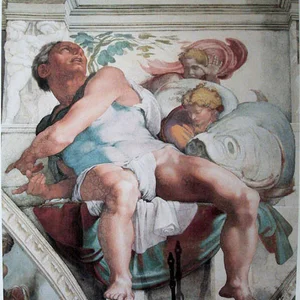

A biblical prophet from the kingdom of Israel (8th century BCE), Jonah is known for being sent by God to Nineveh to preach repentance. According to the Book of Jonah, he was swallowed by a great fish after attempting to flee his divine mission.
Jonas(822 av. J.-C. — 719 av. J.-C.)
Jonas
royaume d'Israël
7 min read
Frequently asked questions
Key Facts
- Prophet sent by God to announce the destruction of Nineveh (the Assyrian capital) if the city did not repent
- Attempted to flee by boat to Tarshish to escape his divine mission
- Swallowed by a great fish (or whale, depending on the translation) and saved after three days
- Conversion and repentance of the people of Nineveh following his preaching
- Biblical narrative from the Book of Jonah, a wisdom text of the Old Testament
Works & Achievements
A foundational biblical text recounting Jonah's prophetic mission to Nineveh and his stay in the belly of the great fish. This major work of biblical literature explores the themes of repentance, divine forgiveness, and the prophet's responsibility.
Jonah is sent by God to preach repentance to the inhabitants of Nineveh, the great Assyrian capital. This mission represents a divine attempt to convert a pagan city and symbolizes the universality of God's message beyond the borders of Israel.
Jonah proclaims to Nineveh that the city will be destroyed in forty days unless it repents. His message triggers a mass conversion of the Assyrian population, from the king down to the animals, demonstrating the effective power of the prophetic word.
The episode of Jonah's three days inside the belly of the fish becomes a major biblical symbol of death and resurrection, widely interpreted in the Christian tradition as a prefiguration of the resurrection of Christ.
Anecdotes
Jonah is one of the few biblical prophets whose mission takes place entirely outside Israel: he is sent to Nineveh, capital of the Assyrian empire, hereditary enemy of his people. This detail is remarkable because, in ancient Hebrew tradition, prophets generally addressed only the people of Israel.
The famous episode of the 'great fish' (dag gadol in Hebrew) is never called a whale in the original text: the Hebrew Bible simply speaks of a 'great fish'. It was the Greek translation (Septuagint) and then the Latin (Vulgate) that popularized the image of the whale. Jonah stays there for three days and three nights before being cast onto the shore.
Unlike most prophetic stories, Jonah's mission is a resounding success: the inhabitants of Nineveh, from the humblest to the king himself, repent immediately after hearing his preaching. This result is all the more striking because Jonah only speaks eight words in Hebrew to convince an entire city.
Jonah's reaction after the success of his mission is surprising: he becomes angry with God for sparing Nineveh. The biblical text ends with a divine rhetorical question, without an explicit answer, which is unique in prophetic literature and has sparked countless theological debates over the centuries.
The Book of Jonah is one of the shortest in the Hebrew Bible (only 48 verses) but one of the most translated and commented upon. It is read in its entirety during Yom Kippur, the great Jewish fast, because its central theme — sincere repentance and divine forgiveness — corresponds exactly to the spirit of this holiday.
Primary Sources
The word of the Lord came to Jonah son of Amittai: 'Go to the great city of Nineveh and preach against it, because its wickedness has come up before me.'
Now the Lord provided a huge fish to swallow Jonah, and Jonah was in the belly of the fish three days and three nights.
The people of Nineveh believed God. A fast was proclaimed, and all of them, from the greatest to the least, put on sackcloth.
Key Places
A town in the kingdom of Israel in Galilee, traditionally considered the birthplace of the prophet Jonah according to biblical tradition and rabbinical sources.
Capital of the Assyrian Empire where Jonah was sent by God to preach repentance. It is the central setting of his prophetic mission according to the Book of Jonah.
A Mediterranean seaport from which Jonah attempted to flee by ship to escape the divine mission entrusted to him.
The body of water where Jonah was thrown overboard during a storm and swallowed by a great fish, spending three days and three nights in its belly.
The political entity whose prophet Jonah was in the 8th century BCE, the place where he received his divine calling and from which he was sent on his mission.
Typical Objects

A mythical sea creature symbolizing divine punishment and the trial of Jonah. According to the Book of Jonah, the prophet remains inside it for three days and three nights before being cast onto the shore, representing his repentance and spiritual rebirth.

The typical writing medium of ancient Mesopotamia, where Nineveh was located. Prophets and scribes of the 8th century BC used these tablets to record divine messages and sacred texts.

A garment of penitence and mourning worn by Jonah and the inhabitants of Nineveh during their repentance. This clothing symbolizes humility, contrition, and submission to God's will in the biblical tradition.

An emblematic accessory carried by biblical prophets such as Jonah, symbolizing divine authority and serving as a support during travels. It represents the connection between the prophet and God.

The inscribed medium carrying the message of repentance that Jonah was to deliver to Nineveh. It represents the word of God entrusted to the prophet to fulfill his divine mission.

The imposing fortifications of the Assyrian capital, Jonah's final destination. These massive walls symbolize the greatness of the city and the importance of the prophet's mission to its people.

A merchant vessel of the era capable of crossing the Mediterranean. Jonah boards it to flee his divine mission, only to be caught in the storm sent by God.

A plant mentioned at the end of the Book of Jonah, created by God to shelter the prophet from the sun. It symbolizes divine mercy and illustrates the final lesson on God's compassion toward all his creatures.
School Curriculum
Vocabulary & Tags
Key Vocabulary
Tags
Mythologie
Daily Life
Morning
Jonah wakes at dawn in his house in Gath-hepher, in Galilee. He begins his day with ritual ablutions and prayers according to the Jewish practices of the 8th century BCE. As a prophet, he devotes his early hours to meditation and listening for the divine word.
Afternoon
In the afternoon, Jonah goes about his daily tasks or prepares to deliver the prophetic messages he has received. He may take part in the communal activities of his village or withdraw for spiritual contemplation. As a prophet, his days alternate between domestic life and preaching missions.
Evening
At nightfall, Jonah shares a meal with his family or disciples. He takes part in the evening religious customs, including sunset prayers. Evenings are devoted to spiritual discussions and rest after an active day.
Food
Jonah eats the typical foods of the ancient Levant: barley bread, legumes, dried fruits, grapes, and figs. Occasionally, his family might eat fish from the Sea of Galilee or poultry for religious festivals. Water and diluted wine are his main drinks.
Clothing
Jonah wears the simple linen or wool tunic typical of Israelite men, belted at the waist. As a prophet, he likely wore a distinctive cloak (tallit) symbolizing his spiritual status. His clothes are modest and practical, suited to the warm Levantine climate.
Housing
Jonah lives in a modest stone house typical of 8th-century BCE Galilean villages, with separate rooms and an inner courtyard. The building has a flat roof and a central hearth. His home reflects his family's standing — respectable but not aristocratic — woven into the everyday life of the village community.
Historical Timeline
Period Vocabulary
Visual Style
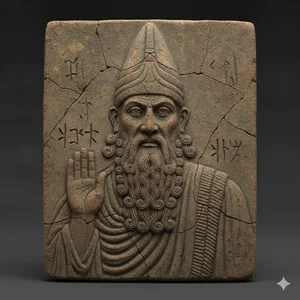
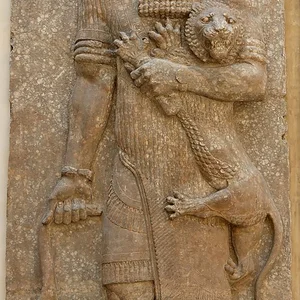
Un style inspiré de l'art mésopotamien antique et des reliefs assyriens du VIIIe siècle av. J.-C., associant la gravité biblique à l'iconographie du Proche-Orient ancien. L'ambiance conjugue le dramatisme spirituel avec une richesse ornementale typique de l'antiquité, utilisant les techniques de gravure et de feuille d'or.
Sound Ambience
Une ambiance marine et mystique mêlant les profondeurs océaniques, les sons d'une cité antique (Ninive) et des éléments spirituels hébraïques, évoquant le voyage initiatique et la rédemption du prophète Jonas.
Liens externes & ressources
Références
Œuvres
Livre de Jonas
VIIIe siècle av. J.-C.
Mission prophétique à Ninive
VIIIe siècle av. J.-C.
Prédication de repentance
VIIIe siècle av. J.-C.
Symbole de résurrection et rédemption
VIIIe siècle av. J.-C.