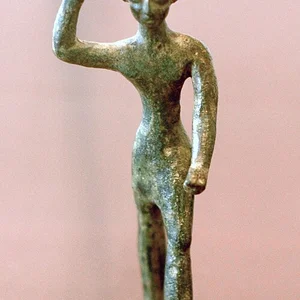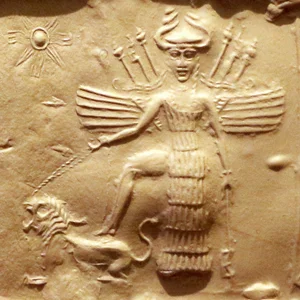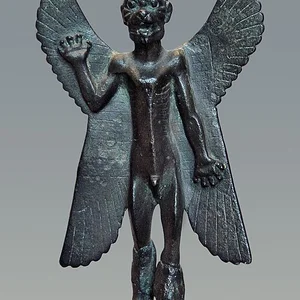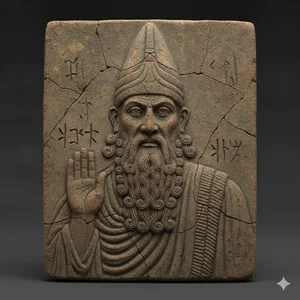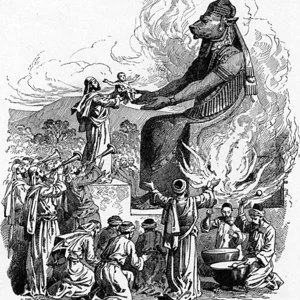

A Canaanite Semitic deity associated with child sacrifice, Moloch is mentioned in the Bible as an abhorrent idol. Depicted as a bull or a bronze statue, he became in Judeo-Christian and literary tradition the symbol of idolatrous cruelty.
Moloch
Moloch
9 min read
Frequently asked questions
Key Facts
- Attested in biblical texts (Leviticus, Kings) as a deity to whom children were sacrificed by fire
- Associated with the ritual of the 'Topheth', a place of sacrifice mentioned in the Valley of Ben-Hinnom near Jerusalem
- King Solomon is said to have erected an altar to Moloch (around 950 BCE) according to the Book of Kings
- Sometimes identified with the Carthaginian Baal-Hammon and with the practice of 'molk' (votive sacrifice)
- John Milton portrays him as one of the great demons in 'Paradise Lost' (1667), cementing his literary notoriety
Works & Achievements
These books of the Hebrew Bible contain the earliest explicit condemnations of the cult of Moloch, in the form of a divine law forbidding one to 'make your children pass through fire.' They represent the oldest primary source on this cult.
This biblical historical text describes the cultic practices of the kings of Israel and Judah, including Josiah's destruction of the Tophet. It is the main source for understanding the struggle between Yahwism and Canaanite cults.
The Greek historian describes in vivid detail — and likely with some embellishment — the child sacrifices practiced at Carthage, particularly during political or military crises. This account has had a lasting influence on the image of Moloch in Western culture.
An English epic in which Moloch is portrayed as one of the great demons of the infernal council, thirsting for blood and destruction. This landmark work of Baroque literature fixed the image of the terrible god for centuries to come.
A historical novel set in Carthage in the 3rd century BC, in which Flaubert powerfully depicts a scene of sacrifice to Moloch. Though fictionalized, this text has profoundly shaped the cultural representation of Moloch across Europe.
Excavations led by Pierre Cintas (1947) and later Lawrence Stager (1970s–1980s) unearthed thousands of urns at the Tophet of Carthage, reigniting scholarly debate over the historical reality of child sacrifice in the Phoenician world.
Anecdotes
The name 'Moloch' is thought to be a deliberate distortion invented by Hebrew scribes: they combined the consonants of the word 'king' (*melech*, מֶלֶךְ) with the vowels of the word 'shame' (*bosheth*), to signal that this deity was a disgracing idol. This subtle wordplay reflects the deep contempt the biblical authors had for the cult.
In Jerusalem, in the Valley of Hinnom to the south of the city, there was a place called Topheth where, according to the Bible, children were offered in sacrifice by fire. King Josiah of Judah had this site destroyed and desecrated around 621 BC to put an end to the practice. This cursed valley later gave rise to the word 'Gehenna', used to designate hell.
In Carthage (modern-day Tunisia), archaeologists have uncovered a large sanctuary also called a Tophet, containing funerary urns holding the bones of infants and lambs. Used from the 8th to the 2nd century BC, the site has reignited debate among historians: were these ritual sacrifices, or simply a cemetery for stillborn children?
Several kings of Israel and Judah are accused in the Bible of having practiced the cult of Moloch. Solomon himself is said to have built a place of worship on the Mount of Olives to satisfy his foreign wives (1 Kings 11:7). These passages illustrate the constant tension between nascent monotheism and the surrounding Canaanite religions.
Over the centuries, Moloch grew into a literary and philosophical figure far beyond his religious origins. John Milton cast him as one of the most ferocious demons in his epic *Paradise Lost* (1667). In the 19th century, Gustave Flaubert depicted him with terrifying power in *Salammbô* (1862), a historical novel set in Carthage, helping to cement the image of the gaping bronze statue with outstretched arms.
Primary Sources
Do not give any of your children to be sacrificed to Molek, for you must not profane the name of your God.
King Josiah desecrated Topheth, which was in the Valley of Ben Hinnom, so that no one could use it to sacrifice their son or daughter in the fire to Molek.
They built high places for Baal in the Valley of Ben Hinnom to sacrifice their sons and daughters to Molek — though I never commanded them to do such a thing, nor did it enter my mind.
The Carthaginians had a bronze statue of Kronos with outstretched hands tilted downward, so that a child placed upon them would slide off and fall into a pit filled with fire.
Formulae of the type: 'To Baal Hammon and Tanit, face of Baal — that which [name of the dedicant] vowed, for [the god] heard his voice and blessed him.'
Key Places
Valley south of Jerusalem where the Tophet was located, a site of sacrifice denounced by the Hebrew prophets. King Josiah destroyed it in 621 BC. This cursed valley gave its name to 'Gehenna,' the realm of Hell in the Judeo-Christian tradition.
Open-air sanctuary discovered at Carthage (in the modern suburbs of Tunis) containing thousands of funerary urns. Used from the 8th to the 2nd century BC, it is the most important archaeological site associated with the cult of Baal Hammon, who was equated with Moloch.
Major Phoenician city and birthplace of the cult of Baal, of which Moloch is a variant. Tyre was the religious and commercial metropolis that spread these cults throughout the western Mediterranean through its colonies, including Carthage.
Another major Phoenician city where the cult of Semitic deities of the Moloch type was practiced. The Bible mentions that Solomon built an altar for the deities of Sidon.
According to 1 Kings 11:7, Solomon built a high place for Moloch there, 'on the mountain that is before Jerusalem.' This sanctuary was destroyed during Josiah's reform, but its location stands as a symbol of the religious compromises made by the kings of Israel.
Typical Objects

According to ancient sources such as Diodorus Siculus, Moloch was represented by a large bronze statue with outstretched arms, sometimes hollow, in which a fire was lit. Its archaeological reality remains debated, but it has become the iconic symbol of the cult.

Thousands of terracotta urns have been found in the Tophet of Carthage, containing the charred bones of young children or substitute animals. They bear witness to funerary or sacrificial practices linked to the cult of Baal Hammon.

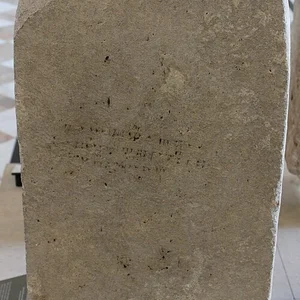
Worshippers who fulfilled a vow to the god would have a stone stele erected, engraved with an inscription and religious symbols (the sign of Tanit, the crescent moon). Thousands have been found at Carthage, forming a unique record of this religion.

Fire was at the heart of the cult: the Hebrews called the sacrificial act 'passing through fire.' The Tophet may derive its name from the Hebrew *toph* (drum) or from a root meaning hearth. Ritual pyres were central objects of the ceremony.

According to some rabbinical interpretations, priests beat drums during sacrifices to drown out the cries of the victims and sustain the ritual trance of participants. This detail, difficult to verify, has contributed to the sinister reputation of the cult.

Moloch was often depicted with the features of a bull or a bull-headed man in the iconographic tradition. Terracotta bull figurines have been found in Canaanite and Phoenician cultic contexts.
School Curriculum
Vocabulary & Tags
Key Vocabulary
Tags
Daily Life
Morning
As a deity, Moloch has no daily life in the strict sense, but his cult shaped the rhythm of his worshippers' lives. Each morning, specialized priests (*kohanim* of the high places) tended the sacred fire of the sanctuary and performed incense offerings and libations at sunrise.
Afternoon
The priests received worshippers who came to fulfill vows or seek divine protection for their affairs, travels, or children. Sacrificial animals (bulls, ewes) were inspected and prepared. Managing the Tophet and maintaining the votive stelae occupied much of the daytime activity.
Evening
The most important ceremonies took place at night, by the light of the flames. Sacrificial rites unfolded in an atmosphere of intense tension and religious fervor, to the sound of drums and chanting. The smoke rising toward the sky symbolized communication with the divine.
Food
Canaanite gods were symbolically nourished by food offerings placed on their altars: bread, fruit, oil, wine, and animals. These offerings were then consumed by the priests or burned entirely, depending on the type of ritual. Animal fat was considered the quintessential divine portion.
Clothing
The priests serving Moloch's cult most likely wore white linen garments (in keeping with contemporary Near Eastern practices) and metal ornaments. Major rituals called for special vestments, and perhaps masks or headdresses shaped like a bull during ceremonies.
Housing
The main sanctuary (*Tophet* or *bamah*, 'high place') was typically an open-air space on a hilltop or in a valley, bounded by standing stones (*masseboth*) and votive stelae. A central altar supported the permanent fire. The cult statue stood in a *naos* (sacred enclosure) at the heart of the sanctuary.
Historical Timeline
Period Vocabulary
Visual Style
Iconographie proche-orientale antique : silhouette monumentale en bronze sur fond de ciel nocturne, éclairée par les flammes du sacrifice, avec des motifs décoratifs inspirés des stèles phéniciennes et de l'art assyrien.
Sound Ambience
Atmosphère nocturne d'un sanctuaire à ciel ouvert dans le monde phénicien ou cananéen : feu de sacrifice, tambours rituels et chants de foule en transe, vent marin et nuit étoilée du Proche-Orient ancien.
Liens externes & ressources
Références
Œuvres
Lévitique et Deutéronome (Torah / Pentateuque)
VIIe-Ve siècle avant J.-C.
Livre des Rois (Bible hébraïque)
VIe siècle avant J.-C.
Bibliothèque historique — Diodore de Sicile
Ier siècle avant J.-C.
Le Paradis perdu — John Milton
1667
Salammbô — Gustave Flaubert
1862
Tophet de Carthage — fouilles archéologiques (Cintas, Stager)
XXe siècle